

UPSC Mains Syllabus 2026: All 9 Papers, Marks
Complete UPSC Mains syllabus 2026 — GS Paper 1, 2, 3, 4, Essay, optional & language papers, marks, exam pattern.
 Competer
The UPSC Mains syllabus covers 9 descriptive papers written over 5 days: two qualifying language papers (Paper A — an Indian language, Paper B — English), the Essay paper, four General Studies papers (GS 1, 2, 3 and 4), and two Optional subject papers. Of these, 7 papers count for merit (1750 marks) and the 2 language papers are only qualifying at 25% each. This guide breaks down every paper topic-by-topic as per the official UPSC notification, maps each theme to study material and previous-year weightage, and gives you a downloadable syllabus PDF and revision checklist.
UPSC Mains Syllabus 2026 & Exam Pattern at a Glance
Before the topic-wise breakdown, it helps to see the full UPSC Mains exam pattern and syllabus in one table. The Mains stage is descriptive (written) and follows the objective Prelims. Every candidate who clears Prelims writes all 9 papers; each paper is 3 hours long and is written by hand.
| Paper | Subject | Marks | Nature | Duration |
|---|---|---|---|---|
| Paper A | Compulsory Indian Language | 300 | Qualifying (25%) | 3 hrs |
| Paper B | English | 300 | Qualifying (25%) | 3 hrs |
| Paper I | Essay | 250 | Merit | 3 hrs |
| Paper II | General Studies I | 250 | Merit | 3 hrs |
| Paper III | General Studies II | 250 | Merit | 3 hrs |
| Paper IV | General Studies III | 250 | Merit | 3 hrs |
| Paper V | General Studies IV (Ethics) | 250 | Merit | 3 hrs |
| Paper VI | Optional Paper 1 | 250 | Merit | 3 hrs |
| Paper VII | Optional Paper 2 | 250 | Merit | 3 hrs |
The total UPSC Mains merit marks are 1750 (4 GS × 250 = 1000, Essay 250, Optional 2 × 250 = 500). Adding the Personality Test (Interview) of 275 marks gives a grand total of 2025 marks that determine the final rank. The two qualifying language papers do not add to the merit total, but you must clear both — marks in the merit papers are counted only if you pass Paper A and Paper B.
Key facts about the UPSC Mains syllabus (quick reference)
- Total papers: 9 (2 qualifying + 7 merit).
- Merit marks: 1750; with interview, 2025.
- Qualifying cut-off: 25% each in Paper A and Paper B.
- Answer type: fully descriptive/analytical, handwritten.
- Exam window: spread across roughly 5 days.
- Source of truth: the annual Civil Services Examination notification on upsc.gov.in.
Qualifying Language Papers — Paper A & Paper B
These are the two papers aspirants most often underestimate. Both are qualifying at 25% (75 out of 300), and failing either means your GS and Optional answer sheets are never evaluated — your entire year of preparation goes unassessed. UPSC releases the language-paper marks only as pass/fail, so they carry zero merit weight but full elimination power.
Paper A — Compulsory Indian Language
You choose one language listed in the Eighth Schedule of the Constitution (from the 22 scheduled languages). Candidates from Arunachal Pradesh, Manipur, Meghalaya, Mizoram, Nagaland and Sikkim are exempt from Paper A. The pattern tests basic language comprehension:
- Comprehension of given passages
- Precis writing
- Usage and vocabulary
- Short essays
- Translation (English to the chosen Indian language and vice versa)
Paper B — English
English follows the same structure — comprehension, precis, usage/vocabulary, and short essays. The standard is roughly matriculation level, so a few timed practice papers are usually enough. Treat both as “do-not-neglect” qualifiers: spend 10–15 hours on precis and translation practice rather than assuming they are automatic. A handful of candidates each year clear the merit cut-off comfortably yet miss selection because they slipped below 25% here.
UPSC Mains GS Paper 1, 2, 3, 4 Syllabus — Full Breakdown
The heart of the upsc mains gs paper 1 2 3 4 syllabus is four General Studies papers of 250 marks each. Below, each paper is expanded topic-by-topic with a study-material and previous-year-question (PYQ) weightage note so you can prioritise. A single, fully-expanded set of tables like this is far easier to revise from than click-through link lists.
GS Paper I — Heritage, History, Society & Geography
GS Paper 1 tests Indian culture, the whole arc of modern Indian history and the world, plus society and geography. It rewards a strong static foundation.
| Theme | Key Topics | Indicative PYQ Weight |
|---|---|---|
| Indian Heritage & Culture | Art forms, literature, architecture from ancient to modern times | 2–3 questions |
| Modern Indian History | Mid-18th century onwards — events, personalities, issues | 2–3 questions |
| Freedom Struggle | Its various stages and important contributors/contributions from different parts of the country | 2 questions |
| Post-Independence | Consolidation and reorganisation within the country | 1–2 questions |
| World History | 18th century events — industrial revolution, world wars, colonisation, decolonisation, political philosophies (capitalism, socialism, communism) | 1–2 questions |
| Indian Society | Salient features, diversity, role of women, population, poverty, urbanisation, globalisation, communalism, regionalism, secularism | 3–4 questions |
| Geography | Physical geography, distribution of natural resources, factors for location of industries, geophysical phenomena (earthquakes, tsunami, cyclones) | 3–4 questions |
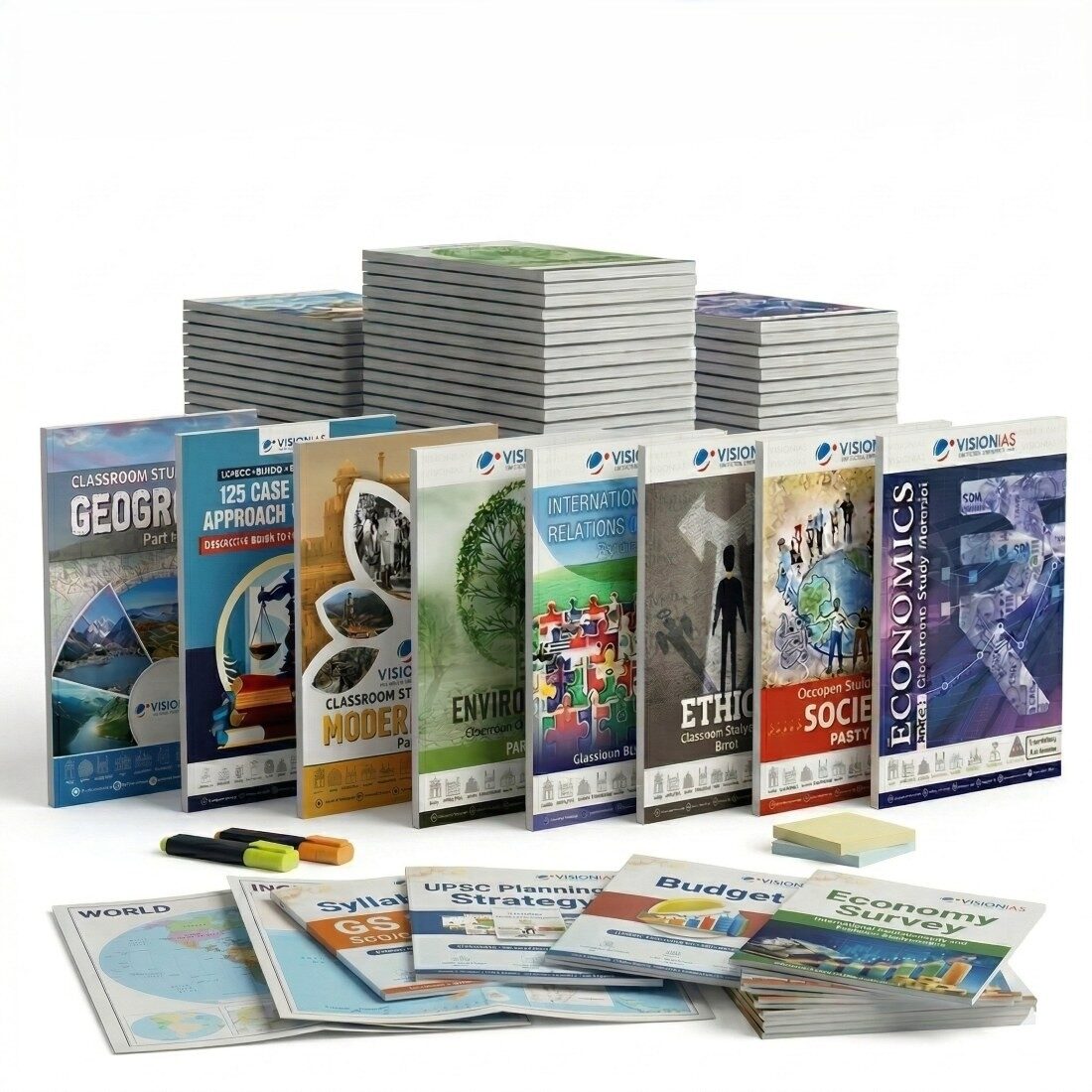
Because GS 1 is heavily static, a consolidated notes set pays off. Many toppers pair NCERTs with a compact printed set such as the Vision IAS complete GS Notes (Prelims + Mains), then add value-added material for culture and society through the Vision IAS GS Value Added Materials.
GS Paper II — Governance, Constitution, Polity, Social Justice & IR
GS Paper 2 is the most current-affairs-linked GS paper. The Constitution is static, but governance, welfare schemes and international relations demand constant news integration.
| Theme | Key Topics |
|---|---|
| Constitution & Polity | Historical underpinnings, evolution, features, amendments, basic structure; separation of powers; comparison with other democracies |
| Federalism & Structure | Devolution of powers, Centre-State relations, local self-government, functions of Union & State |
| Governance | Statutory, regulatory and quasi-judicial bodies; role of civil services; citizens’ charters; transparency, accountability, e-governance |
| Social Justice | Welfare schemes for vulnerable sections, mechanisms/laws/institutions; issues of health, education, human resources; poverty and hunger |
| International Relations | India and its neighbourhood; bilateral, regional & global groupings; effect of policies of developed/developing countries; important institutions/agencies/fora |
Pair the static Polity portion with a focused resource like the Vajiram Polity Notes, and keep the dynamic governance/IR portion fed with a monthly current-affairs magazine so your answers cite the latest committees, judgments and summits.
GS Paper III — Economy, Environment, Science-Tech & Security
GS Paper 3 spans the economy, agriculture, infrastructure, technology, environment, disaster management and internal security. It is broad, so mapping the syllabus to news is essential.
| Theme | Key Topics |
|---|---|
| Indian Economy | Planning, mobilisation of resources, growth, development, employment; inclusive growth; government budgeting |
| Agriculture | Cropping patterns, irrigation, storage/transport/marketing; e-technology for farmers; subsidies & MSP; food processing; food security & PDS |
| Infrastructure | Energy, ports, roads, airports, railways; investment models |
| Science & Technology | Developments and applications; indigenisation; achievements of Indians; awareness in IT, space, computers, robotics, nano-tech, biotech; IPR issues |
| Environment | Conservation, environmental pollution and degradation, environmental impact assessment, biodiversity |
| Disaster Management | Disasters and disaster management |
| Internal Security | Linkages of development & spread of extremism; role of external state/non-state actors; cyber security; money-laundering; border management; security forces & agencies |
Economy alone can draw 4–6 questions, so a clean economy resource such as the Vision IAS Economics Notes plus regular current affairs is a high-return combination.
GS Paper IV — Ethics, Integrity & Aptitude
The upsc mains gs 4 ethics syllabus is unique: it tests your attitude and approach to integrity, probity and problem-solving through both theory and a large case-study section (usually 6 cases worth roughly 120 of the 250 marks). This is the direct answer to “what is the syllabus of GS Paper 4 (Ethics) in UPSC Mains” — the table below lists every listed component.
| Component | Key Topics |
|---|---|
| Ethics & Human Interface | Essence, determinants and consequences of ethics; dimensions; ethics in private and public relationships; human values; role of family, society and educational institutions |
| Attitude | Content, structure, function; influence and relation with thought and behaviour; moral and political attitudes; persuasion |
| Aptitude & Foundational Values | Integrity, impartiality, non-partisanship, objectivity, dedication to public service, empathy, tolerance and compassion towards the weaker sections |
| Emotional Intelligence | Concepts, and their utility and application in administration and governance |
| Moral Thinkers | Contributions of moral thinkers and philosophers from India and the world |
| Public/Civil Service Values | Status and problems; ethical concerns and dilemmas; laws, rules, regulations and conscience as sources of guidance; accountability and governance; probity |
| Probity in Governance | Concept of public service; philosophical basis of governance and probity; RTI, codes of ethics/conduct, citizen’s charters, work culture, quality of service delivery, challenge of corruption |
| Case Studies | Case studies on the above issues |
Ethics is scoring but needs a structured approach — definitions, keywords, thinkers and ready-to-use case-study frameworks. A dedicated booklet like the Drishti IAS Ethics Notes helps you build a repository of examples and quotations that lift answer quality.
Essay Paper — Nature, Themes & Strategy
The Essay paper (250 marks) requires writing two essays, one from each of two sections, typically 1000–1200 words each in three hours. UPSC states candidates must “keep closely to the subject of the essay, arrange ideas in orderly fashion, and write concisely.” Themes fall into three broad buckets:
- Contemporary/socio-economic: education, technology, governance, development.
- Abstract/philosophical: single-line prompts such as “Wisdom finds truth” that reward interpretation and multi-dimensional thinking.
- Reflective/ethical: essays blending values with current issues.
Essay is where a small mark difference can move your rank sharply, yet many aspirants prepare it last. Building a bank of quotes, examples and structures through the Vajiram Essay Notes and writing at least 8–10 full essays before the exam is a reliable strategy.
UPSC Mains Optional Subjects Syllabus — All 48 & How to Choose
Every candidate picks one optional subject with two papers of 250 marks each (500 marks total). The upsc mains optional subjects syllabus is subject-specific and published in full in the notification. There are 48 optional subjects: 25 core disciplines plus 23 literature options.
| Category | Optional Subjects |
|---|---|
| Arts & Humanities | History, Geography, Political Science & IR (PSIR), Sociology, Philosophy, Psychology, Public Administration, Anthropology |
| Sciences | Physics, Chemistry, Mathematics, Statistics, Botany, Zoology, Geology |
| Commerce & Others | Economics, Commerce & Accountancy, Management, Law, Medical Science, Agriculture, Animal Husbandry & Veterinary Science |
| Engineering | Civil, Mechanical, Electrical Engineering |
| Literature (23 languages) | Literature of any one language including Hindi, English, Sanskrit, Urdu, Tamil, Telugu, Kannada, Malayalam, Bengali, Marathi, Gujarati, Punjabi, and more |
A simple framework to choose your optional
- Interest & background: pick a subject you can enjoy for 12–18 months; graduation background helps but is not mandatory.
- GS overlap: PSIR, Sociology, Geography and Public Administration overlap heavily with GS, saving time.
- Material & guidance availability: ensure quality notes and answer-writing support exist.
- Scoring trend & scale: check recent toppers and comfort with the syllabus length.
Once you decide, standardised notes shorten the learning curve — for example the Shubhra Ranjan PSIR Notes for Political Science & International Relations, or subject-specific sets for Sociology, Geography, Economics and Public Administration. For a full comparison, see our dedicated optional-subject guides.
Marks Weightage & Time-Management Summary
Here is a single glanceable view linking each paper to its share of merit marks and a suggested preparation-time emphasis — something top pages rarely put in one place.
| Paper | Merit Marks | Share of 1750 | Prep Emphasis |
|---|---|---|---|
| Essay | 250 | 14.3% | Regular writing, quote/example bank |
| GS I | 250 | 14.3% | Static-heavy — NCERT + notes |
| GS II | 250 | 14.3% | Polity static + governance/IR current affairs |
| GS III | 250 | 14.3% | Economy + environment + security news |
| GS IV (Ethics) | 250 | 14.3% | Frameworks + case studies |
| Optional (2 papers) | 500 | 28.6% | Highest single block — go deep |
The optional (28.6%) and Essay + Ethics together (28.6%) are the two swing areas that separate rankers. Allocate time accordingly rather than spreading effort evenly. A useful rule of thumb: give the optional the single largest slice of your weekly timetable, protect a fixed weekly slot for essay and ethics answer-writing, and treat GS as a daily current-affairs-plus-static rhythm.
Static vs Current-Affairs Overlap & Answer Writing
A major reason candidates score well below their knowledge is treating the syllabus as static-only. In reality, GS II and GS III are 40–60% current-affairs-driven, while GS I and GS IV are largely static. The winning method is to read the syllabus like a checklist and tag every news item to a specific sub-topic. A monthly compilation such as the Vision IAS Current Affairs Magazine makes this tagging effortless. Then convert learning into marks through timed practice on a Vision IAS Mains Test Series — writing under time pressure is the single biggest score multiplier at the Mains stage.
Where to Download the Official UPSC Mains Syllabus PDF & Revision Checklist
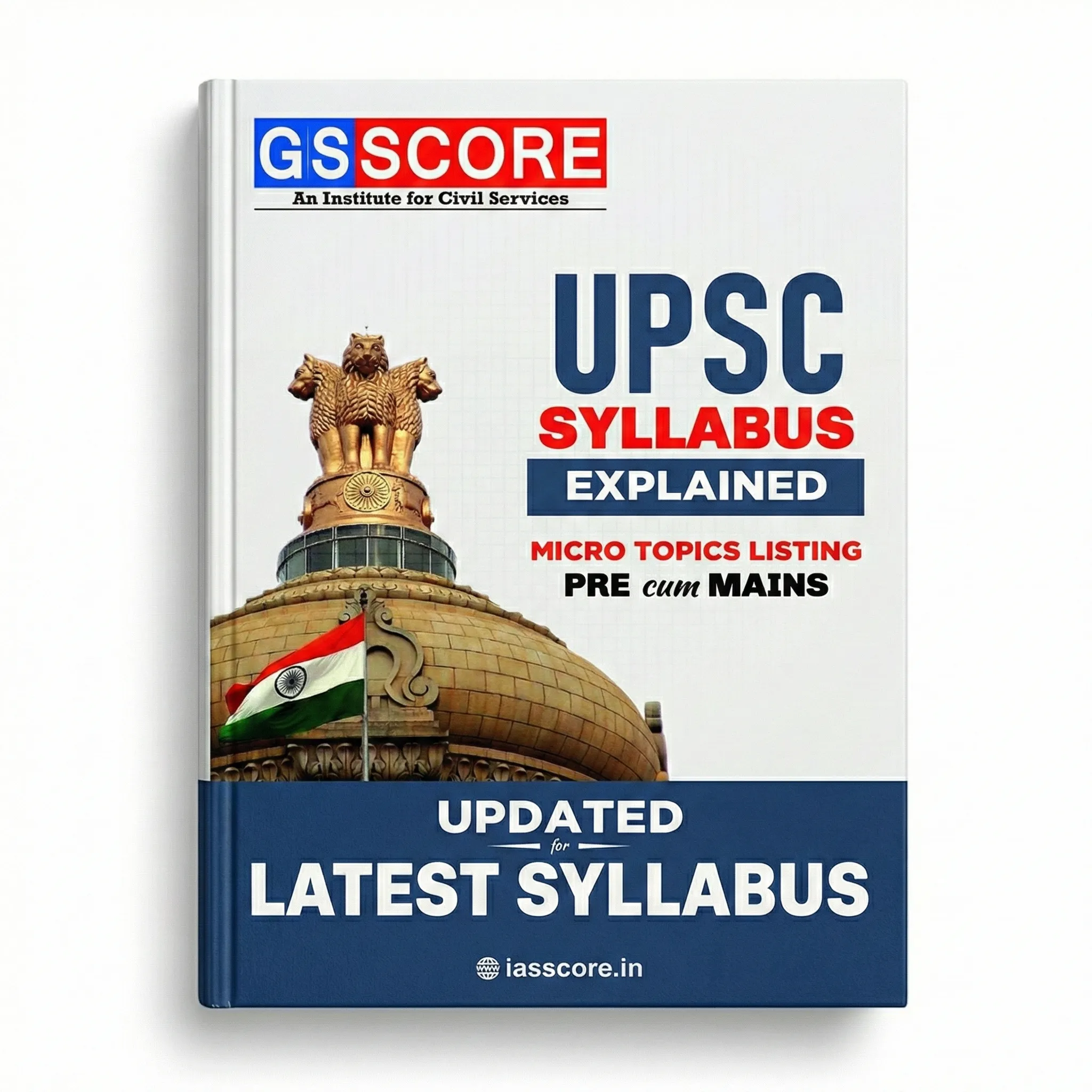
Yes — you can get the upsc mains syllabus pdf download. The syllabus is published in the annual UPSC Civil Services Examination notification on upsc.gov.in, which you can save as a PDF for free. For a print-ready, single-document version you can annotate and tick off, the GS Score Latest Syllabus Booklet 2026-27 gives the full Prelims + Mains syllabus in one compact booklet — ideal as a wall-chart and a revision tracker.
Use this checklist approach: print the syllabus, break every GS paper into its listed sub-topics, and mark each as “studied / revised / test-attempted.” Aspirants who revise directly against the syllabus (not against a book’s chapter order) consistently cover blind spots that others miss.
Prelims vs Mains Syllabus — Are They the Same?
No. The Prelims syllabus is broad and objective (two papers: GS and CSAT), designed as a screening test whose marks do not count towards the final rank. The Mains syllabus is deeper, descriptive and analytical, and its marks (along with the interview) decide selection. There is subject overlap — history, polity, economy, geography, environment appear in both — but Mains demands opinion, inter-linkage and answer writing rather than fact recall. Prepare an integrated foundation for both, then add Mains-specific depth, ethics and your optional.
Has the UPSC Mains Syllabus Changed for 2026?
The structure of the Mains syllabus — 2 qualifying language papers, Essay, four GS papers and one optional with two papers, for 1750 merit marks — has been stable for over a decade and applies to the 2026 cycle. UPSC has not announced a change to the paper pattern for 2026. Always confirm the exact wording, exempted-language list and optional-subject list against the year’s official notification when it is released, because minor clarifications and eligibility notes can be updated there. Treat any coaching summary, including this one, as a study aid layered on top of that official document.
Common Mistakes Aspirants Make with the Mains Syllabus
- Ignoring the qualifying language papers until the last week.
- Studying from books without ever reading the official syllabus wording.
- Starting the optional and Essay too late.
- Reading endless current affairs without tagging them to GS sub-topics.
- Not writing enough full-length answers under a 3-hour clock.
- Spreading time evenly across papers instead of front-loading the high-weight optional.
Frequently Asked Questions
What is the syllabus for UPSC Mains?
The UPSC Mains syllabus consists of 9 papers — two qualifying language papers (an Indian language and English), the Essay, four General Studies papers (GS I: history, culture, society, geography; GS II: polity, governance, IR; GS III: economy, environment, science-tech, security; GS IV: ethics, integrity, aptitude), and two optional subject papers.
How many papers are there in UPSC Mains and which count for merit?
There are 9 papers in all. Seven count for merit (Essay, GS I–IV and two optional papers = 1750 marks), while the two language papers (Paper A and Paper B) are only qualifying and do not add to the merit total.
Is the UPSC Prelims and Mains syllabus the same?
No. Prelims is objective and acts only as a screening test whose marks do not count for the final rank, while Mains is descriptive and analytical and its marks decide selection. Subjects overlap (history, polity, economy, geography, environment), but Mains needs answer writing, inter-linkage and opinion rather than fact recall.
What is the syllabus of GS Paper 4 (Ethics) in UPSC Mains?
GS Paper 4 covers ethics and human interface, attitude, aptitude and foundational values, emotional intelligence, contributions of moral thinkers, public/civil service values, probity in governance, and case studies. Roughly half the 250 marks come from a case-study section testing applied decision-making.
How many optional subjects are there and how do I choose one?
There are 48 optional subjects (25 core subjects plus 23 literature options), each with two papers worth 500 marks. Choose based on real interest, overlap with the GS syllabus, availability of good material and guidance, and recent scoring trends — not on a friend’s choice.
What are the qualifying papers in UPSC Mains and what are the passing marks?
Paper A (a compulsory Indian language from the Eighth Schedule) and Paper B (English) are the qualifying papers, each of 300 marks. You must score at least 25% (75 marks) in each; otherwise your other papers are not evaluated.
How many total marks is the UPSC Mains exam?
The Mains written exam carries 1750 merit marks (Essay 250, four GS papers 1000, and two optional papers 500). Adding the 275-mark Personality Test (interview) gives a final total of 2025 marks that determine the rank; the two language papers are qualifying and add nothing to this total.
Can I download the UPSC Mains syllabus PDF?
Yes. The syllabus is part of the annual UPSC Civil Services Examination notification on upsc.gov.in, which you can save as a PDF for free. For a print-ready, single-document copy to annotate and revise from, you can also use a consolidated syllabus booklet that combines the Prelims and Mains syllabus.
Recommended Study Material

Competer
The Competer team: we pack the orders, so we know which editions aspirants keep coming back for.
Get it printed
UPSC study material aspirants order most on Competer, delivered across India
 Vision IAS GS 2026-27 Booklets with Value Added Materials - 56 Booklets₹6,599View on Competer →
 Vision IAS Current Affairs Magazine December 2025 | English Medium Edition₹199
 Vision IAS Prelims Test Series 2026 | UPSC Prelims GS Tests in English Medium₹1,249View on Competer →
 Vajiram Economics Notes 2025-2026 UPSC Economics Optional Booklets Set of 5₹1,285View on Competer →
Continue reading
More in Buying Guides



Need help choosing?
Tell us your exam and stage on WhatsApp, we suggest the right set.