

UPSC Exam Pattern 2026: Prelims, Mains & Interview Marks
UPSC exam pattern explained: Prelims (400), Mains (1750) & Interview (275) = 2025 merit marks. Full papers, marking scheme, negative marking, CSAT & attempts for 2026.
 Competer

The UPSC exam pattern for the Civil Services Examination (CSE) is a three-stage process: the Preliminary Examination (400 marks, objective, screening only), the Main Examination (1750 merit marks, descriptive), and the Personality Test or Interview (275 marks). Only Mains and Interview marks count towards the final merit list, giving a grand total of 2025 marks. Prelims marks are never added to the final score — they are used purely to shortlist candidates for Mains.
This guide breaks down the complete UPSC CSE exam pattern 2026 stage by stage — number of papers, marks, duration, the exact marking scheme and negative marking, qualifying papers, eligibility and attempts, the optional subject weightage, and how the pattern should shape your preparation strategy. Every figure here reflects the structure notified by the Union Public Service Commission in its annual Civil Services Examination notification and Gazette rules.
UPSC Exam Pattern 2026 at a Glance
Before the stage-wise detail, here is the full three-stage funnel. Understanding that Prelims is only a filter — not a scoring stage — is the single most important idea in the entire UPSC exam pattern.
| Stage | Nature | Papers | Total Marks | Counts in Merit? |
|---|---|---|---|---|
| Prelims (CSE-P) | Objective (MCQ) | 2 | 400 | No — screening only |
| Mains (CSE-M) | Descriptive (written) | 9 | 1750 (merit) + 2 qualifying | Yes |
| Interview / Personality Test | Face-to-face | — | 275 | Yes |
| Final Merit | Mains + Interview | — | 2025 | — |
The exam is conducted once a year by the Union Public Service Commission to recruit officers for the IAS, IPS, IFS (Foreign Service) and other Group A and Group B central services. A single unified exam decides all of them; your rank and service preference determine the service you are allotted. This is the same three-stage structure across the ias exam pattern prelims and mains and every other service under the CSE — there is no separate exam for IAS versus IPS.

Stage 1: UPSC Prelims Exam Pattern
The UPSC prelims exam pattern consists of two objective-type (multiple-choice) papers, both held on the same day in two sessions. Each paper carries 200 marks and lasts two hours. Together they total 400 marks, but — and this is the crucial part — only General Studies Paper I decides the Prelims cut-off.
| Paper | Type | Questions | Marks | Duration | Role |
|---|---|---|---|---|---|
| GS Paper I | Objective (MCQ) | 100 | 200 | 2 hours | Decides cut-off (merit for Prelims) |
| CSAT Paper II | Objective (MCQ) | 80 | 200 | 2 hours | Qualifying only (33% needed) |
Both papers are set in Hindi and English. For visually impaired candidates, an extra 20 minutes per paper is allowed. Question papers are objective throughout Prelims — there is no descriptive writing at this stage.
Is CSAT qualifying or counted in the merit list?
CSAT (Civil Services Aptitude Test, Paper II) is qualifying only. You must score a minimum of 33% — that is, 66 out of 200 marks — to clear it, but the marks are not added to your Prelims score. Your ranking for Prelims selection is decided solely by GS Paper I. If you fail to reach 33% in CSAT, however, your GS Paper I is not even evaluated for the cut-off, and you are out. This is why CSAT cannot be ignored despite being “just qualifying” — aptitude, comprehension, and basic maths in CSAT have knocked out thousands of otherwise strong candidates.
UPSC Prelims Marking Scheme and Negative Marking
Negative marking in UPSC Prelims deducts one-third (0.33) of the marks assigned to a question for every wrong answer. There is no penalty for questions left blank. Because the two papers carry different numbers of questions, the per-question value — and therefore the exact negative mark — differs between GS-I and CSAT.
| Paper | Questions | Marks per correct | Negative per wrong | Total |
|---|---|---|---|---|
| GS Paper I | 100 | +2.0 | −0.66 | 200 |
| CSAT Paper II | 80 | +2.5 | −0.83 | 200 |
So in GS-I, each of the 100 questions is worth 2 marks and a wrong answer costs 0.66 marks (one-third of 2). In CSAT, each of the 80 questions is worth 2.5 marks and a wrong answer costs 0.83 marks (one-third of 2.5). The Decision Making questions in CSAT are an exception — they carry no negative marking. Getting this precise +2/−0.66 versus +2.5/−0.83 split right is essential for calculating how much intelligent guessing you can afford. A clean rule of thumb: guessing pays off statistically only when you can eliminate at least two of the four options.
Stage 2: UPSC Mains Exam Pattern
The UPSC mains exam pattern is entirely descriptive (essay and long-answer writing) and consists of nine papers written over five to six days. Two of these are language papers that are merely qualifying; the remaining seven — Essay, four General Studies papers, and two Optional papers — count towards the merit list.
| Paper | Subject | Marks | Duration | Counts in Merit? |
|---|---|---|---|---|
| Paper A | Indian Language (one of the 22 in Schedule VIII) | 300 | 3 hours | Qualifying (25%) |
| Paper B | English | 300 | 3 hours | Qualifying (25%) |
| Paper I | Essay | 250 | 3 hours | Yes |
| Paper II | General Studies I (History, Geography, Society) | 250 | 3 hours | Yes |
| Paper III | General Studies II (Polity, Governance, IR) | 250 | 3 hours | Yes |
| Paper IV | General Studies III (Economy, Environment, Sci-Tech, Security) | 250 | 3 hours | Yes |
| Paper V | General Studies IV (Ethics, Integrity, Aptitude) | 250 | 3 hours | Yes |
| Paper VI | Optional Paper 1 | 250 | 3 hours | Yes |
| Paper VII | Optional Paper 2 | 250 | 3 hours | Yes |
The seven merit papers total 1750 marks (7 × 250). There is no negative marking in Mains — the challenge is answer-writing quality, structure, and finishing within the time limit. Each paper is three hours long, and the sheer volume of writing (roughly 8,000–10,000 words a day) makes Mains as much a test of stamina and articulation as of knowledge.
The language-qualifying-paper trap
Paper A (Indian language) and Paper B (English) each carry 300 marks but require only a minimum of 25% to pass, and these marks are not counted in the merit list. The trap is this: if you fail either qualifying language paper, the Commission does not evaluate your seven merit papers at all — your entire Mains is voided regardless of how brilliantly you wrote GS or your optional. Candidates from English-medium backgrounds sometimes underestimate Paper A (the compulsory Indian language), and native-language candidates occasionally stumble on Paper B. Never treat these as free passes. (Candidates from certain North-Eastern states are exempt from Paper A.)
UPSC Optional Subjects: List and Weightage
Every candidate chooses one optional subject with two papers of 250 marks each — 500 marks out of 1750, or nearly 29% of the entire Mains merit total. This weight is why optional choice is a genuinely rank-deciding decision, not an afterthought.
| Category | Weight in Mains | Share of 1750 |
|---|---|---|
| Optional (2 papers) | 500 marks | ~29% |
| General Studies (4 papers) | 1000 marks | ~57% |
| Essay | 250 marks | ~14% |
UPSC offers 48 optional subjects, including humanities like Political Science & International Relations (PSIR), Sociology, History, Geography, Public Administration, and Anthropology; sciences like Physics, Chemistry, Zoology, and Botany; commerce, economics, law, medical science, engineering streams; and the literature of numerous Indian languages plus English. You can pick any one regardless of your graduation background. Popular high-scoring choices include PSIR, Sociology, Geography, and Anthropology because of manageable, well-defined syllabi and overlap with GS.
Because the optional carries 500 marks, dependable, syllabus-aligned notes are worth investing in. For instance, aspirants taking PSIR often use Shubhra Ranjan PSIR notes, Sociology candidates rely on structured modules like the SS Pandey Sociology notes, and Economics optional takers use the Vajiram Economics optional booklets. Choosing an optional you can sustain interest in — and finding reliable material for it — directly affects that 500-mark bucket.
Stage 3: UPSC Interview / Personality Test Marks Pattern
The final stage is the Personality Test, commonly called the Interview, worth 275 marks with no minimum qualifying mark. Conducted at UPSC’s Dholpur House in New Delhi before a board chaired by a UPSC member, it assesses mental alertness, clarity of thought, balance of judgement, leadership, intellectual and moral integrity, and depth of interest — not textbook knowledge. Questions draw heavily on your Detailed Application Form (DAF): your background, graduation subject, hobbies, home state, and current affairs. Interview marks, added to the 1750 Mains marks, produce the final merit out of 2025. Because there is no qualifying cut-off here, the full 275-mark range is live — a strong interview can move a rank by dozens of places, and a weak one can undo a good Mains score.
How the Final Merit Is Calculated: 2025 Marks
Here is the complete merit math for the ias exam pattern prelims and mains combined. Prelims contributes zero; only Mains and Interview build your rank.
| Component | Marks | Included in Final Merit |
|---|---|---|
| Prelims (GS-I + CSAT) | 400 | No |
| Mains — 7 merit papers | 1750 | Yes |
| Mains — 2 language papers | Qualifying (25%) | No |
| Personality Test / Interview | 275 | Yes |
| Final Merit Total | 2025 | — |
The Stage-Wise Elimination Funnel
Roughly 9–11 lakh candidates apply each year, but only a few hundred are finally recommended. This funnel is exactly why Prelims is designed as a screening filter rather than a scoring round.
| Stage | Approx. Candidates | Filter Ratio |
|---|---|---|
| Applied | ~9–11 lakh | — |
| Appeared in Prelims | ~5–6 lakh | — |
| Cleared Prelims (for Mains) | ~13,000–15,000 | ~1 in 40 appeared |
| Cleared Mains (for Interview) | ~2,500–3,000 | ~1 in 5 |
| Final selection | ~1,000–1,100 | ~1 in 3 |
Approximately 12–13 times the number of vacancies are shortlisted after Prelims, and roughly twice the vacancies after Mains. The takeaway: clearing Prelims requires beating a cut-off, but ranks are won in Mains and Interview.
UPSC Eligibility: Age Limits and Number of Attempts
The exam pattern is inseparable from eligibility mechanics that most guides bury. You must hold a bachelor’s degree in any discipline. Age (as on 1 August of the exam year) and the number of permitted attempts vary by category.
| Category | Age Limit | Attempts Allowed |
|---|---|---|
| General / EWS | 21–32 years | 6 |
| OBC | 21–35 years (3-yr relaxation) | 9 |
| SC / ST | 21–37 years (5-yr relaxation) | Unlimited (till age limit) |
| PwBD (Gen/EWS/OBC) | Up to +10 years | 9 |
| PwBD (SC/ST) | Up to +10 years | Unlimited (till age limit) |
Appearing for Prelims counts as one attempt; not appearing does not. Defence personnel disabled in operations and certain other categories get further relaxations.
Prelims vs Mains Pattern: Side-by-Side Comparison
Understanding the difference between UPSC Prelims and Mains pattern helps you plan two very different preparation modes — speed-and-accuracy MCQ solving versus structured answer-writing.
| Feature | Prelims | Mains |
|---|---|---|
| Question type | Objective (MCQ) | Descriptive (written) |
| Number of papers | 2 | 9 (7 merit + 2 qualifying) |
| Total marks | 400 | 1750 merit + 275 interview |
| Negative marking | Yes (⅓ per wrong) | No |
| Role in final merit | Screening only | Counts fully |
| Skills tested | Recall, elimination, speed | Analysis, articulation, structure |
| Duration per paper | 2 hours | 3 hours |
The Annual UPSC Cycle: Notification to Final Result
The entire CSE cycle spans roughly 12–15 months from notification to final result, which is why aspirants effectively prepare on a two-year runway. Mapping the calendar onto the pattern helps you sequence your study.
| Stage | Approx. Timing | Gap to Next |
|---|---|---|
| Notification released | January–February | ~3–4 months |
| Prelims exam | May–June | ~3 months |
| Prelims result | June–July | — |
| Mains exam | September–October | ~2–3 months |
| Mains result | December–January | — |
| Interview / Personality Test | January–April | — |
| Final result | April–May | — |
How the Pattern Should Shape Your Preparation
The exam pattern is a strategy document in disguise. Here is how the numbers translate into a plan.
- GS-I decides Prelims, so make it non-negotiable. Since CSAT is only qualifying, your Prelims rank hinges entirely on the 100 GS-I questions. A structured booklist plus daily MCQ practice through a Prelims test series is the highest-leverage investment before May.
- Never skip CSAT. A 33% qualifying bar sounds easy until an unusually hard maths or reasoning-heavy paper appears. Practising a dedicated CSAT test series guards against the single most avoidable elimination.
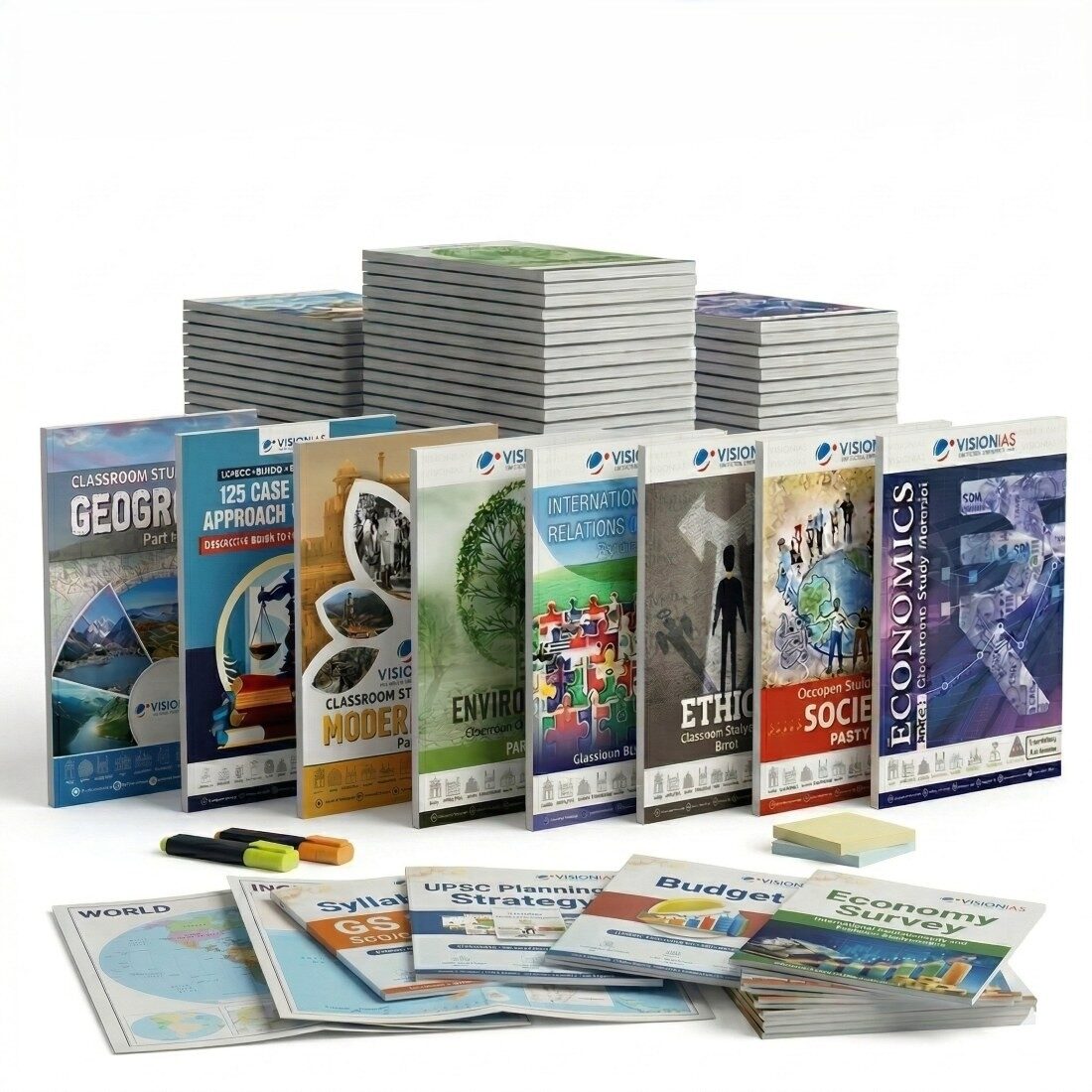
- Prioritise GS by weight. The four GS papers are 1000 of 1750 merit marks. Comprehensive, exam-ready notes such as the Vision IAS complete GS notes (Prelims + Mains) cover the bulk of that weight and serve both stages.
- Treat the optional as 500 marks, not a side subject. A well-chosen optional with strong material can lift your rank by hundreds of places.
- Master essay early. The Essay paper alone is 250 marks — as much as any GS paper — yet is often under-practised. Structured guidance like Vajiram Essay notes helps you build a repeatable framework.
- Know the syllabus cold. Every paper maps to an official syllabus; a dedicated syllabus booklet keeps your reading focused and prevents scope creep.
Common Mistakes Around the UPSC Exam Pattern
- Believing Prelims marks add to the final score — they never do.
- Ignoring CSAT until it’s too late and failing the 33% bar.
- Under-preparing the qualifying language papers and voiding the entire Mains.
- Blind guessing in Prelims and losing marks to the ⅓ negative penalty.
- Choosing an optional based on “scoring reputation” alone rather than personal comfort and available material.
- Neglecting answer-writing practice for Mains, where structure and time management decide marks.
Frequently Asked Questions
What is the exam pattern of UPSC?
The UPSC CSE has three stages: Prelims (2 objective papers, 400 marks, screening only), Mains (9 descriptive papers with 1750 merit marks), and the Interview/Personality Test (275 marks). Final merit is out of 2025 marks — Mains plus Interview — while Prelims only shortlists candidates.
How many papers are there in UPSC Prelims and Mains?
Prelims has 2 papers — GS Paper I and CSAT Paper II. Mains has 9 papers — two qualifying language papers (Paper A and Paper B), Essay, four General Studies papers (GS I–IV), and two Optional papers.
Is there negative marking in the UPSC exam?
Yes, in Prelims only. One-third (0.33) of the marks for a question is deducted for each wrong answer — −0.66 in GS-I and −0.83 in CSAT. There is no penalty for unanswered questions, and no negative marking in Mains.
What are the total marks in the UPSC CSE?
Prelims is 400 marks (not counted in merit), Mains merit is 1750 marks, and the Interview is 275 marks. The final merit list is based on 1750 + 275 = 2025 marks.
Is CSAT qualifying or counted in the merit list?
CSAT (Paper II) is qualifying only — you need 33% (66/200) to pass. Its marks are not added to the merit list; the Prelims cut-off is decided solely by GS Paper I. But failing CSAT eliminates you regardless of your GS-I score.
How many attempts are allowed for the UPSC exam?
General/EWS candidates get 6 attempts (age 21–32), OBC candidates get 9 attempts (up to age 35), and SC/ST candidates get unlimited attempts until the upper age limit of 37. Appearing for Prelims counts as one attempt.
What is the difference between UPSC Prelims and Mains pattern?
Prelims is objective (2 MCQ papers, 400 marks, negative marking, screening only), while Mains is descriptive (9 written papers, 1750 merit marks, no negative marking, counted in the final rank). Prelims tests recall and speed; Mains tests analysis, articulation, and answer structure under a 3-hour limit.
How many optional subjects are there and how many marks do they carry?
UPSC offers 48 optional subjects, and each candidate picks one. The optional has two papers of 250 marks each, totalling 500 marks — nearly 29% of the 1750 Mains merit total — which makes the optional choice a major rank-deciding factor.
How are UPSC Interview (Personality Test) marks counted?
The Interview carries 275 marks with no minimum qualifying cut-off, and the full range counts in the final merit. Interview marks are added directly to the 1750 Mains merit marks to give the final total of 2025.
Recommended Study Material

Competer
The Competer team: we pack the orders, so we know which editions aspirants keep coming back for.
Get it printed
UPSC study material aspirants order most on Competer, delivered across India
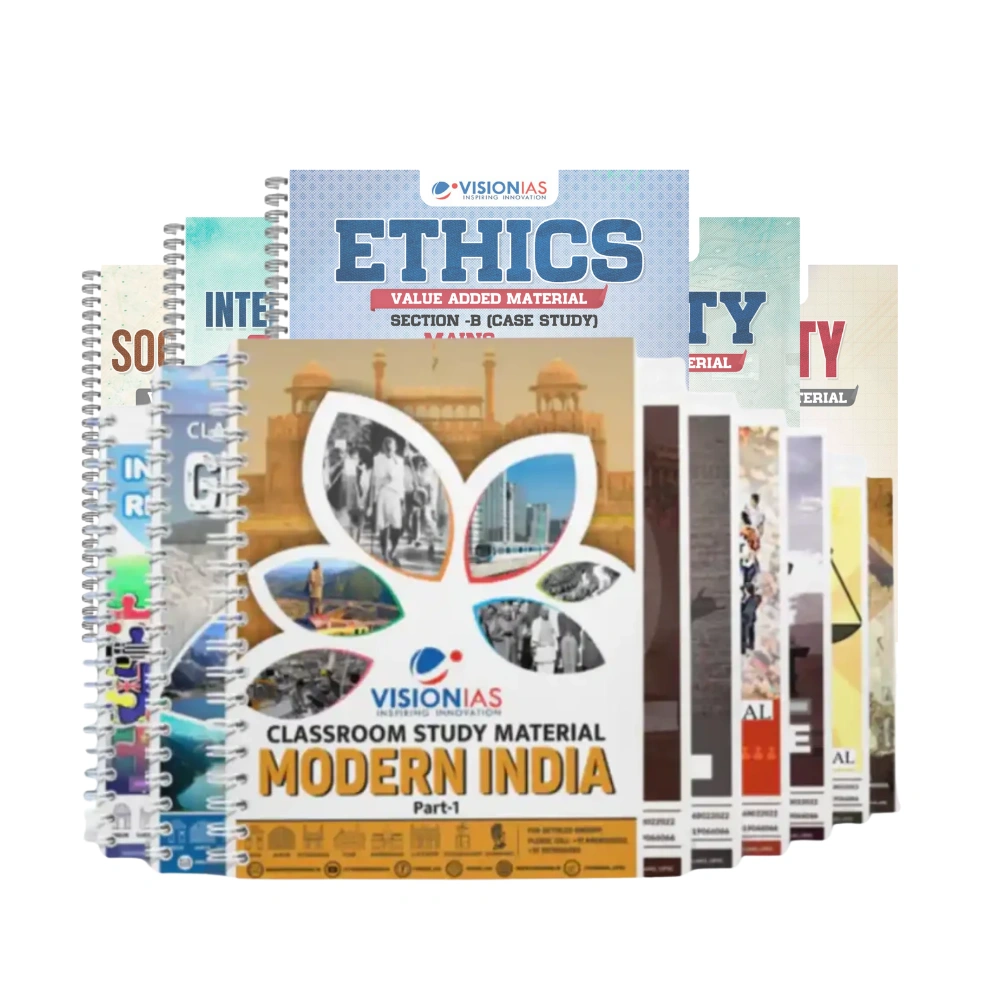 Vision IAS GS 2026-27 Booklets with Value Added Materials - 56 Booklets₹6,599View on Competer →
 Vision IAS Current Affairs Magazine December 2025 | English Medium Edition₹199 Vision IAS Prelims Test Series 2026 | UPSC Prelims GS Tests in English Medium₹1,249View on Competer →
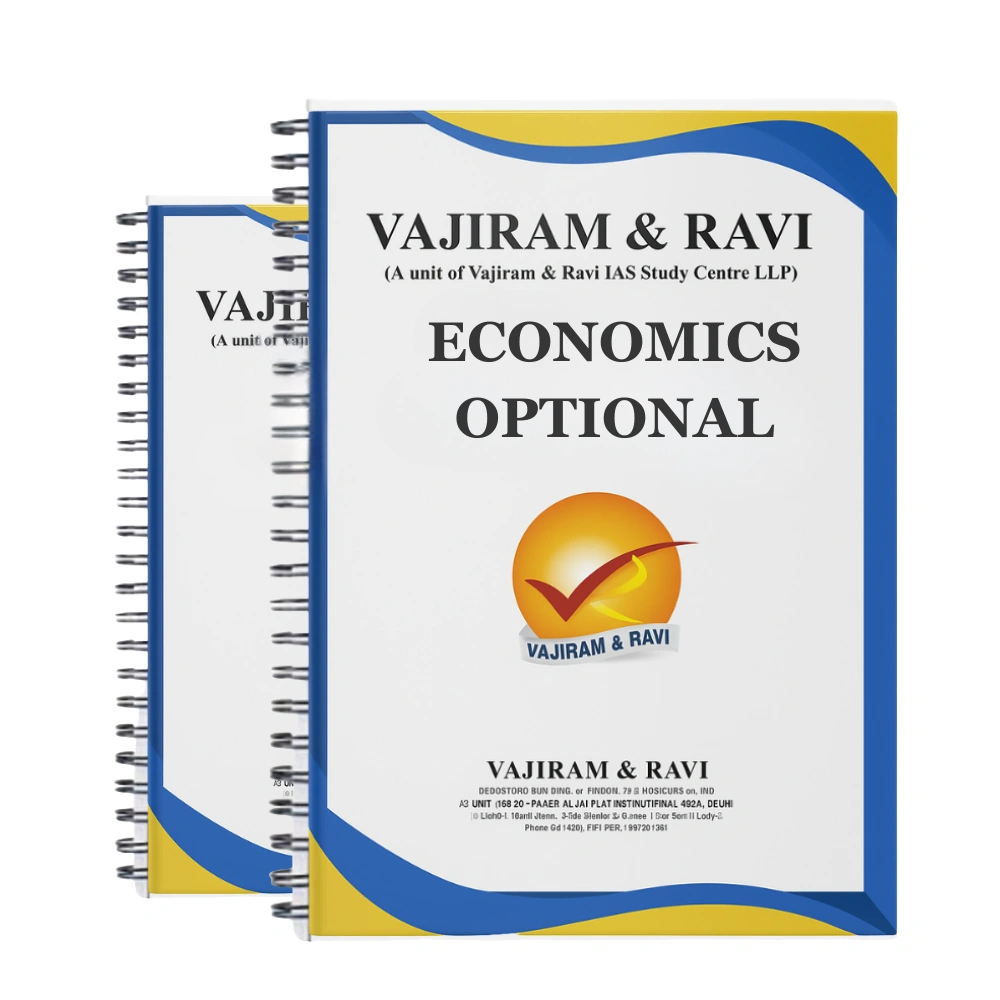 Vajiram Economics Notes 2025-2026 UPSC Economics Optional Booklets Set of 5₹1,285View on Competer →
Continue reading
More in Buying Guides



Need help choosing?
Tell us your exam and stage on WhatsApp, we suggest the right set.