
TNPSC Group 1 Syllabus 2026: Prelims, Mains
TNPSC Group 1 syllabus 2026: unit-wise Prelims & Mains topics, exam pattern, marks weightage, Tamil + English.
 Competer
The TNPSC Group 1 syllabus is set by the Tamil Nadu Public Service Commission (TNPSC) and runs across three stages: a Preliminary exam (200 objective questions for 300 marks, screening only), a Main written exam of four descriptive papers, and an Interview/Oral Test worth 100 marks. Prelims tests General Studies with an Aptitude & Mental Ability section; Mains covers modern Indian history, Indian polity and governance, economy, geography, science & technology, environment, ethics and Tamil society. The Tamil Eligibility Paper (Paper I) is qualifying only — its marks are not added to the final merit, which is built from the three GS Mains papers (750) plus the Interview (100) = 850 marks.
This guide gives you the full unit-wise TNPSC Group 1 syllabus 2026 for Prelims and Mains in English (with a Tamil reference for every unit), the exact exam pattern and marks weightage, a study-time priority map, subject-wise book mapping, an eligibility snapshot, a comparison with UPSC and other TNPSC groups, and where to download the official PDF. Everything is on one fast, fully readable page so you can plan your preparation end to end. Always cross-check each unit against the syllabus attached to the latest official notification on tnpsc.gov.in, since the Commission refines unit descriptions from cycle to cycle.
TNPSC Group 1 2026: Key Highlights at a Glance
Before the detailed tnpsc group 1 syllabus breakdown, here is a quick snapshot of the exam. TNPSC Group 1 (Combined Civil Services Examination-I) recruits to the most senior direct-recruitment posts in the Tamil Nadu state services, including Deputy Collector, Deputy Superintendent of Police (DSP) and Assistant Commissioner (Commercial Taxes).
| Particular | Details |
|---|---|
| Conducting body | Tamil Nadu Public Service Commission (TNPSC) |
| Exam name | Combined Civil Services Examination-I (Group 1 Services) |
| Selection stages | Preliminary → Main (Written) → Interview / Oral Test |
| Prelims marks | 300 (200 questions, single paper) |
| Mains marks | 750 counted (3 GS papers × 250) + Tamil Paper (qualifying) |
| Interview marks | 100 |
| Total merit marks | 850 (Mains 750 + Interview 100) |
| Medium | Tamil and English |
| Negative marking | No negative marking in Prelims |
| Official website | tnpsc.gov.in |
TNPSC Group 1 Eligibility Snapshot (2026)
Syllabus planning only helps if you are eligible to sit the exam, so here is a quick reference before the topic breakdown. Confirm every figure against the official notification, because age relaxations and post-wise limits are set per recruitment cycle.
| Criterion | Requirement |
|---|---|
| Nationality | Indian citizen |
| Educational qualification | Bachelor’s degree from a recognised university (any stream) |
| Minimum age | 21 years |
| Maximum age | Varies by post and category; upper age relaxations apply to SC/ST/BC/MBC and other reserved categories as notified |
| Number of attempts | Governed by the age limit — there is generally no separate attempt cap; verify in the notification |
| Language requirement | Must clear the qualifying Tamil Eligibility Paper (Paper I) in Mains |
TNPSC Group 1 Selection Process: Three Stages
TNPSC Group 1 follows a three-stage funnel. Understanding how each stage feeds the next is the first step in reading the syllabus correctly, because Prelims and Mains overlap heavily in subjects but differ completely in depth and answer format.
Stage 1 — Preliminary Examination (Screening)
The Prelims is a single objective paper of 200 questions carrying 300 marks. It is purely a screening test — the marks do not count towards the final merit. Candidates are shortlisted for Mains at roughly 1:50 of the number of vacancies based on Prelims performance.
Stage 2 — Main Written Examination
The Mains consists of four descriptive papers written in three hours each. Paper I is a Tamil Eligibility Test (qualifying), and Papers II, III and IV are General Studies papers of 250 marks each. Only the three GS papers (750 marks) count towards merit.
Stage 3 — Interview / Oral Test
Candidates who clear Mains are called for an Interview (Oral Test) of 100 marks at a ratio of about 1:3 of vacancies. The final merit list is prepared from the total of Mains (750) and Interview (100) = 850 marks.
TNPSC Group 1 Exam Pattern 2026 (Prelims & Mains)
The tnpsc group 1 exam pattern is straightforward once you separate the two written stages. The table below summarises the full pattern for the 2026 cycle.
| Stage | Paper | Questions / Type | Marks | Duration | Counts in Merit? |
|---|---|---|---|---|---|
| Prelims | General Studies + Aptitude & Mental Ability | 200 objective (MCQ) | 300 | 3 hours | No (screening) |
| Mains | Paper I — Tamil Eligibility Test | Descriptive (qualifying) | 100 | 3 hours | No (qualifying, min 40%) |
| Mains | Paper II — General Studies | Descriptive | 250 | 3 hours | Yes |
| Mains | Paper III — General Studies | Descriptive | 250 | 3 hours | Yes |
| Mains | Paper IV — General Studies | Descriptive | 250 | 3 hours | Yes |
| Interview | Oral Test | Personality assessment | 100 | — | Yes |
Is there negative marking in TNPSC Group 1 Prelims?
No. There is no negative marking in the TNPSC Group 1 Prelims, so you should attempt all 200 questions — leaving no question blank is a free strategy advantage. The Prelims is qualifying with a minimum requirement (which varies by category as notified), and the minimum time you must stay in the hall is 120 minutes.
TNPSC Group 1 Prelims Syllabus 2026 (Unit-Wise)
The tnpsc group 1 prelims syllabus is a single General Studies paper that blends national-level GS with a large Tamil Nadu-specific component and an Aptitude section. The 200 questions are distributed across seven broad units. The table below gives the unit-wise question count — this is the single most important planning tool for Prelims.
| Unit | Subject Area | No. of Questions |
|---|---|---|
| 1 | General Science | 10 |
| 2 | Geography (India & Tamil Nadu) | 10 |
| 3 | Indian History & National Movement | 25 |
| 4 | Indian Polity | 40 |
| 5 | Indian Economy & Development Administration in Tamil Nadu | 50 |
| 6 | History, Culture & Socio-Political Movements of Tamil Nadu | 40 |
| 7 | Aptitude & Mental Ability | 25 |
| — | Total | 200 |
Unit 1 — General Science
Physics: nature of the universe, motion, energy, heat, light, sound, magnetism, electricity. Chemistry: elements and compounds, acids, bases, salts, fertilisers, chemistry in daily life. Botany and Zoology: classification of living organisms, nutrition, human diseases, blood circulation, environment and ecology.
Unit 2 — Geography
Earth and universe, solar system, monsoon, rainfall, natural resources, soil, minerals, forests, agriculture, transport and communication, disaster management, and the physical geography of India with special emphasis on Tamil Nadu.
Unit 3 — Indian History & National Movement
Indus civilisation, Vedic and Sangam ages, major dynasties, the rise of Indian nationalism, the freedom struggle, the role of Tamil Nadu in the national movement, and post-independence consolidation.
Unit 4 — Indian Polity
At 40 questions this is one of the highest-yield units. It covers the Constitution of India, Preamble, salient features, Union and State executive, legislature, judiciary, fundamental rights and duties, Directive Principles, amendments, Panchayati Raj, elections and constitutional bodies.
Unit 5 — Indian Economy & Development Administration in Tamil Nadu
The single largest unit (50 questions). It spans national income, planning, Five-Year Plans, banking, budget, poverty and unemployment, rural and urban development, and — critically — Tamil Nadu’s welfare schemes, e-governance and development administration.
Unit 6 — History, Culture & Socio-Political Movements of Tamil Nadu
A TN-exclusive unit of 40 questions: Tamil society, Dravidian movement, the growth of rationalist and self-respect movements, Tamil literature and culture, social reformers of Tamil Nadu, and political parties of the state.
Unit 7 — Aptitude & Mental Ability
See the dedicated topic list in the section below.
TNPSC Group 1 Syllabus in Tamil + English (Bilingual Unit Table)
Many top-ranking pages skip a clean bilingual view. For Tamil-medium aspirants, here is the tnpsc group 1 syllabus in Tamil mapped side by side with English for every Prelims unit, so you can revise in whichever medium you sit the exam in.
| Unit (English) | அலகு (தமிழ்) |
|---|---|
| General Science | பொது அறிவியல் |
| Geography | புவியியல் |
| Indian History & National Movement | இந்திய வரலாறு மற்றும் தேசிய இயக்கம் |
| Indian Polity | இந்திய அரசியலமைப்பு |
| Indian Economy & Development Administration in TN | இந்தியப் பொருளாதாரம் மற்றும் தமிழ்நாட்டில் வளர்ச்சி நிர்வாகம் |
| History, Culture & Socio-Political Movements of TN | தமிழ்நாட்டு வரலாறு, பண்பாடு மற்றும் சமூக-அரசியல் இயக்கங்கள் |
| Aptitude & Mental Ability | திறனறிவு மற்றும் மனக்கணக்கு |
The official TNPSC notification publishes the syllabus in both languages, and the question paper is set bilingually. If you prepare from an English GS base, cross-reference Tamil terminology for the TN-specific Units 5 and 6, since those carry state-specific names and schemes that appear in Tamil in many past papers.
Aptitude & Mental Ability Topics (25 Questions)
This 25-question unit is scoring for anyone comfortable with basic quantitative aptitude and reasoning. The topics are stable year to year.
| Category | Topics |
|---|---|
| Arithmetic | Simplification, HCF & LCM, ratio & proportion, percentage, average |
| Commercial Maths | Simple interest, compound interest, profit & loss, discount |
| Time & Measurement | Time & work, time & distance, pipes & cisterns, area & volume |
| Number Handling | Number series, decimal fractions, power & roots, divisibility |
| Reasoning | Logical reasoning, puzzles, coding-decoding, blood relations, direction sense |
| Data & Visual | Data interpretation, tables & graphs, dice, calendar, clocks |
TNPSC Group 1 Mains Syllabus 2026 (Paper-Wise)
The tnpsc group 1 mains syllabus is descriptive and demands structured, analytical answer-writing rather than recognition. Paper I is the Tamil Eligibility Test; the three GS papers carry the merit marks. Below is the paper-wise topic breakdown.
How many papers are there in TNPSC Group 1 Mains?
There are four papers in TNPSC Group 1 Mains: one qualifying Tamil Eligibility paper (Paper I, 100 marks) and three General Studies papers (Papers II, III and IV, 250 marks each). Only the three GS papers — 750 marks in total — are counted in the merit list.
| Paper | Core Themes | Marks |
|---|---|---|
| Paper I | Tamil language — grammar, comprehension, précis, translation (qualifying) | 100 |
| Paper II (GS) | Modern Indian history, Indian culture, Indian polity & Constitution, socio-economic issues | 250 |
| Paper III (GS) | Geography of India & Tamil Nadu, economy, science & technology, environment | 250 |
| Paper IV (GS) | Tamil society & culture, current events, administration, ethics & aptitude, analytical ability | 250 |
Detailed Mains Topics
- History & Culture: Modern Indian history from the 18th century, the role of Tamil Nadu in the freedom struggle, Indian culture, art, architecture and literature, and the growth of rationalist and Dravidian movements.
- Polity & Governance: Constitution of India, federal structure, Centre-State relations, local self-government, constitutional and statutory bodies, governance, transparency and accountability, e-governance.
- Economy: Indian economy, planning and NITI Aayog, budget and taxation, banking and financial sector, inclusive growth, welfare economics and Tamil Nadu’s economic development.
- Geography & Environment: Physical, social and economic geography of India and Tamil Nadu, resources, agriculture, environmental ecology, biodiversity, climate change and disaster management.
- Science & Technology: Developments in science and technology, IT and space, defence, health and their applications and effects in everyday life.
- Ethics & Aptitude: Ethics and human interface, values in administration, emotional intelligence, and problem-solving/decision-making scenarios.
- Tamil Society & Current Affairs: Tamil society and culture, contemporary state and national events, and their analytical interpretation.
Is there any optional subject in TNPSC Group 1 Mains?
No. Unlike UPSC Civil Services, there is no optional subject in TNPSC Group 1 Mains. All candidates write the same four papers, which makes the General Studies base and Tamil Nadu-specific knowledge the decisive differentiators.
Are Tamil language (Paper I) marks counted in the final merit?
No. Paper I is a Tamil Eligibility Test worth 100 marks and is purely qualifying — you must score the minimum pass mark (40%), but those marks are not added to your merit total. The ranking is decided by the three GS Mains papers (750) and the Interview (100). Still, treat Paper I seriously: failing it ends your candidature regardless of how well you scored in GS.
Marks Weightage Strategy: Where to Invest Your Time
Question counts are only useful when you convert them into a study-time priority map. Most competitor pages stop at listing the counts — here is what the Prelims distribution actually tells you.
| Priority | Units | Questions | Share of Paper |
|---|---|---|---|
| Tier 1 (must master) | Economy & TN Development (50) + TN History/Culture (40) | 90 | ~45% |
| Tier 2 (high yield) | Indian Polity (40) + Indian History (25) | 65 | ~32.5% |
| Tier 3 (scoring) | Aptitude & Mental Ability (25) | 25 | ~12.5% |
| Tier 4 (stabilisers) | General Science (10) + Geography (10) | 20 | ~10% |
The takeaway: Economy + Tamil Nadu units alone are roughly 45% of the Prelims paper, and adding Polity pushes the top three units past 65%. An aspirant who masters TN-specific content and Polity, and treats Aptitude as a guaranteed-return section, secures the qualifying cut-off comfortably. General Science and Geography are low-count — study them for accuracy, not volume.
How TNPSC Group 1 Differs from UPSC and Other TNPSC Groups
A big planning advantage — missed by most pages — is knowing how much of your prep is reusable. TNPSC Group 1 shares a large national-GS core with UPSC and with TNPSC Group 2/2A/4, but layers heavy Tamil Nadu-specific content on top.
| Feature | TNPSC Group 1 | UPSC Civil Services |
|---|---|---|
| Stages | Prelims + Mains + Interview | Prelims + Mains + Interview |
| Prelims papers | 1 paper (GS + Aptitude) | 2 papers (GS + CSAT) |
| Optional subject | None | One optional (2 papers) |
| Mains GS papers | 3 counted + Tamil (qualifying) | 4 GS + Essay + 2 language (qualifying) |
| Regional focus | Heavy Tamil Nadu content | National + international |
| Interview marks | 100 | 275 |
How is TNPSC Group 1 different from UPSC Civil Services?
TNPSC Group 1 is a state civil services exam with a single Prelims paper, no optional subject, and a large Tamil Nadu-specific component (history, culture, Dravidian movement, state economy and administration). UPSC is national, has a CSAT paper, an essay, and a candidate-chosen optional worth 500 marks. The national GS portions — history, polity, economy, geography, science and environment — overlap substantially, so UPSC-oriented General Studies material covers a big chunk of TNPSC Group 1 prep. Aspirants can reuse standard UPSC GS notes such as Vision IAS English Study Material for the national units and then layer TN-specific sources on top.
The same logic connects Group 1 to Groups 2/2A and 4: the General Studies base is shared, while Group 1 alone demands descriptive Mains answer-writing and deeper analytical treatment. If you are preparing for multiple TNPSC groups, build one common GS foundation and scale the depth per exam.
Subject-Wise Books & Study Material Mapping
Choosing the right material per unit matters more than buying everything. Because the national-GS units overlap with UPSC, standard UPSC GS notes are an efficient, exam-tested backbone; layer Tamil Nadu State Board textbooks and TN-specific guides on top for Units 5 and 6.
| Unit | Recommended Source Type | Suggested Material |
|---|---|---|
| Indian Polity | Structured polity notes | Vajiram Polity Notes |
| Indian Economy & TN Development | Concept + current economy notes | Vision IAS Economics Notes |
| Full GS (History/Geo/Sci/Env) | Complete GS booklet set | Vision IAS English Study Material |
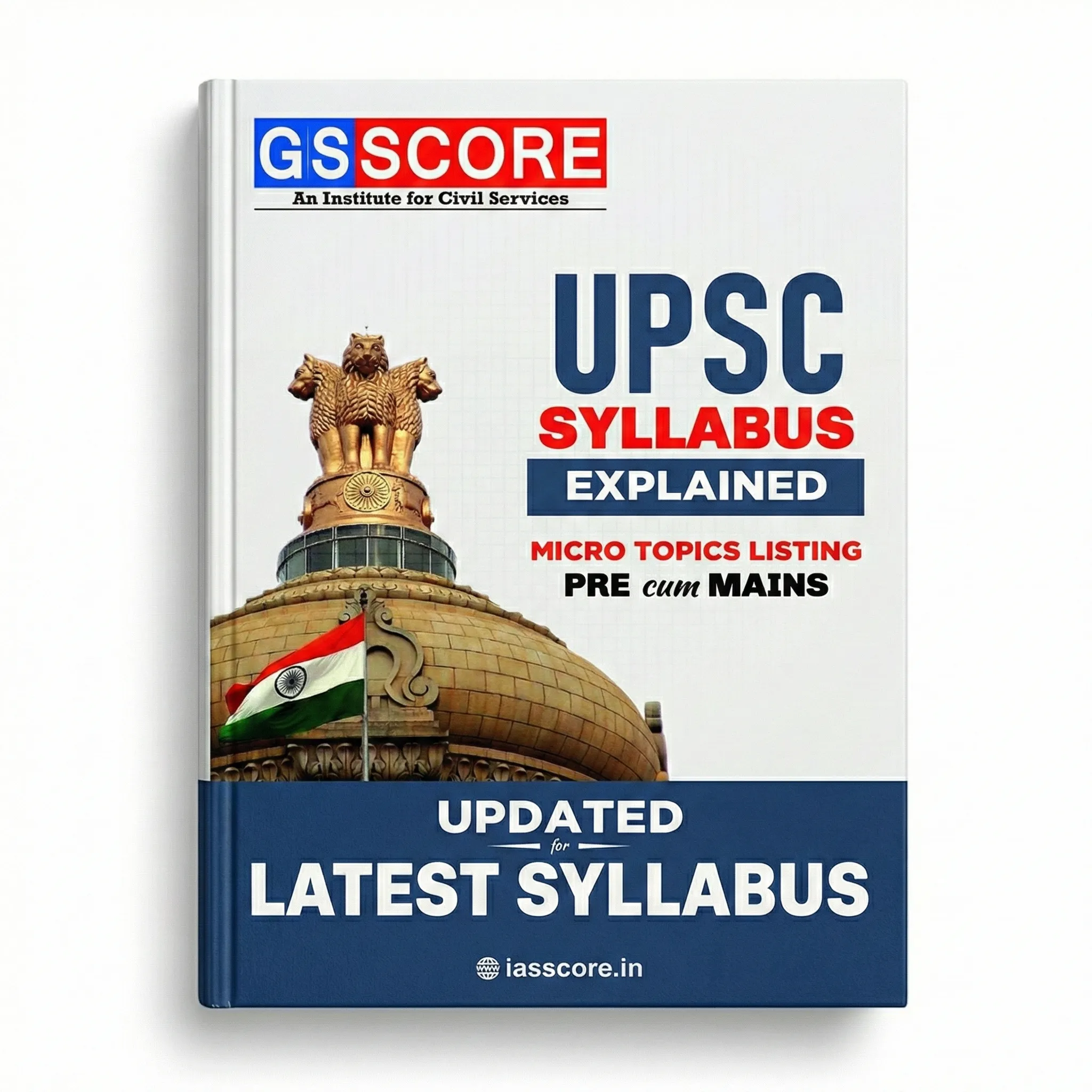
| Syllabus reference | Latest syllabus booklet | GS Score Latest Syllabus Booklet |
| Current Affairs (Prelims + Mains) | Monthly magazine | Vision IAS Current Affairs Magazine |
| TN History, Culture & Society | Tamil Nadu State Board textbooks (Classes 6–12) | Samacheer Kalvi books + TN-specific guides |
For the national units — Polity, Economy, History, Geography, Science and Environment — UPSC GS material is well-structured and directly usable. The Vajiram Polity Notes and Vision IAS Economics Notes map cleanly to the two highest-count Prelims units. For the Tamil Nadu units, nothing beats the Samacheer Kalvi (State Board) textbooks, which the Commission itself draws from.
Current Affairs Integration & Previous-Year Trends
The static syllabus is only half the exam. TNPSC increasingly frames questions around contemporary events — state welfare schemes, budget announcements, government initiatives, science developments and environmental issues — attached to static concepts. This is why the Economy and TN Development unit, the highest-count unit, must be studied alongside a monthly current affairs source rather than in isolation.
Previous-year-paper analysis shows a consistent pattern: Polity and the two Tamil Nadu units are the most frequently and reliably tested, General Science leans towards application and daily-life concepts, and Aptitude repeats topic types year after year. Building a current-affairs habit with a resource like the Vision IAS Current Affairs Magazine keeps both your Prelims factual recall and your Mains answer examples fresh.
| Syllabus Area | PYQ Frequency | Nature of Questions |
|---|---|---|
| Indian Polity | Very High | Conceptual + current constitutional developments |
| TN Economy & Development | Very High | Schemes, welfare, budget-linked current affairs |
| TN History & Socio-Political Movements | High | Dravidian movement, reformers, culture |
| Indian History | Moderate–High | National movement, TN’s role |
| General Science | Moderate | Application, daily life, health |
| Aptitude | Stable | Repetitive topic types, scoring |
Preparation Strategy & Study Plan
A structured timeline turns the syllabus into a plan. The sequence below front-loads the high-weightage units and keeps Mains answer-writing and current affairs running in parallel.
| Phase | Duration | Focus |
|---|---|---|
| Foundation | Months 1–3 | NCERT/Samacheer basics, Polity, Indian & TN History |
| Core Building | Months 4–6 | Economy + TN Development, Geography, Science; start Mains answer-writing |
| Integration | Months 7–8 | Current affairs consolidation, Aptitude practice, revision of TN units |
| Prelims Sprint | Months 9–10 | Full-length mock tests, PYQ solving, weak-area revision |
| Mains Focus | Post-Prelims | Descriptive practice, Tamil paper prep, model answers, current-affairs notes |
Downloadable Unit-Wise Checklist
- Finish State Board (Samacheer Kalvi) books for Classes 6–12 — the backbone of TN units.
- Master Polity and Economy first — together they are the two highest-count Prelims units.
- Maintain a running current-affairs note tied to each static unit.
- Solve at least 5 years of previous papers and attempt full-length mocks weekly in the sprint phase.
- Begin Mains answer-writing early — descriptive skill cannot be built in the final month.
- Do not neglect the Tamil Eligibility Paper; it is qualifying but a fail here ends your candidature.
Common Mistakes to Avoid
- Over-studying low-count units (General Science, Geography) while under-preparing the 50-mark Economy unit.
- Ignoring Tamil Nadu-specific content assuming national GS is enough — TN units are ~45% of Prelims.
- Delaying Mains answer-writing until after Prelims results.
- Skipping current affairs and relying only on static notes.
Where to Download the Official TNPSC Group 1 Syllabus PDF
The authoritative tnpsc group 1 syllabus pdf — in both Tamil and English — is published by the Commission on its official website, tnpsc.gov.in, under the notification and syllabus section for the Combined Civil Services Examination-I. Always download the syllabus attached to the latest official notification, since the Commission updates unit descriptions from cycle to cycle. Use the unit-wise tables on this page as your working reference, and confirm every unit against the official PDF before you build your final timetable. For a broader, UPSC-style syllabus reference you can also keep the GS Score Latest Syllabus Booklet handy, as the national GS units overlap closely.
Frequently Asked Questions
What is the syllabus for TNPSC Group 1?
The TNPSC Group 1 syllabus spans General Science, Geography, Indian History & National Movement, Indian Polity, Indian Economy & Development Administration in Tamil Nadu, Tamil Nadu History/Culture/Socio-Political Movements, and Aptitude & Mental Ability for Prelims. Mains covers the same GS areas in descriptive depth plus ethics, Tamil society and current affairs, along with a qualifying Tamil language paper.
Is there negative marking in TNPSC Group 1 Prelims?
No, there is no negative marking in the TNPSC Group 1 Prelims. Since wrong answers carry no penalty, you should attempt all 200 questions to maximise your score.
How many papers are there in TNPSC Group 1 Mains?
There are four papers in TNPSC Group 1 Mains: a qualifying Tamil Eligibility paper (Paper I, 100 marks) and three General Studies papers (Papers II, III and IV) of 250 marks each. Only the three GS papers — 750 marks — count towards the merit list.
Are Tamil language (Paper I) marks counted in the final merit?
No. The Tamil Eligibility Test (Paper I, 100 marks) is only qualifying — you must secure the minimum pass mark (40%), but these marks are not added to the final merit. The merit list is based on the three GS Mains papers (750) plus the Interview (100).
How many total marks is the TNPSC Group 1 exam?
The Prelims is 300 marks (screening, not counted). The Mains has three GS papers of 250 each (750 counted) plus a qualifying Tamil paper, and the Interview is 100 marks. The final merit is calculated out of 850 marks (Mains 750 + Interview 100).
Is there any optional subject in TNPSC Group 1 Mains?
No. TNPSC Group 1 Mains has no optional subject. Every candidate writes the same four papers — one qualifying Tamil paper and three General Studies papers — so a strong, uniform GS foundation is what decides the outcome.
What is the exam pattern for TNPSC Group 1 2026?
TNPSC Group 1 2026 has three stages: a single objective Prelims paper of 200 questions/300 marks in 3 hours with no negative marking; a Main written exam of four descriptive papers (Tamil qualifying + three GS papers of 250 each) of 3 hours each; and a 100-mark Interview. The final ranking is based on Mains (750) and Interview (100).
How is TNPSC Group 1 different from UPSC Civil Services?
TNPSC Group 1 is a Tamil Nadu state civil services exam with one Prelims paper, no optional subject, and heavy state-specific content (TN history, culture, the Dravidian movement, state economy and administration). UPSC is national, adds a CSAT paper, an essay and a 500-mark optional. The national GS portions overlap, so UPSC GS material covers much of the national units while Samacheer Kalvi and TN-specific sources handle the state units.
What is the eligibility and age limit for TNPSC Group 1 2026?
You need a bachelor’s degree in any discipline and must be at least 21 years old. The upper age limit varies by post and category, with relaxations for reserved categories as specified in the notification, so confirm the exact age criteria for your category in the official advertisement before applying.
Is a TNPSC Group 1 syllabus PDF available in Tamil?
Yes. The Commission publishes the TNPSC Group 1 syllabus PDF in both Tamil and English on tnpsc.gov.in, attached to the Combined Civil Services Examination-I notification. Download the version linked to the latest notification, as the Commission periodically revises unit descriptions.
Recommended Study Material


Competer
The Competer team: we pack the orders, so we know which editions aspirants keep coming back for.
Get it printed
State PCS study material aspirants order most on Competer, delivered across India
 Drishti BPSC Books 2025-2026 | Bihar Civil Services Exam | Hindi Medium Set of 24₹4,899View on Competer →
 Drishti UPPCS Notes 2025-26 | GS UPPSC Hindi Medium | 30 Printed Booklets₹6,199View on Competer →
 UPPCS ONE General Studies Notes 2026 | UPPSC Prelims and Mains | English Medium | 11 Booklets₹999View on Competer →Drishti UPPSC Books 2025-26 | GS UPPCS Hindi Medium Booklets Set of 30₹6,199View on Competer →
Continue reading
More in Buying Guides
Need help choosing?
Tell us your exam and stage on WhatsApp, we suggest the right set.