

SSC Stenographer Syllabus 2026: Grade C & D Pattern
Complete SSC Stenographer syllabus 2026 for Grade C & D: CBT exam pattern, section-wise topics, weightage, skill test WPM rules.
 Competer
The ssc stenographer syllabus is built around a two-stage selection process: a 200-mark Computer Based Test (CBT) covering General Intelligence & Reasoning (50 marks), General Awareness (50 marks) and English Language & Comprehension (100 marks), followed by a qualifying stenography Skill Test at 100 WPM for Grade C and 80 WPM for Grade D. The CBT lasts 2 hours (200 questions, 1 mark each) with 0.25 negative marking, and final selection is decided by CBT marks since the skill test is only qualifying.
This guide gives you the complete, up-to-date ssc stenographer syllabus 2026 — subject-wise topics, a previous-year weightage table, a clear Grade C vs Grade D comparison, eligibility and qualifying marks, skill-test dictation and transcription rules, a study timetable, recommended books, a free PDF download, and answers to the most-searched questions. Whether you prepare in English or Hindi medium, everything you need to plan your preparation is below.
SSC Stenographer 2026: Exam Overview
The Staff Selection Commission (SSC) conducts the Stenographer Grade C and Grade D examination every year to recruit stenographers for various Ministries, Departments and Offices of the Government of India. Grade C stenographers are posted mainly at the Central Secretariat and attached offices, while Grade D stenographers serve in subordinate offices. The recruitment is conducted online (CBT) at the all-India level, and the notification for the next cycle is expected under the SSC Stenographer 2026 calendar.
| Particular | Detail |
|---|---|
| Conducting body | Staff Selection Commission (SSC) |
| Exam name | SSC Stenographer Grade C & Grade D |
| Posts | Stenographer Grade C (Group B, non-gazetted) & Grade D (Group C) |
| Exam level | National |
| Selection stages | Stage 1: CBT • Stage 2: Skill Test (qualifying) • Document Verification |
| Mode of CBT | Online (Computer Based Test) |
| CBT questions/marks | 200 questions / 200 marks |
| Duration | 2 hours (120 minutes) |
| Negative marking | 0.25 mark per wrong answer |
| Skill test | Shorthand dictation & transcription (qualifying) |
| Official website | ssc.gov.in |
SSC Stenographer Eligibility 2026 (Quick Reference)
Before you map the syllabus, confirm you meet the eligibility criteria — they decide whether you can sit the CBT at all. The figures below reflect recent SSC notifications; always verify the exact numbers in the official notification for your cycle.
| Criterion | Requirement |
|---|---|
| Nationality | Indian citizen (or as specified in the notification) |
| Educational qualification | 12th pass (10+2) from a recognised board or university |
| Age limit – Grade C | 18–30 years (typical) |
| Age limit – Grade D | 18–27 years (typical) |
| Age relaxation | OBC +3 years, SC/ST +5 years, PwBD +10 years, plus other category relaxations |
| Application fee | Around ₹100; women, SC, ST, PwBD and eligible ex-servicemen are typically exempt |
Note that shorthand knowledge is not required to apply — it is tested only at the skill-test stage — but you should begin shorthand practice early because building speed takes months.
SSC Stenographer Selection Process 2026
The selection process has three clear steps, and understanding them is the first step to reading the ssc stenographer syllabus correctly:
- Stage 1 — Computer Based Test (CBT): A single objective paper of 200 marks. This is the only stage where your marks count towards the final merit list.
- Stage 2 — Skill Test (Stenography): Candidates who clear the CBT cut-off are called for a shorthand dictation and transcription test. It is purely qualifying — you must pass, but the marks are not added to the merit list.
- Document Verification (DV): Final-stage verification of eligibility, category, age and educational certificates before appointment.
Because merit is decided entirely by the CBT, your written-test score is where the competition is won or lost — while the skill test simply must be cleared within the permitted error limit.
SSC Stenographer Exam Pattern 2026 (CBT)
The ssc stenographer exam pattern for the CBT is identical for Grade C and Grade D. It is a single online paper with three sections and a combined 2-hour time limit — there is no sectional timing, so you can move between sections freely.
| Section | No. of Questions | Maximum Marks |
|---|---|---|
| General Intelligence & Reasoning | 50 | 50 |
| General Awareness | 50 | 50 |
| English Language & Comprehension | 100 | 100 |
| Total | 200 | 200 |
Key rules to remember about the pattern and marking scheme:
- Each question carries 1 mark; there are 200 questions for 200 marks.
- Negative marking of 0.25 mark applies for every wrong answer, so blind guessing is penalised.
- Total time is 120 minutes (160 minutes for candidates eligible for a scribe).
- Questions are set in both English and Hindi except the English Language section.
- The English section alone carries 100 of 200 marks (50% weightage) — making it the single most important section for the CBT.
SSC Stenographer Qualifying Marks & Score Normalisation
Two details that most syllabus pages skip can decide whether you reach the skill test at all. First, SSC sets minimum qualifying marks in the CBT by category — indicatively around 30% for UR, 25% for OBC/EWS and 20% for other categories. You must cross this bar even before the cut-off is applied. Second, because the CBT is conducted in multiple shifts, SSC normalises raw scores across shifts to adjust for differences in difficulty, and the normalised score — not the raw score — is used for the merit list. Practising a large, varied question bank helps because it prepares you for whichever shift difficulty you draw.
SSC Stenographer Syllabus 2026: Section-Wise Topics
The detailed ssc stenographer grade c syllabus and ssc stenographer grade d syllabus are the same for the CBT — the difference between the two grades appears only in the skill-test speed. Below is the complete subject-wise topic list.
General Intelligence & Reasoning (50 Marks)
This section tests both verbal and non-verbal reasoning through analogies, similarities and differences, and problem-solving. Expected topics include:
| Reasoning Topic | What It Covers |
|---|---|
| Analogies | Semantic, symbolic, number & figural analogy |
| Classification (Odd one out) | Semantic, symbolic and figural classification |
| Series | Number series, figural series, semantic series |
| Coding-Decoding | Letter/number/symbol coding, coded operations |
| Blood Relations | Family-tree and relationship puzzles |
| Direction & Distance | Sense of direction, displacement problems |
| Ranking & Seating Arrangement | Linear/circular arrangement, order & ranking |
| Syllogism & Statements | Logical statements, conclusions, assumptions |
| Non-Verbal Reasoning | Embedded figures, paper folding/cutting, mirror & water images, figure completion |
| Miscellaneous | Venn diagrams, word building, numerical operations, space visualisation, critical thinking |
General Awareness (50 Marks)
General Awareness tests the candidate’s knowledge of the environment around them and its application to society, along with current events. The core topic areas are:
| GA Topic | Key Areas |
|---|---|
| Current Affairs | National & international events, awards, sports, appointments, schemes (last 6–12 months) |
| Static GK | Books & authors, important days, capitals & currencies |
| Indian Polity | Constitution, Parliament, fundamental rights, governance |
| History | Ancient, medieval & modern India; freedom struggle |
| Geography | Indian & world geography, rivers, physical features |
| Economy | Basic economics, budget, banking, economic terms |
| General Science | Physics, Chemistry, Biology fundamentals |
| Culture | Art, culture, festivals, scientific research |
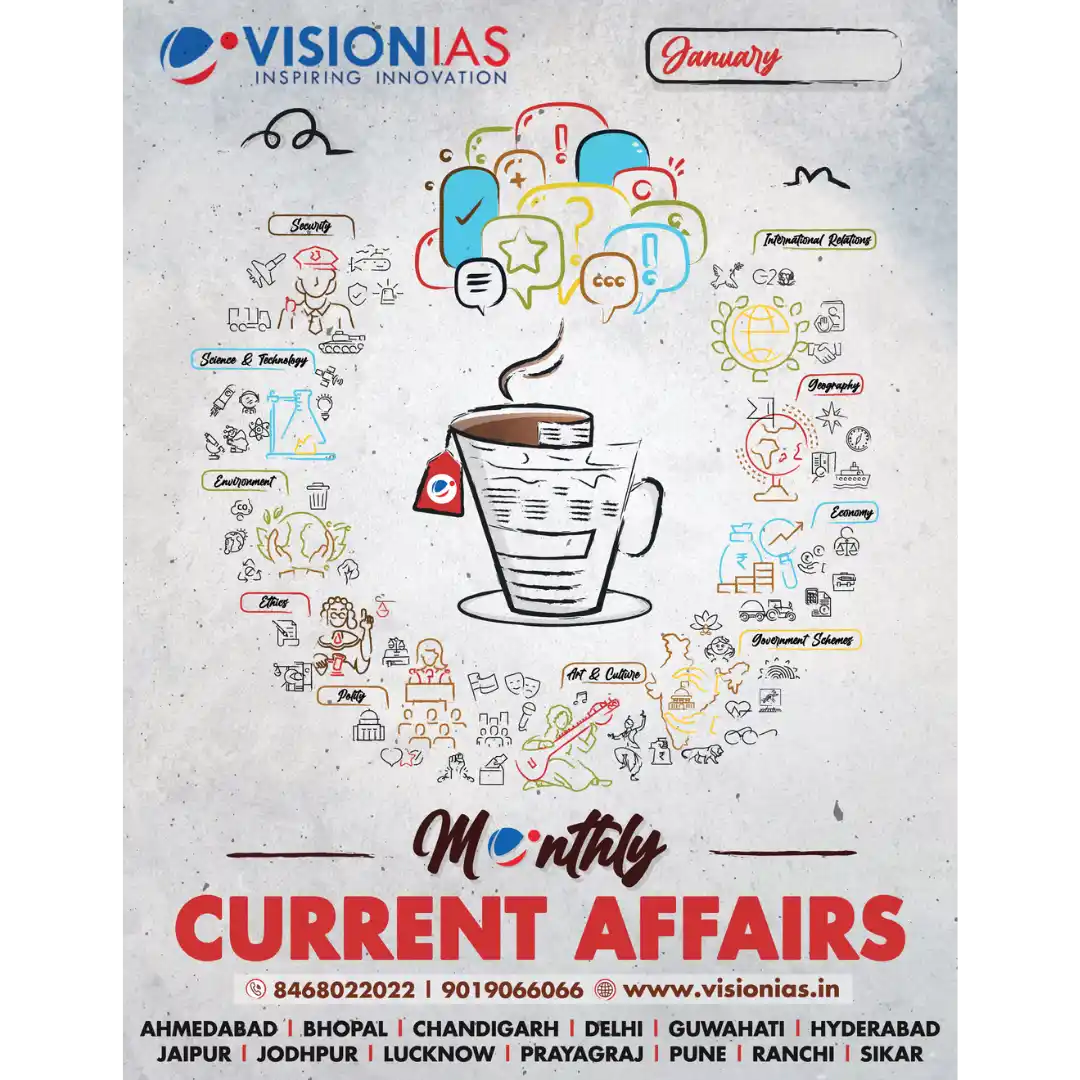
Because current affairs and static GK move fast, a reliable monthly current-affairs resource keeps this section under control. English-medium aspirants can use the Vision IAS Current Affairs Magazine (January 2026, English), while Hindi-medium candidates can pick the Hindi-medium edition to cover the same events in their preferred language.
English Language & Comprehension (100 Marks)
This is the highest-weightage section, testing grammar, vocabulary and comprehension. Because it carries half of the total CBT marks, it deserves the largest share of your preparation time. Topics include:
| English Topic | Sub-Topics |
|---|---|
| Grammar & Error Spotting | Spot the error, sentence correction, common errors |
| Vocabulary | Synonyms & antonyms, one-word substitution, idioms & phrases, spelling |
| Fill in the Blanks | Single/double blanks, cloze test |
| Sentence Structure | Sentence rearrangement, sentence improvement, active/passive voice, direct/indirect speech |
| Comprehension | Reading comprehension passages, para jumbles |
| Usage | Fill-in-the-blank prepositions, articles, conjunctions |
SSC Stenographer Topic-Wise Weightage (PYQ Trend Analysis)
Most syllabus pages give you a flat topic list but never tell you where to focus. Based on previous-year-paper trends, the table below shows the approximate number of questions per topic so you can prioritise high-yield areas. (Figures are indicative averages from recent SSC Stenographer papers and may vary slightly year to year.)
| Section / Topic | Expected Questions | Priority |
|---|---|---|
| Reasoning – Analogy, Classification, Series | 15–18 | High |
| Reasoning – Coding-Decoding, Direction, Blood Relation | 10–12 | High |
| Reasoning – Non-verbal (figures, images) | 8–10 | Medium |
| Reasoning – Miscellaneous (Venn, matrix) | 8–10 | Medium |
| GA – Current Affairs | 12–15 | High |
| GA – Static GK & General Science | 15–18 | High |
| GA – Polity, History, Geography, Economy | 15–20 | High |
| English – Vocabulary (synonyms, antonyms, idioms) | 25–30 | Very High |
| English – Grammar & Error Spotting | 25–30 | Very High |
| English – Comprehension & Cloze Test | 20–25 | High |
| English – Sentence Rearrangement/Improvement | 15–20 | High |
Which subjects have the highest weightage in SSC Stenographer? English Language & Comprehension dominates with 100 marks (50%), so vocabulary and grammar are the highest-return topics. Within the 50-mark sections, static GK/general science and current affairs in General Awareness, and analogy/series/coding in Reasoning, deliver the most questions per hour of study.
SSC Stenographer Grade C vs Grade D: Side-by-Side Comparison
The single biggest confusion among aspirants is the difference between the two grades. The CBT and its syllabus are identical; the real difference is in the posts, dictation speed and transcription time. Here is a clear comparison.
| Parameter | Grade C | Grade D |
|---|---|---|
| Post level | Group B (non-gazetted), Central Secretariat & attached offices | Group C, subordinate offices |
| Educational qualification | 12th pass (10+2) from a recognised board | 12th pass (10+2) from a recognised board |
| Age limit (typical) | 18–30 years (with category relaxations) | 18–27 years (with category relaxations) |
| Dictation speed (skill test) | 100 WPM | 80 WPM |
| Dictation duration | 10 minutes | 10 minutes |
| Transcription time (English) | 40 minutes (computer) | 50 minutes (computer) |
| Transcription time (Hindi) | 55 minutes (computer) | 65 minutes (computer) |
| Pay level | Pay Level 6 (higher) | Pay Level 4 |
In short: aim for the same CBT preparation, but if you target Grade C you must build higher shorthand speed (100 WPM) and clear transcription in a tighter window than Grade D (80 WPM).
SSC Stenographer Skill Test Syllabus 2026 (Dictation & Transcription)
The ssc stenographer skill test syllabus is not a subject list — it is a practical stenography assessment. Candidates are given a passage dictated at the prescribed speed, which they take down in shorthand and then transcribe on a computer within the allotted time.
| Skill Test Detail | Grade C | Grade D |
|---|---|---|
| Dictation speed | 100 words per minute | 80 words per minute |
| Dictation time | 10 minutes | 10 minutes |
| Total words dictated (approx.) | ~1000 words | ~800 words |
| Transcription (English) | 40 minutes | 50 minutes |
| Transcription (Hindi) | 55 minutes | 65 minutes |
| Scribe transcription (English) | 55 minutes | 70 minutes |
| Scribe transcription (Hindi) | 75 minutes | 90 minutes |
| Nature | Qualifying only | Qualifying only |
Skill Test Dictation Topics
The dictation passage is usually drawn from matters of national interest and formal government language, so practising with these sources mirrors the real test:
- President’s address / speeches to Parliament
- Newspaper editorials on national issues
- Union Budget and Railway Budget speeches
- Government reports, schemes and policy statements
- Subjects of national and international importance
Permissible Errors
The skill test is qualifying, but you must stay within the permissible mistake limit set by SSC (a percentage of total words), with lower error tolerance for reserved posts. Both accuracy and speed matter — a fast but error-heavy transcript can still fail.
Shorthand & Typing: How to Build Skill-Test Speed and Accuracy
Most syllabus pages only state the WPM rule and stop there. Here is practical guidance the top pages miss — how to actually build stenography speed and avoid common transcription mistakes:
- Master your shorthand system first: Whether Pitman or another system, perfect the outlines and phrasing before chasing speed. Weak outlines break down under dictation pressure.
- Increase speed in steps: Move up 5–10 WPM at a time (e.g., 60→70→80→90→100), holding each level until you can take dictation cleanly for 10 minutes.
- Daily dictation practice: Take at least one 10-minute dictation every day from editorials and budget/policy speeches to match the real dictation register.
- Build transcription typing speed: You must transcribe on a computer within a tight window — practise typing your own shorthand notes so reading-back is fast and error-free.
- Avoid common transcription mistakes: Misreading similar outlines, dropping punctuation, wrong homophones (their/there), and skipping words when you fall behind. Leave a gap and continue rather than freezing.
- Simulate exam conditions: Practise full-length mock skill tests with a timer to build stamina for the 10-minute dictation plus transcription.
SSC Stenographer Study Plan & Timetable
A realistic plan maps the syllabus to a timeline. Here is a sample 3-month CBT study schedule (adjust to your own pace) that many aspirants find workable alongside shorthand practice.
| Phase | Duration | Focus |
|---|---|---|
| Month 1 – Foundation | Weeks 1–4 | English grammar & vocabulary basics; Reasoning core topics (analogy, series, coding); NCERT-level GA; start daily shorthand at 60–70 WPM |
| Month 2 – Building | Weeks 5–8 | Advanced English (comprehension, rearrangement); Reasoning non-verbal & puzzles; Static GK + current affairs; push shorthand to 80–90 WPM |
| Month 3 – Revision & Tests | Weeks 9–12 | Full-length CBT mocks, PYQ practice, weak-area revision; 100 WPM dictation practice; timed transcription drills |
Daily template: 2 hours English, 1.5 hours Reasoning + GA (alternate), 1 hour current affairs revision, and 1 hour dedicated shorthand/typing practice. Increase mock-test frequency in the final month.
Best Books for SSC Stenographer 2026
Pair the right books with regular test practice. Here is a subject-wise booklist that covers the full CBT syllabus.
| Subject | Recommended Resource |
|---|---|
| English | Objective General English (S.P. Bakshi); Word Power Made Easy (Norman Lewis) for vocabulary |
| Reasoning | A Modern Approach to Verbal & Non-Verbal Reasoning (R.S. Aggarwal) |
| General Awareness | Lucent’s General Knowledge + a monthly current-affairs magazine |
| Current Affairs | Monthly current-affairs compilation (last 6–12 months) |
| Shorthand | Pitman Shorthand Instructor and Key; regular dictation books |
| Practice | SSC Stenographer previous-year papers + mock test series |
Previous-year practice is one of the highest-return activities for any SSC exam. Aspirants building a strong PYQ habit often use topic-wise question banks like the Forum IAS Topic-Wise PYQ Toolkit to understand how objective questions are framed and to sharpen accuracy under negative marking. For the General Awareness section, keeping a printed current-affairs magazine on hand — such as the Vision IAS Current Affairs Magazine — makes month-on-month revision far easier.
Section-Wise Smart Preparation Strategy
English (100 marks) — your scoring engine
Since English is half the paper, target it first. Build a daily vocabulary habit (10–15 new words), master high-frequency grammar rules (subject-verb agreement, tenses, prepositions), and solve one reading comprehension passage daily. Error-spotting and sentence-improvement questions are formula-driven — learn the rules once and they repeat.
General Awareness (50 marks) — high speed, low time
GA questions are answered in seconds with no calculation, so a strong GA score buys time for reasoning and comprehension. Focus on static GK, general science and last-year current affairs. Revise a monthly magazine repeatedly rather than reading many sources once.
Reasoning (50 marks) — accuracy over guesswork
Reasoning is scoring if practised. Prioritise analogy, classification, series and coding-decoding (the highest-frequency topics), then move to non-verbal and puzzles. Because of 0.25 negative marking, avoid wild guesses on ambiguous puzzle questions.
Common Mistakes to Avoid
- Ignoring the skill test until the CBT is over — start shorthand practice from day one; speed takes months to build.
- Under-weighting English — it is 50% of the paper; neglecting it caps your score.
- Reckless guessing — 0.25 negative marking can erase your hard-earned marks.
- Reading many GA sources shallowly — revise one reliable source multiple times instead.
- Skipping full-length mocks — timed practice builds the stamina needed for a 200-question, 2-hour paper.
Where to Download the Official SSC Stenographer Syllabus PDF 2026
You can download a clean, current ssc stenographer syllabus pdf covering the CBT pattern, section-wise topics, weightage table and skill-test rules for both Grade C and Grade D. Save it for offline revision and to plan your study timetable. Always cross-check topic details with the official SSC notification for your recruitment cycle on ssc.gov.in, as the Commission may revise the pattern or vacancy details year to year.
Bilingual Note for Hindi-Medium Aspirants
The SSC Stenographer CBT is bilingual — General Intelligence & Reasoning and General Awareness questions appear in both Hindi and English, so Hindi-medium candidates are not at a disadvantage in these sections. Only the English Language & Comprehension section is in English. Hindi-medium aspirants can also opt for the Hindi transcription in the skill test (with a slightly longer transcription window). For current affairs and GA in Hindi, resources like the Vision IAS Current Affairs Magazine (Hindi Medium) keep preparation accessible in your own language.
Frequently Asked Questions
What is the syllabus of SSC Stenographer?
The SSC Stenographer syllabus covers three CBT sections — General Intelligence & Reasoning (50 marks), General Awareness (50 marks) and English Language & Comprehension (100 marks) — for 200 marks total, followed by a qualifying stenography skill test that assesses shorthand dictation and computer transcription.
What is the exam pattern for SSC Stenographer 2026?
The SSC Stenographer 2026 CBT has 200 objective questions worth 200 marks across three sections, completed in 2 hours (120 minutes). Each question carries 1 mark with 0.25 negative marking for wrong answers. English carries the highest weightage at 100 marks.
How many questions are asked in the SSC Stenographer CBT?
The SSC Stenographer CBT has 200 questions in total — 50 from General Intelligence & Reasoning, 50 from General Awareness and 100 from English Language & Comprehension. Each question carries 1 mark, so the paper is worth 200 marks and must be completed within 2 hours.
Is there negative marking in the SSC Stenographer exam?
Yes. The SSC Stenographer CBT has a negative marking of 0.25 mark for every incorrect answer. There is no penalty for unattempted questions, so avoid blind guessing on questions you are unsure about.
What is the difference between SSC Stenographer Grade C and Grade D?
The CBT syllabus is identical for both. The difference is in the skill test and posts: Grade C requires 100 WPM dictation and offers higher Group B posts, while Grade D requires 80 WPM dictation for Group C posts, with Grade D also allowing slightly longer transcription time.
What is the WPM speed required for SSC Stenographer skill test?
The dictation speed is 100 words per minute for Grade C and 80 words per minute for Grade D, dictated for 10 minutes. Candidates then transcribe the passage on a computer within the prescribed time (40 minutes for Grade C English, 50 minutes for Grade D English).
Is the SSC Stenographer skill test qualifying in nature?
Yes. The stenography skill test is only qualifying — you must clear it within the permissible error limit, but its marks are not added to the final merit list. Final selection is based entirely on your CBT score, subject to clearing the skill test and document verification.
Which subjects have the highest weightage in SSC Stenographer?
English Language & Comprehension has the highest weightage at 100 marks — 50% of the CBT — so vocabulary, grammar and comprehension give the best return on study time. General Awareness and General Intelligence & Reasoning carry 50 marks each, where static GK, current affairs, and analogy/series/coding are the highest-yield topics.
Recommended Study Material


Competer
The Competer team: we pack the orders, so we know which editions aspirants keep coming back for.
Get it printed
SSC study material aspirants order most on Competer, delivered across India
 Parmar SSC GK Polity 4.0 Batch Notes 2026-27 | English Medium Edition₹545View on Competer →
 Parmar SSC GK Geography 4.0 Batch Notes 2026-27 | English Medium Edition₹745View on Competer →
 Parmar SSC GK History 4.0 Batch Notes 2026-27 | English Medium Edition₹745View on Competer →
 Parmar SSC GK Polity in Hindi - 4.0 Batch Notes 2026-27₹545View on Competer →
Continue reading
More in Buying Guides



Need help choosing?
Tell us your exam and stage on WhatsApp, we suggest the right set.