

SSC Selection Post Syllabus 2026: Level-Wise Topics, Pattern
Complete SSC Selection Post syllabus 2026 with level-wise topics for Matric, 12th & graduation, Phase 14 exam pattern, negative marking, weightage, skill test.
 Competer

The SSC Selection Post syllabus covers four sections — General Intelligence & Reasoning, General Awareness, Quantitative Aptitude and English Language — with 25 questions (50 marks) each, for a total of 100 questions and 200 marks in a 60-minute Computer Based Examination (CBE). The core topics stay identical across the Matriculation (10th), Higher Secondary (12th) and Graduation & above levels; only the difficulty of the questions rises with each level, while the Quantitative Aptitude part stays anchored to the 10th standard. There is negative marking of 0.50 marks for every wrong answer, and selection is based on the CBE followed by a skill/typing test (where applicable) and document verification.
This guide gives you the complete, level-wise SSC Selection Post syllabus, the latest SSC Selection Post exam pattern including the new sectional-timing update, a PYQ-based high-weightage topic table, the skill-test details most sites skip, a ready-to-use study plan, cut-off and normalisation explained, and a step-by-step SSC Selection Post syllabus PDF download guide. If you are planning for the SSC Selection Post Phase 14 syllabus 2026, read this end to end and build your timetable around it.
Last reviewed: October 2026. All figures below reflect the latest Selection Post scheme of examination. The official SSC Phase 14 notification on ssc.gov.in is the single authoritative source for the exam pattern, post-wise eligibility and syllabus — always cross-check it before finalising your preparation.
Key takeaways (read this first)
- Pattern: 100 questions, 200 marks, 4 sections of 25 questions each, 60 minutes.
- Marking: +2 per correct answer, −0.50 per wrong answer; no penalty for unattempted questions.
- Levels: same topics for Matric, 12th and Graduation — only difficulty changes; Quant stays at 10th-standard level for all.
- No interview: selection is CBE → qualifying skill/typing test (only for posts that need it) → document verification.
- Watch for sectional timing: many SSC CBEs now lock each section to ~15 minutes — confirm the rule in your Phase 14 notice.
SSC Selection Post 2026: Exam Overview & Highlights
The Staff Selection Commission (SSC) conducts the Selection Post examination to recruit candidates for a large number of Group B and Group C posts across various Ministries, Departments and Offices of the Government of India. Unlike SSC CGL or CHSL, Selection Post is a category-based recruitment where vacancies are released together but filled against specific posts, each with its own eligibility level — Matriculation, Higher Secondary or Graduation. Phase 14 is the 2026 cycle of this recruitment, conducted online as a single-tier CBE.
| Particular | Details |
|---|---|
| Conducting Body | Staff Selection Commission (SSC) |
| Examination | Selection Post Phase 14 (2026) |
| Levels | Matriculation (10th), Higher Secondary (12th), Graduation & above |
| Mode | Computer Based Examination (CBE / CBT), online |
| Total Questions | 100 |
| Total Marks | 200 |
| Duration | 60 minutes (80 minutes for scribe-eligible candidates) |
| Negative Marking | 0.50 mark per wrong answer |
| Sections | 4 (Reasoning, General Awareness, Quantitative Aptitude, English) |
| Selection Stages | CBE → Skill/Typing/DEST test (if required) → Document Verification |
| Language of Paper | English & Hindi (except English section) |
Because vacancies run into the hundreds across multiple departments and education levels, Selection Post is one of the highest-volume SSC exams — which makes understanding the exact syllabus and weightage the single biggest time-saver in your preparation.

SSC Selection Post Exam Pattern 2026
The SSC Selection Post exam pattern is uniform across all three levels. The paper has four sections of 25 questions and 50 marks each. Every question carries 2 marks, and 0.50 mark is deducted for each incorrect response — so blind guessing hurts your score.
| Section | Questions | Marks | Negative Marking |
|---|---|---|---|
| General Intelligence & Reasoning | 25 | 50 | 0.50 |
| General Awareness | 25 | 50 | 0.50 |
| Quantitative Aptitude | 25 | 50 | 0.50 |
| English Language | 25 | 50 | 0.50 |
| Total | 100 | 200 | — |
What is the exam pattern for SSC Selection Post Phase 14?
For Phase 14, the pattern stays at 100 questions / 200 marks in 60 minutes. The important recent change aspirants must note is sectional timing: SSC has moved several CBEs to a 15-minute-per-section format, where each of the four sections is allotted roughly 15 minutes and you cannot jump back once a section closes. Always confirm the exact timing rule in your official Phase 14 notice, because it changes how you distribute speed across sections. If a 15-minute sectional lock is in force, you lose the ability to “park” tough questions for the end — so accuracy per section becomes critical.
Is there negative marking in SSC Selection Post?
Yes. There is a deduction of 0.50 marks for every wrong answer. Unattempted questions are not penalised. With 2 marks per correct answer and 0.5 deducted per wrong one, your attempt strategy should target high accuracy — aim to keep accuracy above roughly 85% so the net loss from wrong answers stays negligible.
Scribe & extra time
Candidates eligible for a scribe (PwBD candidates, as per SSC rules) are given compensatory time of 20 minutes, taking the total to 80 minutes. Scribe eligibility and the associated extra time must be claimed as per the official notification.
SSC Selection Post Syllabus: Level-Wise Split (Matric / 12th / Graduation)
A question we get constantly: is the SSC Selection Post syllabus the same for matric, 12th and graduation levels? In terms of topics, broadly yes — all three levels test the same four subjects and the same chapter list. What changes is the depth and difficulty of the questions. So whether you are looking for the SSC Selection Post matric level syllabus or the graduation level syllabus, the topic list below is the same; the table shows how to practically calibrate your preparation per level.
| Aspect | Matriculation (10th) | Higher Secondary (12th) | Graduation & above |
|---|---|---|---|
| Overall difficulty | Basic / easy | Moderate | Moderate to hard |
| Reasoning | Direct, single-step puzzles | Multi-step, moderate puzzles | Complex arrangements & analytical |
| General Awareness | Static GK + basic current affairs | More static + 8-10 months CA | Analytical GK, deeper current affairs |
| Quantitative Aptitude | 10th-standard maths | 10th-standard maths (slightly tricky) | 10th-standard maths with trickier framing |
| English | Basic grammar & vocabulary | Moderate comprehension | Advanced vocabulary & comprehension |
The crucial insight competitors miss: the Quantitative Aptitude section stays at the Matriculation (10th-standard) level across ALL three levels. SSC does not raise maths to 12th or graduation standard. So even a graduation-level aspirant is tested on 10th-class arithmetic and basic advanced maths — the questions are only framed to be a little more time-consuming. This means your maths effort is reusable no matter which level you are applying for; the real difficulty scaling happens in Reasoning, General Awareness and English.
The next four sections give the full SSC Selection Post subject wise syllabus — one table per subject — so you can tick off topics as you cover them.
Subject-Wise Syllabus: General Intelligence & Reasoning
This section tests both verbal and non-verbal reasoning. It is largely the same across levels, with the graduation level featuring more layered puzzles. Expect a mix of easy direct questions and 2-3 time-consuming puzzles.
| Category | Topics |
|---|---|
| Analogies | Semantic, symbolic, number & figural analogy |
| Classification | Odd one out (words, numbers, figures) |
| Series | Number series, alphabet series, figural series |
| Coding-Decoding | Letter, number & symbol coding |
| Logical Reasoning | Syllogism, statement-conclusion, assumptions |
| Arrangements | Seating (linear/circular), order & ranking |
| Direction & Distance | Direction sense, distance calculation |
| Blood Relations | Family tree, coded relations |
| Non-Verbal | Mirror & water images, paper folding/cutting, embedded & completion of figures |
| Others | Venn diagrams, matrix, missing number, word formation, Maths operations |
Subject-Wise Syllabus: General Awareness
General Awareness is the most scoring and least time-consuming section — you either know the answer or you don’t, so there is no time cost. It combines static GK with current affairs. A frequent gap in other guides is that they never tell you how many months of current affairs to prepare: for Selection Post, cover roughly the last 8–10 months of current affairs before your exam date, with extra focus on the most recent 4–6 months.
| Area | Topics |
|---|---|
| Current Affairs | National & international news, awards, sports, appointments, summits, government schemes (last 8–10 months) |
| History | Ancient, medieval & modern India; freedom struggle |
| Geography | Indian & world physical geography, rivers, mountains, climate |
| Polity | Constitution, Fundamental Rights, Parliament, governance |
| Economy | Basic economics, budget, banking, economic terms |
| General Science | Physics, chemistry, biology (10th level), everyday science |
| Static GK | Books & authors, important days, dances, culture, abbreviations |
To keep your current-affairs net tight, a structured monthly compilation beats scattered news. Monthly magazines like the Vision IAS Current Affairs Magazine (January 2026) and the December 2025 edition give you exam-ready, categorised current affairs that map directly onto this section.
Subject-Wise Syllabus: Quantitative Aptitude
As noted, Quant stays at the 10th-standard level. It splits into Arithmetic and Advanced Maths. For most Selection Post aspirants, mastering Arithmetic alone can secure the bulk of the 50 marks.
| Part | Topics |
|---|---|
| Number System | Whole numbers, decimals, fractions, LCM & HCF, simplification |
| Arithmetic | Percentage, ratio & proportion, average, profit & loss, discount, simple & compound interest, time & work, time-speed-distance, partnership, mixture & alligation |
| Algebra | Basic algebraic identities, linear equations, graphs |
| Geometry | Triangles, circles, congruence & similarity, tangents |
| Mensuration | Area & volume of 2D/3D figures (square, triangle, circle, cylinder, cone, sphere) |
| Trigonometry | Ratios, heights & distances, identities, complementary angles |
| Data Interpretation | Bar graph, pie chart, histogram, frequency table |
Subject-Wise Syllabus: English Language
English difficulty scales most visibly with level — graduation-level papers carry tougher vocabulary and denser comprehension passages. Grammar and vocabulary carry the heaviest weight.
| Category | Topics |
|---|---|
| Grammar | Error spotting, sentence correction, fill in the blanks, tenses, articles, prepositions |
| Vocabulary | Synonyms, antonyms, one-word substitution, idioms & phrases, spelling check |
| Sentence Skills | Sentence rearrangement (para jumbles), sentence improvement, active/passive voice, direct/indirect speech |
| Comprehension | Reading comprehension (passage-based), close test (cloze passage) |
PYQ-Based High-Weightage Topics (Section-Wise Trend)
This is where you win marks fast. Based on previous Selection Post and comparable SSC CBE trends, here is the approximate distribution of questions across high-yield topics. Treat these as indicative ranges from past-paper patterns rather than a fixed blueprint, and prioritise the heavy-weightage rows first.
| Section | High-Weightage Topics | Approx. Questions |
|---|---|---|
| Reasoning | Series, analogy, coding-decoding, classification | 10–13 |
| Reasoning | Puzzles, arrangement, non-verbal | 6–9 |
| General Awareness | Current affairs + static GK (Polity, History, Science) | 15–18 |
| Quantitative Aptitude | Arithmetic (percentage, ratio, SI/CI, time & work, average) | 12–15 |
| Quantitative Aptitude | Geometry, mensuration, trigonometry, DI | 8–11 |
| English | Grammar (error/correction), vocabulary (syn/anto, idioms) | 12–15 |
| English | Comprehension, cloze test, para jumbles | 8–11 |
The takeaway: Arithmetic, grammar-vocabulary and current-affairs-heavy GA together account for a disproportionate share of marks. A candidate who nails just these three clusters is already competitive on cut-off. Practising topic-wise previous year questions is the fastest way to internalise this pattern — a topic-wise PYQ resource such as the Forum IAS Topic-Wise PYQ Toolkit trains you to recognise recurring question frames across reasoning, GA and quant.
SSC Selection Post Selection Process & Skill Test
Is there an interview or skill test in SSC Selection Post? There is no interview. Selection runs through the CBE, followed by a skill/typing test only where the specific post requires it, and then document verification.
| Stage | What Happens |
|---|---|
| 1. Computer Based Examination (CBE) | 100 questions / 200 marks; merit prepared post-normalisation |
| 2. Skill / Typing / DEST Test | Qualifying in nature; only for posts that require it (e.g. DEO, typing posts) |
| 3. Document Verification (DV) | Final verification of eligibility, category & certificates |
Skill test / Typing test / DEST details
Most guides give this one line — here is the detail that matters. The skill test is qualifying only (marks don’t add to merit) but you must clear it to be considered:
- DEST (Data Entry Speed Test): Required for Data Entry Operator / data-entry posts. Typical benchmark is around 8,000 key depressions per hour on the given passage.
- Typing Test: Required for clerical/typing posts — commonly 35 words per minute in English or 30 words per minute in Hindi.
- Posts without skill test: Many Selection Post vacancies have no skill test at all — your CBE score plus DV decides selection.
Always check the post-specific requirement in the notification; the same phase can mix posts that need DEST, posts that need typing, and posts that need neither.
Documents required at verification
- Matriculation (10th) certificate — for date of birth
- Educational qualification certificates (10th / 12th / graduation as per post level)
- Category certificate (SC/ST/OBC/EWS) if applicable
- PwBD certificate if applicable
- Recent passport-size photographs and valid photo ID (Aadhaar/PAN/etc.)
- Printout of online application & admit card
Cut-Off Trend & Normalisation Explained
Selection Post is conducted in multiple shifts across different days, and difficulty varies from shift to shift. To be fair, SSC applies normalisation — your raw score is statistically adjusted relative to your shift’s difficulty, and the merit list is prepared on normalised marks, not raw marks. This is why your raw-score estimate and the final cut-off can differ, and why an “easy” shift does not automatically mean a higher final score.
| Level | Indicative Cut-off Range (UR, normalised) |
|---|---|
| Matriculation (10th) | ~110–130 / 200 |
| Higher Secondary (12th) | ~115–135 / 200 |
| Graduation & above | ~120–145 / 200 |
These ranges are indicative, drawn from past-phase trends, and vary sharply by post, state and category — some high-demand posts close far above these numbers. Treat the upper end as your realistic target so you are safely above the line after normalisation.
SSC Selection Post Study Plan & Resource Mapping
Vague “practice consistently” advice doesn’t help. Here is a concrete, section-mapped plan you can run in 8–10 weeks.
| Phase | Focus | What To Do |
|---|---|---|
| Weeks 1–3 (Foundation) | Quant + Reasoning basics | Finish Arithmetic + high-weight reasoning topics; 20 practice Qs/topic daily |
| Weeks 4–6 (Build GA + English) | GA + English | Daily current affairs, 1 static GK topic/day, 1 grammar + 1 vocab set/day |
| Weeks 7–8 (Application) | Mixed practice | 3–4 full mocks/week + topic-wise PYQs; analyse errors |
| Weeks 9–10 (Revision) | Speed + accuracy | Daily sectional timed tests (15 min/section), revise GA notes & formulae |
Section-wise resource & mock mapping
- General Awareness: One monthly current-affairs magazine + a static GK handbook. Revise the last 8–10 months before exam day.
- Quant & Reasoning: A topic-wise PYQ book + at least 15 timed sectional tests each.
- English: A grammar handbook + daily vocabulary and one RC passage.
- Full mocks: Simulate the 15-min sectional lock so exam-day timing feels natural.
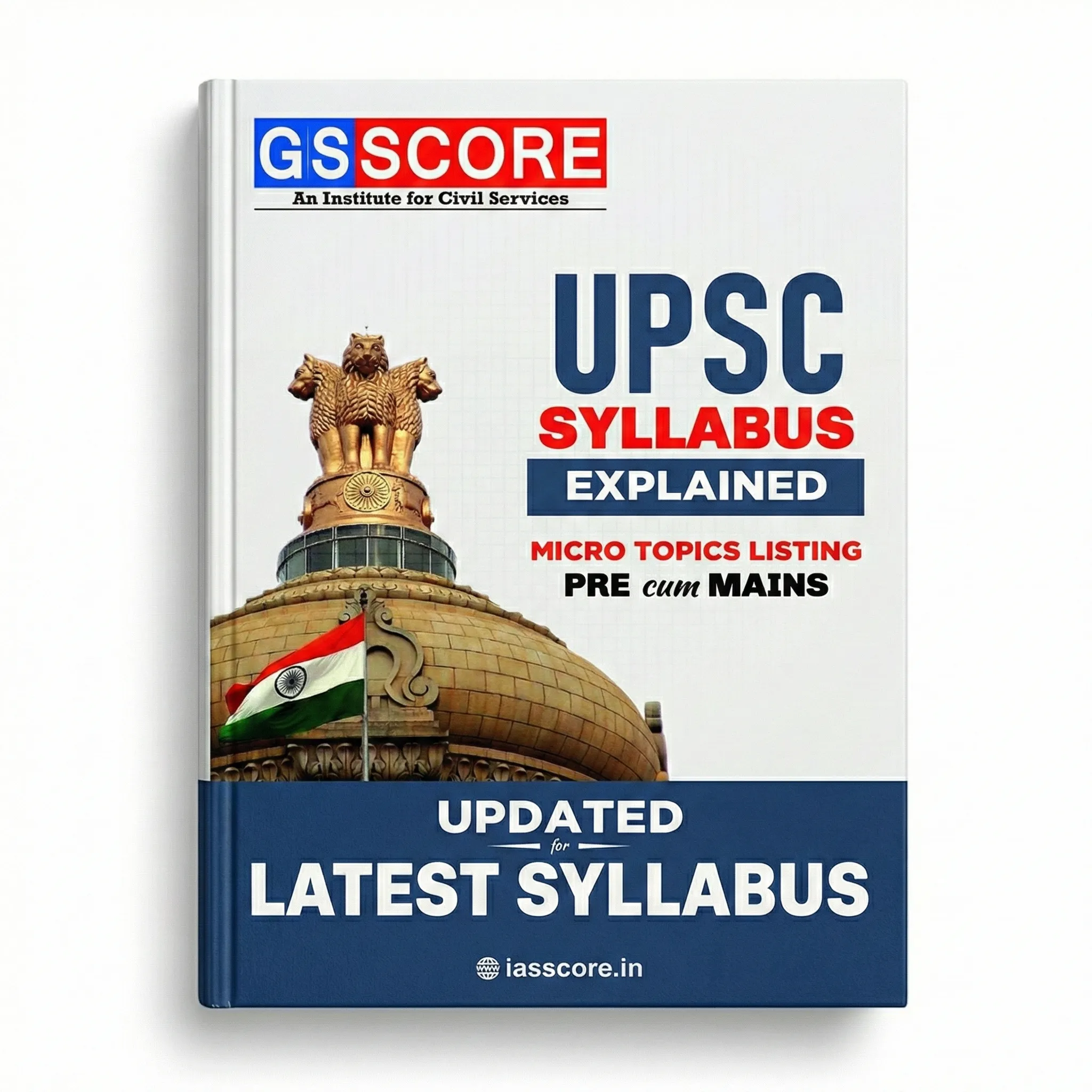
If you also appear for syllabus-heavy exams, a consolidated syllabus reference like the GS Score Latest Syllabus Booklet keeps your static GK and polity-economy base organised in one place.
How to Download the SSC Selection Post Syllabus PDF
How can I download the SSC Selection Post syllabus PDF? There is no standalone “syllabus PDF” on the SSC site — the authoritative syllabus lives inside the Phase 14 notification. Here is the SSC Selection Post syllabus PDF download process for the official version:
- Visit the official SSC website (ssc.gov.in).
- Open the active Selection Post Phase 14 notification under the “Notice” or “Latest Notifications” section.
- Scroll to the Scheme of Examination / syllabus annexure within the PDF.
- Download and save the official notification PDF — it contains the authoritative exam pattern and syllabus.
For quick revision, use the section-wise syllabus checklist in this article: copy the four subject tables above into a single page, tick off each topic as you complete it, and keep it beside your desk. A checklist you actually mark off beats a generic PDF you never open.
Common Mistakes to Avoid
- Over-preparing maths: Quant stays 10th-level — don’t waste weeks on graduation-level maths that is never asked.
- Ignoring General Awareness: It’s the fastest-scoring section; skipping it quietly sinks your normalised score.
- Blind guessing: With 0.50 negative marking, guess only when you can eliminate at least two options.
- Not practising sectional timing: If the 15-min lock applies, untimed practice gives a false sense of readiness.
- Stale current affairs: Preparing random months instead of the specific 8–10 month window before your exam.
- Skipping the post-wise skill-test check: Assuming your post needs a typing/DEST test (or assuming it doesn’t) instead of reading the post-specific requirement in the notice.
Frequently Asked Questions
What is the syllabus for SSC Selection Post?
The SSC Selection Post syllabus has four sections: General Intelligence & Reasoning, General Awareness, Quantitative Aptitude and English Language, with 25 questions each. It covers reasoning (analogy, series, coding), static GK plus current affairs, 10th-level arithmetic and advanced maths, and English grammar, vocabulary and comprehension.
Is the SSC Selection Post syllabus the same for matric, 12th and graduation levels?
The topics are the same across all three levels; only the difficulty of the questions increases with each level. Importantly, the Quantitative Aptitude section stays at the 10th-standard level even for the graduation paper, so your maths preparation is reusable across levels.
How many questions are asked in the SSC Selection Post exam?
A total of 100 questions are asked — 25 each from Reasoning, General Awareness, Quantitative Aptitude and English — for 200 marks. Each question carries 2 marks and there is a 0.50-mark deduction for every wrong answer.
What is the duration of the SSC Selection Post exam and is there sectional timing?
The exam duration is 60 minutes (80 minutes for scribe-eligible candidates). SSC has moved several CBEs to a 15-minute-per-section format, so check your Phase 14 notice — if sectional timing applies, you cannot return to a section once its time ends.
Is there an interview or skill test in SSC Selection Post?
There is no interview. Some posts require a qualifying skill test — a Data Entry Speed Test (around 8,000 key depressions per hour) or a typing test (about 35 wpm English / 30 wpm Hindi). Many posts have no skill test and are decided on the CBE score and document verification.
How can I download the SSC Selection Post syllabus PDF?
Go to ssc.gov.in, open the active Selection Post Phase 14 notification, and find the Scheme of Examination/syllabus annexure inside the PDF. Download the official notification to get the authoritative pattern and syllabus, and use the section-wise checklist in this guide for daily revision.
What is a good score in SSC Selection Post?
Because the merit is built on normalised marks, aim comfortably above the indicative cut-off bands — roughly 130+ for Matric/12th and 140+ for graduation-level posts for unreserved candidates. High-demand posts can close higher, so target accuracy on your strong sections rather than just raw attempts.
Is the SSC Selection Post syllabus the same as SSC CGL or CHSL?
The four subjects overlap heavily with CHSL and the CGL Tier-1 syllabus, so the same reasoning, quant, GA and English preparation carries over. The key difference is level framing: Selection Post difficulty is pegged to the post’s education level (10th/12th/graduation), and Quantitative Aptitude stays at the 10th standard across all levels.
Recommended Study Material



Competer
The Competer team: we pack the orders, so we know which editions aspirants keep coming back for.
Get it printed
SSC study material aspirants order most on Competer, delivered across India
 Parmar SSC GK Polity 4.0 Batch Notes 2026-27 | English Medium Edition₹545View on Competer →
 Parmar SSC GK Geography 4.0 Batch Notes 2026-27 | English Medium Edition₹745View on Competer →
 Parmar SSC GK History 4.0 Batch Notes 2026-27 | English Medium Edition₹745View on Competer →
 Parmar SSC GK Polity in Hindi - 4.0 Batch Notes 2026-27₹545View on Competer →
Continue reading
More in Buying Guides



Need help choosing?
Tell us your exam and stage on WhatsApp, we suggest the right set.