
JEE Main Syllabus 2026: Subject-Wise Chapters
Complete JEE Main syllabus 2026 — NTA-verified Physics, Chemistry & Maths chapters, weightage, deleted topics, exam pattern.
 Competer

The JEE Main syllabus is the official list of Class 11 and Class 12 topics — released by the National Testing Agency (NTA) on jeemain.nta.nic.in — that candidates must study for the B.E./B.Tech (Paper 1), B.Arch (Paper 2A) and B.Planning (Paper 2B) exams. It is built almost entirely on the NCERT curriculum and is divided into three subjects: Physics, Chemistry and Mathematics. For 2026, the NTA has retained the reduced syllabus introduced in 2024, so several chapters remain deleted and the paper stays at 75 questions for 300 marks.
This guide gives you the complete, chapter-wise JEE Main syllabus 2026 for all three subjects, a free PDF download, chapter-wise weightage with a data-driven “study-first” priority list, the full deleted-topics table, Paper 1 and Paper 2 patterns, best books, and a 30/60/90-day plan — each chapter linked to the right study resource so you know exactly what to read next.
JEE Main Syllabus 2026: Quick Overview
The jee main syllabus does not usually change every year. Since the 2024 revision, the NTA has trimmed the number of chapters but kept the core structure identical, and the 2026 syllabus is the same reduced version. It is officially notified alongside the Information Bulletin, and it is drawn from the CBSE NCERT textbooks for Classes 11 and 12. Below is the headline snapshot before we go subject by subject.
| Particular | Detail (JEE Main 2026) |
|---|---|
| Conducting body | National Testing Agency (NTA) |
| Official website | jeemain.nta.nic.in |
| Based on | Class 11 & 12 NCERT curriculum |
| Subjects (Paper 1) | Physics, Chemistry, Mathematics |
| Total chapters (approx.) | Physics ~20, Chemistry ~28, Maths ~14 |
| Total questions | 75 (25 per subject) |
| Total marks | 300 |
| Papers | Paper 1 (B.E./B.Tech), Paper 2A (B.Arch), Paper 2B (B.Planning) |
| Negative marking | -1 for wrong answers (both Section A & B) |

Is JEE Main Syllabus Same as NCERT?
Yes — to a very large extent. The JEE Main syllabus is drawn directly from the Class 11 and Class 12 NCERT textbooks, and roughly 80-85% of the chapter names match the NCERT index one-to-one. Every JEE aspirant should treat NCERT as the non-negotiable base, especially for Chemistry, where a large share of questions are lifted almost verbatim from NCERT lines. The difference lies in depth: JEE Main asks tougher, application-heavy and numerical questions than the NCERT exercises, so NCERT alone covers the syllabus but not the difficulty. That is why toppers pair NCERT with a rigorous problem book — a gap our recommended eSaral IIT JEE Modules 2026 are designed to close by mapping each NCERT chapter to graded JEE-level practice.
JEE Main Physics Syllabus (Chapter Wise)
The jee main physics syllabus chapter wise spans mechanics, electrodynamics, optics, modern physics and thermodynamics. There are about 20 units after the 2024 reduction (the Communication Systems chapter was removed). Physics is scoring but calculation-intensive, so accuracy matters more than speed here.
| Class 11 Physics | Class 12 Physics |
|---|---|
| Units and Measurements | Electrostatics |
| Kinematics | Current Electricity |
| Laws of Motion | Magnetic Effects of Current & Magnetism |
| Work, Energy and Power | Electromagnetic Induction & Alternating Current |
| Rotational Motion | Electromagnetic Waves |
| Gravitation | Optics (Ray & Wave) |
| Properties of Solids and Liquids | Dual Nature of Matter and Radiation |
| Thermodynamics | Atoms and Nuclei |
| Kinetic Theory of Gases | Electronic Devices (Semiconductors) |
| Oscillations and Waves | Experimental Skills |
Physics Experimental / Practical Skills
The Experimental Skills unit is compulsory and regularly tested. It covers vernier callipers, screw gauge, simple pendulum, Young’s modulus, surface tension by capillary rise, coefficient of viscosity, speed of sound (resonance tube), specific heat, metre bridge, potentiometer, Ohm’s law verification, focal length of mirrors/lenses, and characteristic curves of a p-n junction diode and zener diode. Expect 1-2 direct questions from this unit.
JEE Main Chemistry Syllabus 2026
The jee main chemistry syllabus 2026 is split into three parts — Physical, Inorganic and Organic Chemistry. Chemistry saw the biggest cuts in the 2024 revision (several full chapters were removed), so double-check that you are not studying deleted matter. It remains the most NCERT-aligned and time-efficient subject to score in.
| Physical Chemistry | Inorganic Chemistry | Organic Chemistry |
|---|---|---|
| Some Basic Concepts in Chemistry | Classification of Elements & Periodicity | Basic Principles of Organic Chemistry |
| Atomic Structure | Chemical Bonding & Molecular Structure | Hydrocarbons |
| Chemical Thermodynamics | p-Block Elements | Organic Compounds Containing Halogens |
| Solutions | d- and f-Block Elements | Organic Compounds Containing Oxygen |
| Equilibrium | Coordination Compounds | Organic Compounds Containing Nitrogen |
| Redox Reactions & Electrochemistry | Biomolecules | |
| Chemical Kinetics | Principles of Practical Chemistry |
Chemistry Experimental / Practical Skills
The “Principles Related to Practical Chemistry” unit covers detection of extra elements (N, S, halogens) in organic compounds, functional-group tests (alcohols, phenols, aldehydes, ketones, carboxylic and amino groups), qualitative salt analysis (cations and anions), and titrimetric exercises (acid-base, redox). These carry easy, high-return marks — do not skip them.
JEE Main Maths Syllabus with Weightage
The jee main maths syllabus with weightage covers about 14 units. Calculus and Coordinate Geometry together account for the largest share of marks, so treat them as anchor topics. Mathematical Reasoning and Mathematical Induction were dropped in the 2024 revision.
| Unit | Key Topics |
|---|---|
| Sets, Relations and Functions | Types of relations, functions, composition |
| Complex Numbers & Quadratic Equations | Argand plane, roots, nature of roots |
| Matrices and Determinants | Inverse, system of equations |
| Permutations and Combinations | Arrangements, selections |
| Binomial Theorem | General term, coefficients |
| Sequences and Series | AP, GP, sums |
| Limit, Continuity & Differentiability | Calculus foundations |
| Integral Calculus | Definite/indefinite integrals, area |
| Differential Equations | Order, degree, solutions |
| Coordinate Geometry | Straight lines, circles, conic sections |
| Three Dimensional Geometry | Lines and planes in 3D |
| Vector Algebra | Dot/cross products |
| Statistics and Probability | Mean, variance, probability |
| Trigonometry | Identities, inverse functions |
JEE Main Chapter-Wise Weightage (Data-Driven)
Weightage patterns are averaged over recent years and shift slightly per shift/session, but the high-value chapters stay remarkably consistent. Use the tables below to prioritise. The percentages are approximate marks-share per subject.
Physics Weightage
| Chapter | Approx. Questions | Weightage |
|---|---|---|
| Modern Physics (Atoms, Nuclei, Dual Nature) | 3-4 | ~14% |
| Electrodynamics (Electrostatics + Current) | 4-5 | ~18% |
| Optics | 2-3 | ~10% |
| Mechanics (Kinematics to Rotation) | 5-6 | ~22% |
| Heat & Thermodynamics | 2 | ~8% |
| Magnetism & EMI/AC | 3 | ~12% |
| SHM & Waves | 2 | ~8% |
Chemistry & Maths Weightage
| Subject | High-Weightage Chapters | Approx. Weightage |
|---|---|---|
| Chemistry | Coordination Compounds, Chemical Bonding, p-Block | ~25% combined |
| Chemistry | Organic (GOC, Oxygen & Nitrogen compounds) | ~30% |
| Chemistry | Thermodynamics, Equilibrium, Electrochemistry | ~20% |
| Maths | Calculus (Limits, Differentiation, Integration) | ~28% |
| Maths | Coordinate Geometry (2D + 3D) | ~18% |
| Maths | Algebra (Complex No., Matrices, Sequences) | ~20% |
Which Chapters Have the Highest Weightage? (Study-First Priority)
If you have limited time, this priority ranking maps chapters to expected marks so you attack the highest-ROI topics first. Clearing the “Tier 1” list below can secure roughly 60% of the paper.
| Priority | Chapters to master first | Why |
|---|---|---|
| Tier 1 (do first) | Calculus, Coordinate Geometry, Organic GOC, Electrodynamics, Coordination Compounds, Mechanics | Highest marks-per-hour; ~55-60% of paper |
| Tier 2 (next) | Chemical Bonding, Modern Physics, p-Block, Complex Numbers, Thermodynamics | Consistent 2-3 questions each |
| Tier 3 (revise) | Optics, Vectors & 3D, Probability, SHM & Waves, Electrochemistry | Reliable, formula-driven marks |
Once you know your Tier 1 targets, practise them against a full-syllabus module set. The PW Prayas JEE Modules 2026 (18-book set) organise Class 11 and 12 chapters in exactly this priority order, which makes it easy to align your study plan with weightage.
JEE Main Deleted Syllabus 2026: What Changed and When
The jee main deleted syllabus 2026 is the same reduction the NTA introduced in 2024 and carried into 2025 and 2026 — no fresh chapters were added or removed for 2026. Because so many portals mix up 2025/2026/2027 headings, here is a single, clean, dated table of what was actually deleted. Chemistry lost the most.
| Subject | Deleted / Removed Topics (since 2024, still out in 2026) |
|---|---|
| Physics | Communication Systems (full chapter); parts of Experimental Skills |
| Chemistry (Physical) | States of Matter, Surface Chemistry |
| Chemistry (Inorganic) | Hydrogen, s-Block Elements, General Principles & Processes of Isolation of Metals, Environmental Chemistry |
| Chemistry (Organic) | Polymers, Chemistry in Everyday Life |
| Mathematics | Mathematical Reasoning, Mathematical Induction |
Note: Always cross-verify against the official Information Bulletin PDF on jeemain.nta.nic.in before dropping any topic, since a few of these chapters still appear in JEE Advanced and in your school boards.
JEE Main Exam Pattern 2026: Paper 1 and Paper 2
The jee main syllabus paper 1 and paper 2 differ because the papers lead to different degrees. Paper 1 is for engineering (B.E./B.Tech); Paper 2A is for B.Arch and Paper 2B is for B.Planning. Understanding the section split is essential — Section A is MCQ and Section B is numerical (integer answer).
| Paper | Subjects | Questions | Marks |
|---|---|---|---|
| Paper 1 (B.E./B.Tech) | Physics, Chemistry, Maths | 75 (25 each) | 300 |
| Paper 2A (B.Arch) | Maths, Aptitude, Drawing | 77 | 400 |
| Paper 2B (B.Planning) | Maths, Aptitude, Planning | 100 | 400 |
Section A and Section B Split (Paper 1)
Each subject has 25 questions: 20 MCQs (Section A) and 5 numerical-value questions (Section B), all of which are mandatory. Each correct answer earns +4; each wrong answer, including in the numerical section, carries -1. That is 75 questions, 300 marks, in a 3-hour window (4 hours for PwD candidates).
Difference Between Paper 1 and Paper 2 Syllabus
Paper 1 uses the full Physics + Chemistry + Maths syllabus described above. Paper 2A (B.Arch) replaces Physics and Chemistry with an Aptitude Test (awareness of places, buildings, 3D visualisation) and a pen-and-paper Drawing test. Paper 2B (B.Planning) keeps Maths and Aptitude but swaps Drawing for a Planning section (general awareness, development issues, comprehension). Mathematics is common to all three papers.
Where to Download the Official JEE Main Syllabus 2026 PDF (Free)
You can get the jee main syllabus 2026 pdf download — both the overall PDF and separate subject-wise PDFs — free from the official site. Follow these steps:
- Visit the official portal jeemain.nta.nic.in.
- Open the latest Information Bulletin or the “Syllabus” link on the homepage.
- Download the combined syllabus PDF, or scroll to the subject annexure for Physics, Chemistry and Mathematics PDFs.
- Save the file and print a copy so you can tick chapters off as you finish them.
For an easy revision aid, keep a one-page printable checklist beside your desk: list all ~20 Physics, ~28 Chemistry and ~14 Maths chapters, and mark each as Not started / Learning / Revised / PYQ done. This single tracker keeps your whole syllabus visible at a glance.
Best Books to Cover the JEE Main Syllabus
NCERT is the mandatory foundation; layer specialist books on top for practice. Here is the topper-tested combination.
| Subject | Foundation | Practice / Advanced |
|---|---|---|
| Physics | NCERT Class 11 & 12 | HC Verma (Concepts of Physics), DC Pandey (Arihant) |
| Chemistry | NCERT (esp. Inorganic & Organic) | N. Awasthi (Physical), MS Chouhan (Organic), JD Lee (Inorganic) |
| Mathematics | NCERT Class 11 & 12 | Cengage series, RD Sharma (Objective) |
Rather than sourcing each title separately, many aspirants prefer an integrated, syllabus-mapped module set. The eSaral IIT JEE Modules 2026 and the PW Prayas JEE Modules (11+12) both bundle theory, solved examples and previous-year questions chapter by chapter, so you cover the entire JEE Main syllabus from one printed set. For a deeper title-by-title breakdown, see our guide on the best subject-wise books for JEE Main.
30/60/90-Day Study Plan Built Around the Syllabus
Map your remaining time to the weightage tables above. This phased plan front-loads Tier 1 chapters and back-loads full-length mocks.
| Phase | Focus | Deliverable |
|---|---|---|
| Days 1-30 | Tier 1 high-weightage chapters (Calculus, Mechanics, Organic GOC, Electrodynamics, Coordination Compounds) | Concepts + NCERT + 30 PYQs per chapter |
| Days 31-60 | Tier 2 chapters + Experimental/Practical Skills; start subject-wise tests | Full subject coverage; 15 chapter tests |
| Days 61-90 | Tier 3 revision + full-length mocks (Section A & B), error log | 10-15 full mocks; timing & accuracy fixed |
Common Mistakes to Avoid
- Studying deleted topics: wasting time on States of Matter, Surface Chemistry or Communication Systems that are no longer in the syllabus.
- Skipping Section B: all 5 numerical questions per subject are mandatory and carry negative marking — practise them.
- Ignoring NCERT for Chemistry: a large share of Inorganic and Organic questions come straight from NCERT lines.
- No weightage strategy: spreading effort evenly instead of prioritising high-ROI chapters first.
- Confusing years: using 2023 or older syllabus PDFs — always download the current 2026 bulletin.
Frequently Asked Questions
Is the JEE Main syllabus the same as NCERT?
Largely yes — the JEE Main syllabus is based on the Class 11 and 12 NCERT curriculum, and about 80-85% of chapters match one-to-one. The difference is depth: JEE Main questions are more application-based and numerical, so NCERT covers the syllabus but you need extra practice books for the difficulty level.
What is the JEE Main 2026 syllabus for Physics, Chemistry and Maths?
Physics has ~20 chapters (mechanics, electrodynamics, optics, modern physics, thermodynamics), Chemistry ~28 chapters across Physical, Inorganic and Organic, and Maths ~14 units led by Calculus and Coordinate Geometry. All are drawn from Class 11 and 12 NCERT and published on jeemain.nta.nic.in.
Which topics have been deleted from the JEE Main syllabus?
Since the 2024 revision (still applicable in 2026), deleted topics include Communication Systems in Physics; States of Matter, Surface Chemistry, Hydrogen, s-Block, Environmental Chemistry, Polymers and Chemistry in Everyday Life in Chemistry; and Mathematical Reasoning and Mathematical Induction in Maths. Chemistry lost the most.
Which chapters have the highest weightage in JEE Main?
Calculus and Coordinate Geometry in Maths, Mechanics and Electrodynamics in Physics, and Organic GOC, Coordination Compounds and Chemical Bonding in Chemistry carry the highest weightage. Mastering these Tier 1 chapters can secure roughly 55-60% of the paper.
How many chapters are there in the JEE Main syllabus?
After the 2024 reduction, there are approximately 20 chapters in Physics, 28 in Chemistry and 14 units in Mathematics — around 62 chapters in total for Paper 1, all based on the NCERT Class 11 and 12 syllabus.
What is the difference between JEE Main Paper 1 and Paper 2 syllabus?
Paper 1 (B.E./B.Tech) covers Physics, Chemistry and Maths. Paper 2A (B.Arch) has Maths, Aptitude and a Drawing test, while Paper 2B (B.Planning) has Maths, Aptitude and a Planning section. Mathematics is common to all three papers.
Recommended Study Material

Competer
The Competer team: we pack the orders, so we know which editions aspirants keep coming back for.
Get it printed
JEE study material aspirants order most on Competer, delivered across India
 eSaral IIT JEE Modules 2026 | Complete Modules for JEE Preparation₹3,499
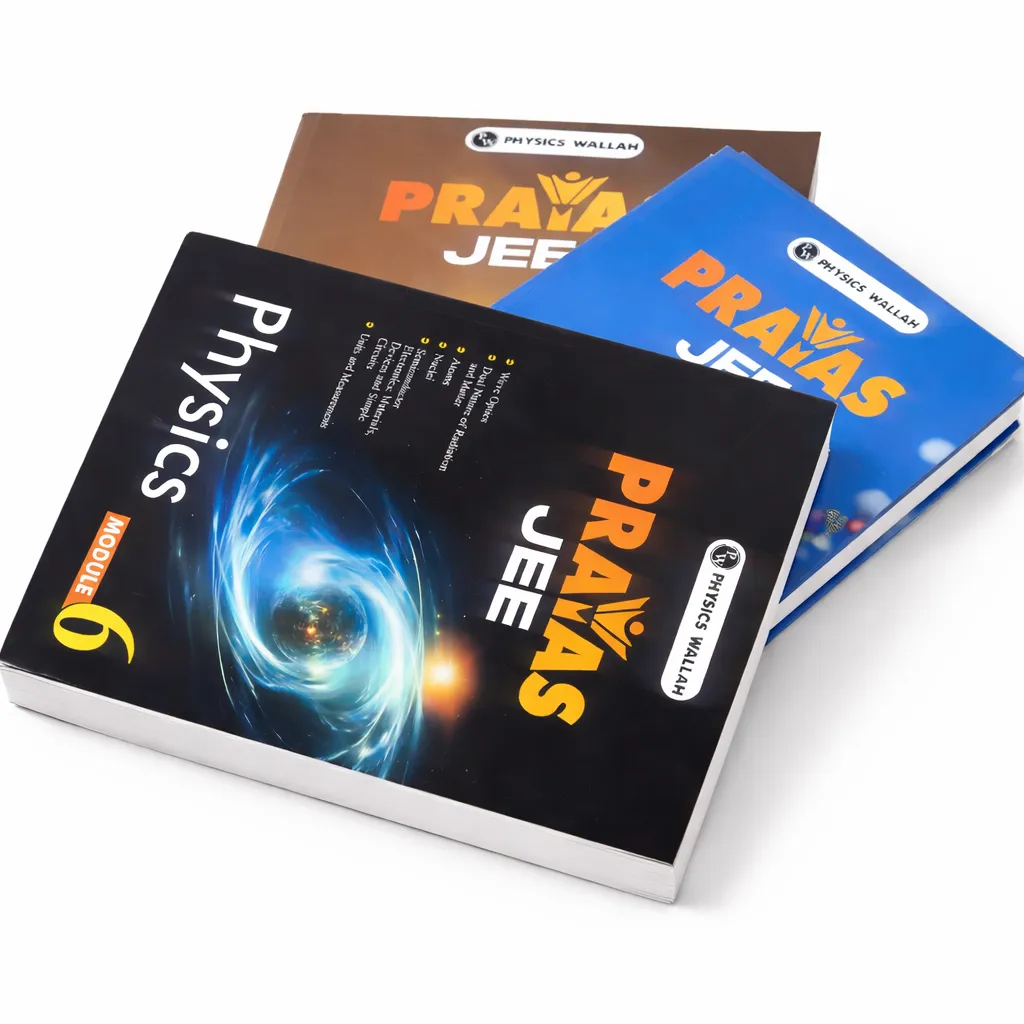 PW Prayas JEE Modules for 2026 | 18 Books Set for JEE 11+12 Preparation₹2,499
 Unacademy IIT JEE Version 4.0 for 2025- Complete Module Set Edition 24 Booklets₹3,499
 Bansal Classes Engineering Modules for JEE 2026 | 29 Modules for 11th+12th Class₹5,499
Continue reading
More in Buying Guides



Need help choosing?
Tell us your exam and stage on WhatsApp, we suggest the right set.