
JEE Main Exam Pattern 2026: Marks, Sections & Marking Scheme
JEE Main exam pattern 2026 explained: 75 questions, 300 marks, Section A vs B, marking scheme, negative marking, duration, 13 languages, attempts & strategy.
 Competer
The JEE Main exam pattern for 2026 keeps Paper 1 (B.Tech) at 75 questions worth 300 marks, split across Physics, Chemistry and Mathematics — each subject carrying 20 MCQs (Section A) plus 5 compulsory Numerical Value Questions (Section B). It is a 3-hour computer-based test with +4 for every correct answer and –1 for every wrong one, and from 2025 onwards the Section B numerical questions are all compulsory (no optional choice) and also carry negative marking.
If you are planning your attempt strategy, that single change — Section B becoming compulsory with negative marking — is the biggest thing to internalise. This guide breaks down the complete structure for Paper 1, Paper 2A (B.Arch) and Paper 2B (B.Plan), the exact marking scheme, subject-wise and chapter-wise weightage, a 3-hour time plan, the number of attempts and languages, and how raw marks become your NTA percentile. Everything is India-focused and mapped to the 2026 cycle. Figures here reflect the NTA-established pattern carried forward from 2025; always cross-check exam-specific dates against the official Information Bulletin on nta.nic.in / jeemain.nta.nic.in before you apply.
What’s New in the JEE Main 2026 Exam Pattern
Before the full breakdown, here are the pattern points that actually change how you should prepare and attempt:
- Section B is fully compulsory — 5 numerical questions per subject, no more “attempt any 5 of 10”.
- Negative marking on numericals — a wrong typed value now costs –1, closing the old free-guess loophole.
- Paper 1 structure is stable — 20 MCQ + 5 NVQ per subject, so 2025 mocks and PYQs remain fully valid.
- Two sessions, best-of-two — January and April, with your higher NTA score counted.
JEE Main Exam Pattern 2026 at a Glance
JEE Main is conducted by the National Testing Agency (NTA) in two sessions (January and April). Candidates can appear for Paper 1 for B.E./B.Tech admissions, Paper 2A for B.Arch, Paper 2B for B.Plan, or any combination. Here is the top-level structure every aspirant must know before starting preparation.
| Feature | Details (2026) |
|---|---|
| Conducting Body | National Testing Agency (NTA) |
| Mode | Computer-Based Test (CBT); Drawing section of Paper 2A is offline (pen & paper) |
| Sessions | Two — Session 1 (January) & Session 2 (April) |
| Papers | Paper 1 (B.Tech), Paper 2A (B.Arch), Paper 2B (B.Plan) |
| Duration | 3 hours (4 hours for PwD candidates with scribe) |
| Total Marks (Paper 1) | 300 |
| Total Questions (Paper 1) | 75 (attempt all — Section B is now compulsory) |
| Marking | +4 correct, –1 incorrect, 0 unattempted |
| Languages | 13 (English, Hindi, Assamese, Bengali, Gujarati, Kannada, Malayalam, Marathi, Odia, Punjabi, Tamil, Telugu, Urdu) |
The B.Tech pattern is unchanged from 2025 — the NTA-established format of 20 MCQs and 5 compulsory numerical questions per subject continues. So any 2025 mock or previous-year paper you practise remains fully relevant for 2026.
JEE Main Paper 1 Exam Pattern (B.Tech)
Paper 1 is the route to NITs, IIITs, GFTIs and the JEE Advanced qualification list for IIT admissions. It is entirely computer-based and consists of three subjects with an identical internal structure.
| Subject | Section A (MCQ) | Section B (Numerical) | Total Questions | Marks |
|---|---|---|---|---|
| Physics | 20 | 5 | 25 | 100 |
| Chemistry | 20 | 5 | 25 | 100 |
| Mathematics | 20 | 5 | 25 | 100 |
| Total | 60 | 15 | 75 | 300 |
Each subject is worth 100 marks, and all three carry equal weightage. There is no separate sectional time limit — you can move freely between Physics, Chemistry and Maths within the 3-hour window.
Section A vs Section B Explained
Section A holds the 20 Multiple Choice Questions per subject. Each has four options with exactly one correct answer.
Section B holds the 5 Numerical Value Questions (NVQs) per subject. Here there are no options — you compute a numerical answer and type it in. If the answer is a decimal, it is generally rounded off to the nearest integer or to two decimal places as instructed on screen. The key 2026-relevant change: earlier, Section B offered 10 questions of which you attempted any 5; now it is 5 compulsory questions with no choice, and negative marking applies.
JEE Main Marking Scheme 2026
The JEE Main marking scheme is uniform across both question types in Paper 1. Understanding it precisely is what separates a strategic attempt from a reckless one.
| Question Type | Correct Answer | Incorrect Answer | Unattempted |
|---|---|---|---|
| Section A — MCQ | +4 | –1 | 0 |
| Section B — Numerical Value | +4 | –1 | 0 |
The headline point for 2026 aspirants: NVQs now carry negative marking of –1 for a wrong answer. In older years, numerical questions had no penalty, which encouraged blind guessing. That loophole is closed. A blank NVQ costs nothing, but a wrongly typed value costs a full mark plus the 4 you could have earned — a 5-mark swing on a single question.
Key 2026 Change: Section B Is Now Compulsory
Previously, Section B gave you 10 numerical questions and let you choose your best 5. That optional buffer is gone. In 2026 you face exactly 5 NVQs per subject and all are compulsory. There is no discarding your weakest attempts. Combined with negative marking, this means your accuracy on numerical problems now matters as much as it does on MCQs — you can no longer treat Section B as a free guessing zone.
JEE Main Paper 2 Exam Pattern (B.Arch & B.Plan)
Candidates targeting architecture and planning programmes sit Paper 2, which differs substantially from Paper 1. It is offered as Paper 2A for B.Arch and Paper 2B for B.Plan, and you may take one or both.
| Section | Paper 2A (B.Arch) | Paper 2B (B.Plan) |
|---|---|---|
| Mathematics | 25 questions (20 MCQ + 5 NVQ) | 25 questions (20 MCQ + 5 NVQ) |
| Aptitude Test | 50 questions | 50 questions |
| Drawing Test | 2 questions (100 marks, offline) | — |
| Planning Test | — | 25 questions (MCQ) |
| Total Questions | 77 | 100 |
| Total Marks | 400 | 400 |
| Duration | 3 hours | 3 hours |
In Paper 2A, the Drawing Test is conducted offline on a drawing sheet and has no negative marking — it is evaluated on the quality of your sketches, proportion and composition. Mathematics and Aptitude follow the standard +4/–1 scheme. Paper 2B replaces Drawing with a Planning section of 25 MCQs.
Paper 1 vs Paper 2: What Is the Difference?
Paper 1 is for engineering (B.Tech) and tests Physics, Chemistry and Maths across 75 questions and 300 marks. Paper 2 is for architecture and planning, replaces Physics and Chemistry with Aptitude plus a Drawing (2A) or Planning (2B) component, and totals 400 marks. Mathematics is the one subject common to both. Many students take Paper 1 and Paper 2 in the same session to keep both career paths open, since the syllabi overlap on Maths.
Subject-Wise & Chapter-Wise Weightage (The Data Most Pages Skip)
Knowing the pattern is half the battle; knowing where the marks live is the other half. Based on trends across recent JEE Main papers, here is an indicative high-yield chapter map. Weightage varies slightly by shift, but these chapters consistently dominate.
| Physics | Chemistry | Mathematics |
|---|---|---|
| Modern Physics & Semiconductors | Chemical Bonding | Coordinate Geometry |
| Electrodynamics (Current, Magnetism, EMI) | Coordination Compounds | Calculus (Limits, Continuity, Integration) |
| Mechanics (Rotation, Work-Energy) | Thermodynamics & Equilibrium | Matrices & Determinants |
| Optics & Waves | Organic — GOC, Aldehydes/Ketones | Vectors & 3D Geometry |
| Heat & Thermodynamics | Mole Concept & Solutions | Probability & Statistics |
A practical takeaway: in Chemistry, Inorganic and Physical chapters are the fastest-scoring because they are formula- or fact-driven, while in Maths, Calculus and Coordinate Geometry together contribute the largest share of marks. Physics rewards students who master Modern Physics and Electrodynamics thoroughly. Structured module sets such as the eSaral IIT JEE Modules 2026 organise practice by exactly these high-weightage chapters, which makes weightage-first revision far easier than working from a single textbook.
How to Allocate Your 3 Hours: Attempt Strategy
The pattern directly dictates strategy. With 75 questions in 180 minutes, you have roughly 2.4 minutes per question on average — but you should never spend it evenly. Here is a proven time-management framework.
| Phase | Time | Action |
|---|---|---|
| Round 1 — Chemistry | 35–40 min | Start here; it is fastest. Lock easy MCQs and confident NVQs. |
| Round 1 — Maths | 50–55 min | Attempt scoring chapters first; flag long calculations. |
| Round 1 — Physics | 45–50 min | Do theory-based and single-concept problems first. |
| Round 2 — Cleanup | 30–35 min | Return to flagged questions; recheck typed NVQ values. |
Order matters: most toppers open with the subject they are strongest in to bank marks and build momentum, then move to the heavier subject. Because there is no sectional locking, use that freedom.
Section B Strategy Under Negative Marking
Now that all 5 NVQs per subject are compulsory and penalised, treat them like MCQs, not like free points. The rule: only type an answer if you have actually solved the problem. A rough guess on a numerical question is statistically worse than leaving it blank, because there is no 25% chance like in a four-option MCQ — the answer space is effectively infinite. Solve the NVQs you are confident about, and leave the rest untouched rather than entering a stray value. Double-check the rounding instruction (integer vs two decimals) before submitting each numerical answer.
JEE Main Total Marks, Number of Questions & Duration
To summarise the numbers every aspirant memorises: Paper 1 has 75 questions for 300 total marks, attempted over 3 hours. Each of the three subjects contributes 25 questions and 100 marks. There is no overall attempt cap on questions within the paper — all 75 are to be attempted.
| Metric | Paper 1 (B.Tech) |
|---|---|
| Total Questions | 75 |
| Questions to Attempt | 75 (all compulsory) |
| Total Marks | 300 |
| Maximum per Subject | 100 |
| Duration | 180 minutes |
| Best-of-Two | Better of Session 1 & Session 2 NTA scores counted |
How Raw Marks Become Your NTA Percentile
Because JEE Main runs across multiple shifts and two sessions, raw marks alone cannot be compared fairly — one shift may be harder than another. NTA therefore uses normalisation and reports a percentile, not a raw score.
Your NTA percentile is calculated per session using the formula: (number of candidates in your session who scored equal to or below you ÷ total candidates in that session) × 100. The topper of each shift gets 100 percentile. If you appear in both sessions, your better of the two NTA scores is considered for ranking, and the two are merged to produce your final All India Rank. This is why appearing in both January and April is generally advantageous — you keep your higher performance.
A common misconception: percentile is not percentage. A 99 percentile does not mean 99% marks — it means you scored better than 99% of test-takers. Roughly 90+ marks can translate to a high percentile in a tough shift, while an easy shift pushes cut-offs higher. Ties in percentile are broken by NTA’s published tie-breaking order (subject-wise scores, then age), so two candidates rarely end up sharing the same rank.
Exam Mode, Languages & Number of Attempts
JEE Main Paper 1 and the objective parts of Paper 2 are fully computer-based (online CBT). Only the Drawing Test in Paper 2A is offline. The paper is available in 13 languages, so candidates can choose their most comfortable medium — the language does not change the difficulty or pattern. In many centres the question is shown bilingually (your chosen regional language alongside English), and in case of any ambiguity in translation the English version is treated as final.
On attempts: NTA conducts JEE Main twice a year, and a candidate may appear in up to 3 consecutive years from the year they pass Class 12 — since each year has two sessions, this effectively gives many students around six sittings across those years. There is no single fixed lifetime number; it is governed by the consecutive-year rule, and there is no upper age limit to appear (though individual institutes may set their own age criteria for admission).
Best Books & Study Material Mapped to the Pattern
The pattern rewards two things: conceptual clarity for MCQs and speed-plus-accuracy for NVQs. Your material should therefore combine theory, solved examples and large question banks organised by chapter weightage. Full module sets do this better than scattered reference books because they mirror the exam’s three-subject, section-wise structure.
The PW Prayas JEE Modules 2026 (18-book set covering Class 11 and 12) give a complete, syllabus-aligned foundation, while the eSaral IIT JEE Modules 2026 pack chapter-wise theory with graded practice ideal for Section B numerical drilling. Both are printed and delivered by Competer, so you get the complete module set ready for weightage-first revision. Pair either with previous-year and memory-based question practice — the single most reliable way to internalise the marking scheme’s risk-reward maths before exam day.
Common Mistakes Aspirants Make With the Pattern
Even strong students lose marks to avoidable pattern errors. Watch for these:
- Guessing NVQs — treating Section B as penalty-free is now a costly mistake; each wrong value is a 5-mark swing.
- Ignoring rounding rules — typing 3.33 when the screen asks for the nearest integer marks the answer wrong.
- Uneven time spend — sinking 8 minutes into one Maths problem starves you of easy Chemistry marks.
- Skipping the second session — you forfeit the best-of-two advantage that normalisation offers.
- Studying without weightage — spending equal time on 1-mark and 8-mark chapters wastes preparation hours.
- Not using the on-screen calculator/rough sheet correctly — practise on the official mock interface so exam-day tools feel familiar.
Quick Summary Cheat-Sheet
Keep this printable summary handy through your preparation:
| Point | Fact |
|---|---|
| Questions | 75 (Paper 1) |
| Marks | 300 |
| Per subject | 20 MCQ + 5 NVQ = 25 Q, 100 marks |
| Marking | +4 correct, –1 wrong (both sections) |
| Section B | 5 compulsory, negative marking applies |
| Duration | 3 hrs (4 hrs PwD) |
| Mode | CBT online (Drawing offline) |
| Languages | 13 |
| Attempts | Twice a year, up to 3 consecutive years |
| Paper 2A | 77 Q / 400 marks (B.Arch) |
| Paper 2B | 100 Q / 400 marks (B.Plan) |
Frequently Asked Questions
What is the exam pattern of JEE Main 2026?
JEE Main 2026 Paper 1 (B.Tech) is a 3-hour computer-based test with 75 questions worth 300 marks. Each of the three subjects — Physics, Chemistry and Mathematics — has 20 MCQs in Section A and 5 compulsory numerical value questions in Section B, with +4 for correct and –1 for incorrect answers.
How many questions are there in JEE Main?
JEE Main Paper 1 has 75 questions in total — 25 per subject (20 MCQs plus 5 numerical value questions). All 75 are compulsory. Paper 2A (B.Arch) has 77 questions and Paper 2B (B.Plan) has 100 questions.
Is there negative marking for numerical questions in JEE Main?
Yes. From 2025 onwards, Section B numerical value questions carry negative marking of –1 for a wrong answer, the same as MCQs. You get +4 for a correct answer and 0 for an unattempted one, so only type a numerical answer when you are confident.
How many marks is JEE Main total?
JEE Main Paper 1 is out of 300 marks — 100 marks each for Physics, Chemistry and Mathematics. Paper 2A (B.Arch) and Paper 2B (B.Plan) are each out of 400 marks.
Is Section B compulsory in JEE Main 2026?
Yes. Section B now has 5 numerical value questions per subject and all of them are compulsory — the earlier option to attempt any 5 out of 10 has been removed. These questions also carry negative marking.
What is the difference between JEE Main Paper 1 and Paper 2?
Paper 1 is for B.Tech/B.E. and covers Physics, Chemistry and Mathematics (75 questions, 300 marks). Paper 2 is for architecture and planning: Paper 2A (B.Arch) has Mathematics, an Aptitude Test and an offline Drawing Test, while Paper 2B (B.Plan) has Mathematics, Aptitude and a Planning section. Both Paper 2 versions total 400 marks, and Mathematics is common to Paper 1 and Paper 2.
How many attempts are allowed for JEE Main?
JEE Main is held twice a year (January and April sessions), and a candidate can appear for up to 3 consecutive years starting from the year they pass Class 12. Across those years this gives roughly six sittings. There is no fixed lifetime attempt number and no upper age limit to appear in the exam itself.
In how many languages is JEE Main conducted?
JEE Main is conducted in 13 languages: English, Hindi, Assamese, Bengali, Gujarati, Kannada, Malayalam, Marathi, Odia, Punjabi, Tamil, Telugu and Urdu. The choice of language does not affect the exam pattern or difficulty.
Recommended Study Material

Competer
The Competer team: we pack the orders, so we know which editions aspirants keep coming back for.
Get it printed
JEE study material aspirants order most on Competer, delivered across India
 eSaral IIT JEE Modules 2026 | Complete Modules for JEE Preparation₹3,499
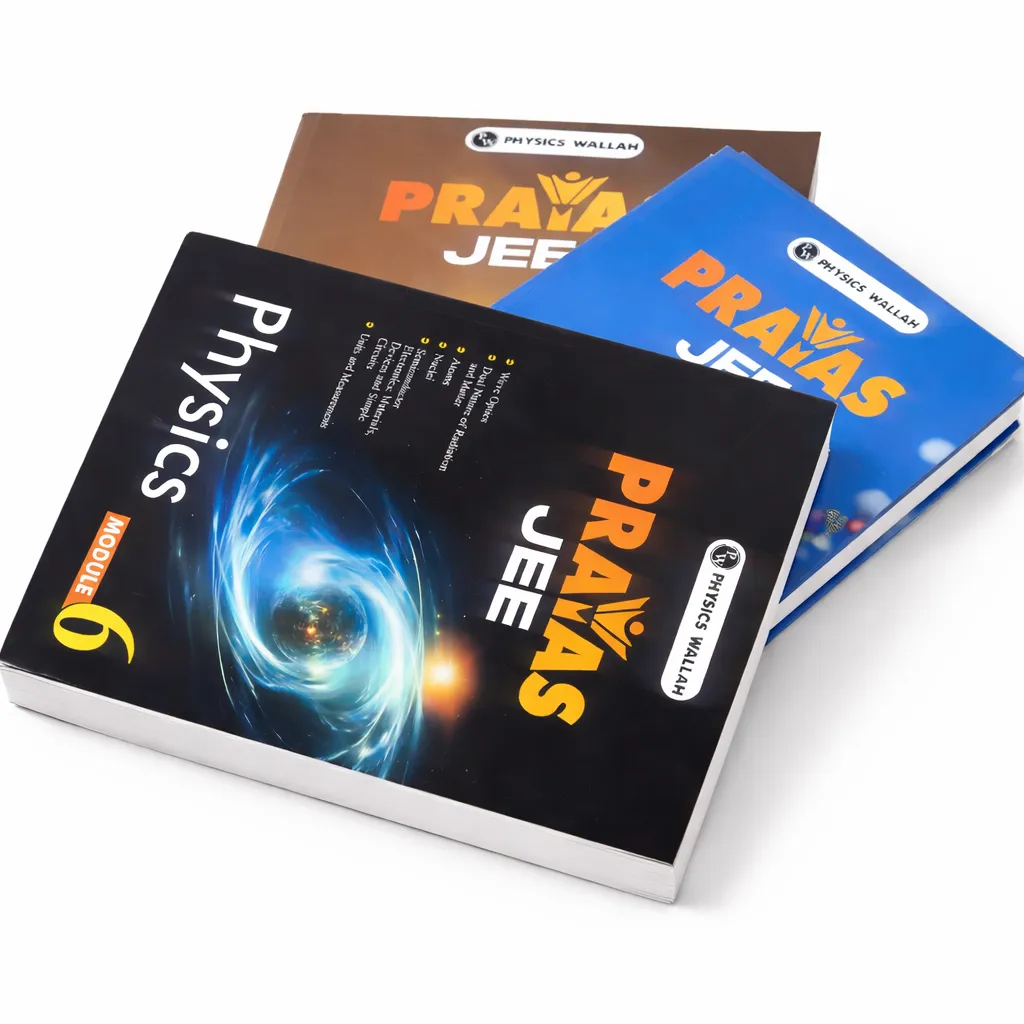 PW Prayas JEE Modules for 2026 | 18 Books Set for JEE 11+12 Preparation₹2,499
 Unacademy IIT JEE Version 4.0 for 2025- Complete Module Set Edition 24 Booklets₹3,499
 Bansal Classes Engineering Modules for JEE 2026 | 29 Modules for 11th+12th Class₹5,499
Continue reading
More in Buying Guides



Need help choosing?
Tell us your exam and stage on WhatsApp, we suggest the right set.