
JEE Main Exam Pattern 2026: Questions, Marks & Marking Scheme
JEE Main exam pattern 2026 explained: 75 questions, 300 marks, +4/−1 marking scheme, Paper 1/2A/2B structure, negative marking on numericals, duration, 13 languages & weightage table.
 Competer
The JEE Main exam pattern for 2026 is a computer-based test (CBT) conducted by the National Testing Agency (NTA) in two sessions. For Paper 1 (B.E./B.Tech), candidates answer 75 questions across Physics, Chemistry and Mathematics for a total of 300 marks in 3 hours, with +4 for every correct answer and −1 for every wrong answer. The biggest 2026 change: Section B (numerical questions) no longer has an optional choice — all five numericals per subject are compulsory, and negative marking now applies to them too.
This guide gives you the exact, official-style structure of JEE Main 2026 — number of questions, sections, marks, marking rules, duration, mode, languages and shift timings — plus chapter-wise weightage, a year-over-year change table, a worked score calculation, and an attempt strategy built around the pattern. Everything an aspirant or parent needs to plan the attempt and the preparation.
Key Takeaways (JEE Main 2026 at a Glance)
- 75 questions, 300 marks in Paper 1 — 25 questions per subject (Physics, Chemistry, Maths).
- Marking scheme: +4 correct, −1 wrong, 0 unattempted, for both MCQs and numericals.
- Biggest 2026 change: all 5 Section B numericals are now compulsory and carry −1 negative marking.
- Duration: 3 hours (180 minutes); +1 hour for PwD candidates.
- Languages: 13; Mode: Computer-Based Test by NTA.
- Two sessions (January & April 2026) — the best of your two NTA scores counts.
JEE Main Exam Pattern 2026: Quick Overview
Before the section-wise breakdown, here is the top-level snapshot of the jee main exam pattern 2026 that most aspirants search for first.
| Feature | Details |
|---|---|
| Conducting body | National Testing Agency (NTA) |
| Exam mode | Computer-Based Test (CBT) — online; Drawing section of Paper 2A is on paper (pen & A4 sheet) |
| Papers | Paper 1 (B.E./B.Tech), Paper 2A (B.Arch), Paper 2B (B.Plan) |
| Subjects (Paper 1) | Physics, Chemistry, Mathematics |
| Total questions (Paper 1) | 75 (to be answered) |
| Total marks (Paper 1) | 300 |
| Duration | 3 hours (180 minutes); 4 hours for Paper 2A/2B combined; +1 hour compensatory time for PwD candidates |
| Sessions | Two — Session 1 (January 2026) & Session 2 (April 2026) |
| Marking scheme | +4 correct, −1 incorrect, 0 unattempted |
| Medium | 13 languages |
| Negative marking | Applies to both Section A (MCQ) and Section B (numerical) in 2026 |

Has the JEE Main 2026 Exam Pattern Changed?
Yes — and this is the single most important update to understand. From 2021 to 2024, Section B of each subject carried 10 numerical-value questions out of which candidates had to attempt any 5 (optional choice). This buffer, introduced during the pandemic, let students skip the hardest numericals without penalty.
For 2026, NTA has removed the optional choice in Section B. Each subject now has exactly 5 numerical questions and all 5 are compulsory. Crucially, negative marking of −1 now applies to these numerical (Section B) questions as well. Earlier, numericals had no negative marking, so blind attempts were cost-free. That is no longer true.
The total question count answered (75) and total marks (300) remain the same as 2025. What changed is the risk profile — careless or purely guessed numericals now cost you marks.
Year-over-Year Change Comparison (2024 vs 2025 vs 2026)
| Element | 2024 | 2025 | 2026 |
|---|---|---|---|
| Section A per subject | 20 MCQs (all compulsory) | 20 MCQs (all compulsory) | 20 MCQs (all compulsory) |
| Section B per subject | 10 numericals, attempt any 5 | 5 numericals, all compulsory | 5 numericals, all compulsory |
| Questions to answer | 75 | 75 | 75 |
| Total marks | 300 | 300 | 300 |
| Negative marking on numericals | No | Yes (−1) | Yes (−1) |
| Duration | 3 hours | 3 hours | 3 hours |
JEE Main Paper 1 Exam Pattern (B.Tech)
Paper 1 is for admission to B.E./B.Tech programmes at NITs, IIITs, GFTIs and participating state/private institutions, and is also the qualifying gateway to JEE Advanced for IIT aspirants. The jee main paper 1 exam pattern (b.tech) is identical across Physics, Chemistry and Mathematics.
Each subject has two sections:
- Section A: 20 Multiple-Choice Questions (MCQs), all compulsory.
- Section B: 5 Numerical-Value Questions (NVQs), all compulsory in 2026.
That makes 25 questions per subject × 3 subjects = 75 questions, each worth 4 marks, for a total of 300 marks.
JEE Main Total Number of Questions and Marks (Subject-Wise)
| Subject | Section A (MCQ) | Section B (Numerical) | Questions to answer | Marks |
|---|---|---|---|---|
| Physics | 20 | 5 | 25 | 100 |
| Chemistry | 20 | 5 | 25 | 100 |
| Mathematics | 20 | 5 | 25 | 100 |
| Total | 60 | 15 | 75 | 300 |
How Many Sections Are There in JEE Main Paper 1?
There are two sections per subject — Section A (MCQs) and Section B (numericals) — so six sections in total across the three subjects. The on-screen interface, however, groups them as three subject tabs, each split into Section A and Section B.
JEE Main Marking Scheme
The jee main marking scheme is uniform for both MCQs and numerical questions in 2026:
| Response | Marks awarded |
|---|---|
| Correct answer | +4 |
| Incorrect answer | −1 |
| Unattempted / left blank | 0 |
| MCQ with more than one correct option (dropped question) | +4 to all who attempted |
The maximum achievable raw score is 300 (all 75 correct). The theoretical minimum is −75 (all 75 attempted and wrong), which is why reckless attempting hurts.
Is There Negative Marking in JEE Main Numerical (Section B) Questions?
Yes. This is the callout every 2026 aspirant must internalise: jee main negative marking for numerical questions is now −1 per wrong answer, same as MCQs. In numericals you type the answer (rounded to the nearest integer where specified) instead of selecting an option. Because there are no options to eliminate, a wild guess on an NVQ is statistically a losing bet. Attempt a numerical only when you have actually solved it or are confident of the computed value.
JEE Main Paper 2 Exam Pattern (B.Arch & B.Plan)
Paper 2 is for architecture and planning aspirants and is split into two sub-papers. The jee main paper 2 exam pattern (b.arch & b.plan) differs significantly from Paper 1 — both carry 400 marks and run for 3 hours each (4 hours if a candidate takes both 2A and 2B together).
Paper 2A (B.Arch) Pattern
| Section | Question type | No. of questions | Marks |
|---|---|---|---|
| Mathematics — Part I (Section A) | MCQ | 20 | 80 |
| Mathematics — Part II (Section B) | Numerical | 5 | 20 |
| Aptitude Test | MCQ | 50 | 200 |
| Drawing Test | Drawing (on paper) | 2 | 100 |
| Total | — | 77 | 400 |
Paper 2B (B.Plan) Pattern
| Section | Question type | No. of questions | Marks |
|---|---|---|---|
| Mathematics — Part I (Section A) | MCQ | 20 | 80 |
| Mathematics — Part II (Section B) | Numerical | 5 | 20 |
| Aptitude Test | MCQ | 50 | 200 |
| Planning-Based Questions | MCQ | 25 | 100 |
| Total | — | 100 | 400 |
The Mathematics and Aptitude portions are common to both; the differentiator is the Drawing Test (B.Arch) versus the Planning section (B.Plan). The Drawing Test is evaluated manually, so results for Paper 2A take slightly longer than the fully automated Paper 1.
Duration, Mode and Shift Timings
What is the duration of the JEE Main exam? Paper 1 runs for 3 hours (180 minutes). Candidates with benchmark disabilities (PwD) get an extra 60 minutes of compensatory time and may use a scribe. Paper 2A or 2B alone is 3 hours; taking both together gives 4 hours.
The exam is conducted in two daily shifts. Exact timings are confirmed on the admit card, but the standard structure is:
| Shift | Reporting time | Exam timing |
|---|---|---|
| Shift 1 (Morning) | From ~7:00 AM | 9:00 AM – 12:00 PM |
| Shift 2 (Afternoon) | From ~1:00 PM | 3:00 PM – 6:00 PM |
Because candidates sit the paper across multiple shifts and days with different question sets, NTA applies a normalisation process to ensure fairness (explained below).
In How Many Languages Is the JEE Main Exam Conducted?
JEE Main 2026 is offered in 13 languages: English, Hindi, Assamese, Bengali, Gujarati, Kannada, Malayalam, Marathi, Odia, Punjabi, Tamil, Telugu and Urdu. The medium is chosen during application and is final. Regional languages are offered as per the exam-centre state, while English and Hindi are available at all centres.
Is the JEE Main Pattern the Same in Both Sessions?
Yes. Session 1 (January) and Session 2 (April) follow the identical exam pattern — same 75 questions, 300 marks, two sections per subject and +4/−1 marking. The only practical difference is the question set and the difficulty normalisation applied per shift. If you appear in both sessions, NTA takes the better of your two NTA scores for the final rank list, so attempting both is a low-risk way to improve your percentile.
Chapter-Wise Weightage with Expected Questions (Paper 1)
Most pattern pages stop at marks tables. Here is the gap-filler: a data-backed, chapter-wise weightage view compiled from past-year JEE Main trends, showing the approximate number of questions you can expect per high-yield area. Use this to prioritise revision — these are indicative, not guaranteed, and vary slightly by shift.
Physics — High-Weightage Topics
| Topic / Chapter group | Approx. questions | Approx. weightage |
|---|---|---|
| Modern Physics & Electronics | 4–5 | ~18% |
| Electrodynamics (Current, Magnetism, EMI) | 5–6 | ~24% |
| Mechanics (Kinematics, Laws, Rotation, SHM) | 6–7 | ~28% |
| Heat & Thermodynamics | 2–3 | ~10% |
| Optics & Waves | 2–3 | ~10% |
| Properties of Matter / Units & Measurement | 2 | ~10% |
Chemistry — High-Weightage Topics
| Topic / Chapter group | Approx. questions | Approx. weightage |
|---|---|---|
| Physical Chemistry (Mole, Thermo, Equilibrium, Electrochem) | 8–9 | ~34% |
| Inorganic Chemistry (Periodic, Coordination, p/d-block) | 8–9 | ~34% |
| Organic Chemistry (GOC, Hydrocarbons, Biomolecules, Polymers) | 8–9 | ~32% |
Mathematics — High-Weightage Topics
| Topic / Chapter group | Approx. questions | Approx. weightage |
|---|---|---|
| Calculus (Limits, Differentiation, Integration, AOD) | 7–8 | ~30% |
| Algebra (Quadratics, Matrices, Complex Numbers, Binomial) | 6–7 | ~28% |
| Coordinate Geometry (Straight Lines, Circles, Conics) | 4–5 | ~18% |
| Vectors & 3D Geometry | 3–4 | ~14% |
| Trigonometry, Probability & Statistics | 3 | ~10% |
A structured module set that maps to these chapters makes weightage-based revision far easier. Our PW Prayas JEE Modules (18-book Class 11+12 set) and eSaral IIT JEE Modules 2026 are organised chapter-by-chapter across all three subjects, so you can allocate time proportional to the weightage above.
Worked Example: How Your JEE Main Score Is Calculated
Suppose in Paper 1 you attempt 68 of the 75 questions. Of these, 55 are correct, 13 are wrong, and 7 are left unattempted. Your raw score is:
- Correct: 55 × (+4) = +220
- Incorrect: 13 × (−1) = −13
- Unattempted: 7 × 0 = 0
- Raw score = 220 − 13 = 207 / 300
Notice how 13 wrong attempts cost 13 marks — enough to drop you a few thousand ranks. This is exactly why the 2026 negative marking on numericals matters: a disciplined aspirant who skips 7 unsure numericals protects their score better than one who guesses all 75.
NTA Score, Percentile, Normalisation and Tie-Breaking
Because JEE Main is held in multiple shifts, your raw marks are converted into an NTA percentile score (not a percentage). The percentile reflects how many candidates in your shift scored at or below you, normalised across all shifts:
Percentile = (Number of candidates with raw score equal to or below you in the session ÷ Total candidates in that session) × 100.
The topper of each shift gets 100 percentile. The percentiles from both sessions are combined, and the best of the two NTA scores is used for ranking. A Common Rank List (CRL) is then prepared.
Tie-Breaking Rules (in order)
| Priority | Tie-breaker criterion |
|---|---|
| 1 | Higher NTA score (percentile) in Mathematics |
| 2 | Higher NTA score in Physics |
| 3 | Higher NTA score in Chemistry |
| 4 | Candidate with fewer wrong answers relative to correct answers across the paper |
| 5 | Older candidate by date of birth (older ranked higher) |
Marks vs Rank: Good Score Benchmarks
Tying the 300-mark structure to outcomes helps you set a target. These are indicative percentile/rank bands from recent years — they shift slightly each session with difficulty and candidate volume.
| Raw marks (/300) | Approx. percentile | Approx. rank band |
|---|---|---|
| 250+ | 99.5+ | Top ~15,000 (NIT/IIIT front-runner) |
| 200–250 | 98.5–99.5 | ~15,000–45,000 |
| 150–200 | 95–98.5 | ~45,000–1,20,000 |
| 100–150 | 85–95 | ~1,20,000–3,00,000 |
| Qualifying (JEE Advanced cut-off, approx.) | ~90–93 for General | Top ~2,50,000 eligible |
For B.Tech CSE at top NITs, aim for 200+ marks; a safe JEE Advanced qualification generally needs 90+ percentile in the General category.
Attempt Strategy Built Around the 2026 Pattern
Knowing the pattern is only half the battle — here is how to convert it into marks.
- Time per section: With 180 minutes for 75 questions, budget roughly 55–60 minutes per subject. A common split: Chemistry first (35–40 min, most scoring), then Maths (65–70 min, most time-consuming), then Physics (55–60 min).
- Section B discipline: Since numericals now carry −1, attempt only the ones you fully solve. Leave unsure numericals blank — a guess has no option-elimination advantage.
- Two-pass approach: Pass 1 — clear all sure-shot MCQs and solved numericals. Pass 2 — return to flagged questions with remaining time.
- Accuracy over volume: From the worked example, 55 correct + 0 wrong beats 58 correct + 10 wrong (232 vs 222). Protect marks by not over-attempting.
- Mock-test calibration: Take full-length mocks in the exact 75-question, +4/−1 format so your guessing instinct adapts to the new numerical penalty.
Chapter-aligned module sets help here. The eSaral IIT JEE Modules 2026 include topic-wise practice that mirrors Section A/B distribution, while the PW Prayas JEE Modules cover the full Class 11+12 syllabus in 18 books so no high-weightage chapter is left out.
Pattern → Recommended Study Material Mapping
Because the pattern is fixed around three subjects, two sections and a weightage curve, your material should match that structure exactly. Here is how to map the pattern to preparation resources available at Competer.
| Pattern need | What to use |
|---|---|
| Full syllabus coverage (Class 11+12, all 3 subjects) | PW Prayas JEE Modules (18 books) |
| Chapter-wise theory + solved examples matched to weightage | eSaral IIT JEE Modules 2026 |
| Concept clarity for aspirants also eyeing NEET-pattern practice | Careerwill NEET Module Set (NTA-pattern, 23 modules) |
Pair your modules with full-length mock tests in the exact 75-question, +4/−1 format to internalise the 2026 negative-marking rule on numericals.
Exam-Day Instructions You Should Know
- Carry a printed admit card with a passport-size photo, plus a valid photo ID (Aadhaar preferred).
- Reach the centre before the gate-closing time on your admit card — late entry is not permitted.
- Rough sheets and (for Paper 2A) the drawing sheet are provided at the centre; carry your own geometry box/pencils only where the admit card permits.
- Electronic items, calculators, smartwatches and study material are strictly prohibited inside.
- An on-screen calculator is NOT provided for Paper 1 — all numericals are solved manually, another reason to master mental calculation.
- Use the on-screen “Mark for Review” and “Save & Next” buttons to manage your two-pass strategy.
One-Page Quick-Glance Summary
Keep this printable summary handy — it captures the entire jee main exam pattern at a glance:
| Parameter | Paper 1 (B.Tech) | Paper 2A (B.Arch) | Paper 2B (B.Plan) |
|---|---|---|---|
| Questions to answer | 75 | 77 | 100 |
| Total marks | 300 | 400 | 400 |
| Duration | 3 hours | 3 hours | 3 hours |
| Marking | +4 / −1 / 0 | +4 / −1 (Drawing evaluated separately) | +4 / −1 / 0 |
| Mode | CBT | CBT + paper drawing | CBT |
| Negative marking on numericals | Yes | Yes | Yes |
Frequently Asked Questions
What is the exam pattern of JEE Main 2026?
JEE Main 2026 is a computer-based test by NTA. Paper 1 (B.Tech) has 75 questions across Physics, Chemistry and Mathematics — 20 MCQs and 5 compulsory numericals per subject — for 300 marks in 3 hours, marked +4 for correct and −1 for wrong answers.
How many questions are there in JEE Main and what are the total marks?
In Paper 1, candidates answer 75 questions (25 per subject) for a total of 300 marks. Paper 2A (B.Arch) has 77 questions for 400 marks, and Paper 2B (B.Plan) has 100 questions for 400 marks.
Is there negative marking in JEE Main numerical (Section B) questions?
Yes. From 2025 onward, including 2026, numerical-value (Section B) questions carry −1 for every wrong answer, the same as MCQs. All 5 numericals per subject are now compulsory, so attempt only those you have actually solved.
Has the JEE Main 2026 exam pattern changed?
Yes. The optional choice in Section B has been removed — all 5 numerical questions per subject are now compulsory, and negative marking of −1 applies to them. Total questions (75) and marks (300) remain unchanged from 2025.
What is the marking scheme for JEE Main?
Each correct answer gives +4 marks, each incorrect answer deducts −1 mark, and unattempted questions score 0. This applies to both MCQs and numerical questions in 2026, making accuracy critical.
What is the duration of the JEE Main exam?
JEE Main Paper 1 lasts 3 hours (180 minutes). Paper 2A or 2B alone is also 3 hours, while taking both 2A and 2B together gives 4 hours. PwD candidates receive an extra 60 minutes of compensatory time.
In how many languages is the JEE Main exam conducted?
JEE Main 2026 is conducted in 13 languages — English, Hindi, Assamese, Bengali, Gujarati, Kannada, Malayalam, Marathi, Odia, Punjabi, Tamil, Telugu and Urdu. English and Hindi are available at all centres; regional languages depend on the exam-centre state.
Is a calculator allowed in JEE Main 2026?
No. Physical calculators are prohibited, and no on-screen calculator is provided for Paper 1 — every numerical must be solved manually. Rough sheets are supplied at the centre, so practising quick mental and pen-paper calculation is essential.
What is a good score in JEE Main 2026?
As a rough guide, 250+ marks corresponds to roughly 99.5+ percentile, 200+ marks targets top NIT branches, and around 90+ percentile (General category) is typically needed to qualify for JEE Advanced. Exact cut-offs vary each session with difficulty and candidate volume.
How many sections are there in JEE Main Paper 1?
Each subject has two sections — Section A (20 MCQs) and Section B (5 numericals) — so there are six sections in total across Physics, Chemistry and Mathematics, shown on screen as three subject tabs.
Recommended Study Material

Competer
The Competer team: we pack the orders, so we know which editions aspirants keep coming back for.
Get it printed
JEE study material aspirants order most on Competer, delivered across India
 eSaral IIT JEE Modules 2026 | Complete Modules for JEE Preparation₹3,499
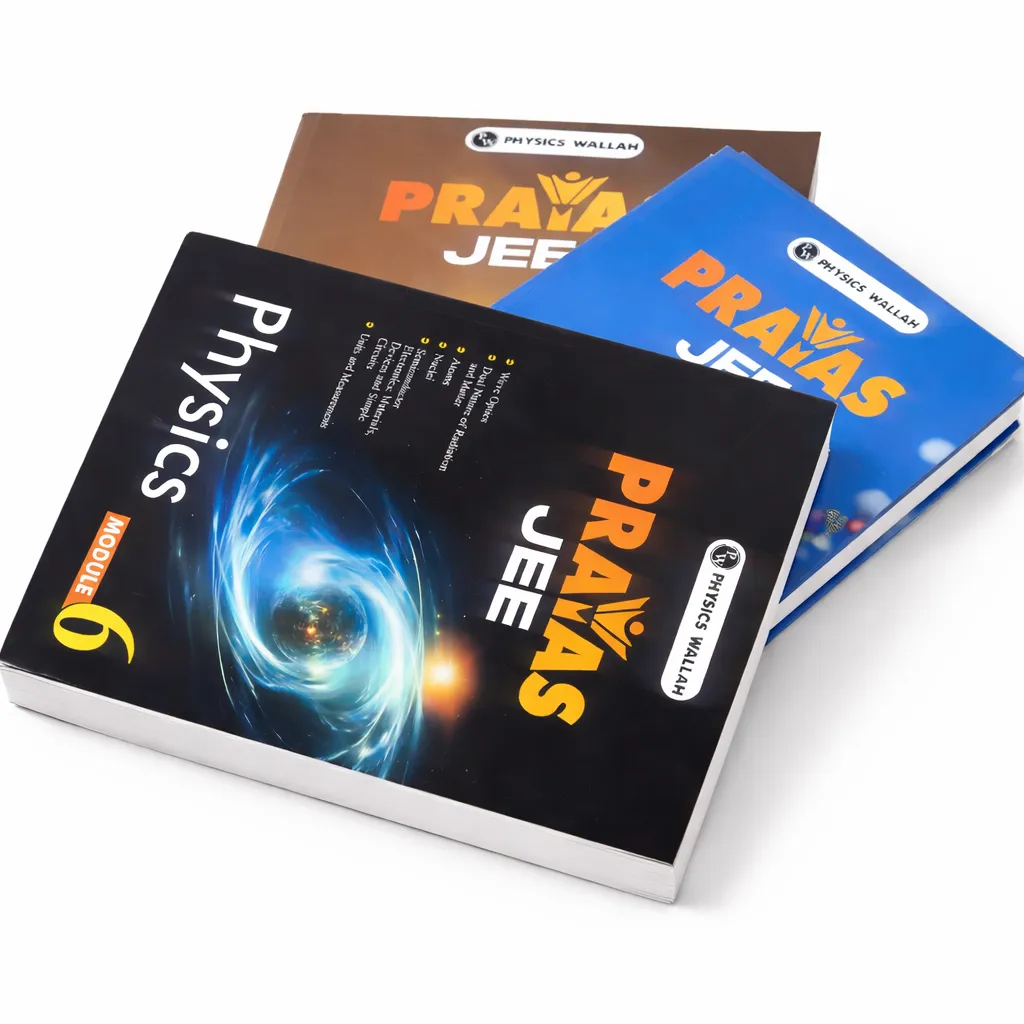 PW Prayas JEE Modules for 2026 | 18 Books Set for JEE 11+12 Preparation₹2,499
 Unacademy IIT JEE Version 4.0 for 2025- Complete Module Set Edition 24 Booklets₹3,499
 Bansal Classes Engineering Modules for JEE 2026 | 29 Modules for 11th+12th Class₹5,499
Continue reading
More in Buying Guides



Need help choosing?
Tell us your exam and stage on WhatsApp, we suggest the right set.