
JEE Main 2026 Preparation: Plan, Books, Weightage & Study Timetable
JEE Main 2026 preparation guide: 90-day study plan, daily timetable, chapter-wise weightage table, best books, marks-vs-percentile data and a mock-test strategy to score 99+ percentile.
 Competer

Last reviewed: October 2026. This guide is built on the official NTA exam pattern and the marks trend of the last 3–5 years of JEE Main question papers; always confirm specifics against the current NTA information bulletin.
Effective JEE Main 2026 preparation comes down to three things done consistently: master the NCERT and standard reference books for Physics, Chemistry and Maths; follow a phase-wise study plan that moves from concept-building to full-length mock tests; and prioritise high-weightage chapters using a data-backed marks table from the last 3-5 years of papers. Do this with 6-8 focused hours a day, 30-40 questions daily, a maintained error log and 20-30 full mocks before the exam, and a 99+ percentile is realistically achievable even if you start with only 3-4 months in hand.
This guide gives you everything the coaching and aggregator pages leave out: a concrete 90-day roadmap, a printable daily timetable, a chapter-wise weightage table, a marks-vs-percentile reference, subject-wise strategy, the exact books to buy, separate plans for Class 11 / Class 12 / droppers, and a mock-and-PYQ framework. Let’s build your roadmap.
JEE Main 2026 Exam Overview and Important Dates
JEE Main is conducted by the National Testing Agency (NTA) twice a year. The score is used for admission to NITs, IIITs, GFTIs and several state and private engineering colleges, and Paper 1 is also the qualifying gateway for JEE Advanced (for IIT admission). The two-session, two-attempt system lets you appear in both January and April, and your best of the two NTA scores is considered for the final rank, so a weak first attempt does not end your chance.
| Particular | Detail |
|---|---|
| Conducting body | National Testing Agency (NTA) |
| Exam name | JEE (Main) 2026 — Paper 1 (B.E./B.Tech) & Paper 2 (B.Arch/B.Plan) |
| Session 1 (tentative) | Late January 2026 |
| Session 2 (tentative) | April 2026 |
| Mode | Computer-Based Test (CBT); Paper 2 drawing section is offline |
| Attempts | Two sessions; best score counted |
| Result | NTA percentile score with normalisation across shifts |
| Admission | NITs, IIITs, GFTIs + JEE Advanced eligibility |
Dates are tentative until NTA releases the official information bulletin on jeemain.nta.ac.in. Always verify the latest bulletin, as syllabus and pattern notes can be revised year to year.

JEE Main 2026 Exam Pattern and Syllabus Structure
Paper 1 (B.E./B.Tech) is a 3-hour computer-based test with three subjects — Physics, Chemistry and Mathematics — carrying equal weight. Each subject has two sections: Section A has 20 multiple-choice questions and Section B has 5 numerical-value questions, all of which are to be attempted. The total is 75 questions for 300 marks.
| Subject | Section A (MCQ) | Section B (Numerical) | Questions attempted | Marks |
|---|---|---|---|---|
| Physics | 20 | 5 | 25 | 100 |
| Chemistry | 20 | 5 | 25 | 100 |
| Mathematics | 20 | 5 | 25 | 100 |
| Total | 60 | 15 | 75 | 300 |
Marking scheme: +4 for every correct answer and −1 for every incorrect answer, in both MCQ and numerical sections. There is no negative marking for unattempted questions. Because of normalisation, your raw marks are converted to a percentile relative to your shift — so accuracy matters more than blindly attempting everything. The syllabus closely follows NCERT Class 11 and 12 for all three subjects, with a few chapters trimmed in recent years (always cross-check deletions in the official bulletin before investing time in a topic).
JEE Main 2026 Marks vs Percentile: What Score Gets You 99+
Knowing your target removes guesswork from your JEE Main 2026 preparation strategy. Percentile depends on shift difficulty and the number of candidates, so the band below is an approximate reference drawn from recent years’ trends — not an official promise. Use it to set a realistic marks goal per subject.
| Approx. marks (/300) | Approx. percentile | What it means |
|---|---|---|
| 250+ | 99.5+ | Top NITs/IIITs range; strong JEE Advanced base |
| 200-250 | 98-99.5 | Good NIT/IIIT chances across branches |
| 150-200 | 95-98 | Mid-tier NITs, GFTIs, many state colleges |
| 100-150 | 85-95 | Qualifying-plus; state/private options widen |
The practical takeaway: aiming for roughly 85-90 marks per subject puts a 99+ percentile in play. That is why securing high-weightage chapters with high accuracy — rather than chasing the entire syllabus — is the smartest route.
How to Start JEE Main 2026 Preparation From Zero (Step-by-Step)
If you are wondering how to prepare for JEE Main 2026 from scratch, the biggest mistake is jumping straight into advanced problem books. Build the foundation first, then layer difficulty. Follow this checklist in order:
- Step 1 — Read NCERT line by line: It is the backbone of the syllabus, especially for Chemistry. Finish the relevant NCERT chapter before touching any reference book.
- Step 2 — Build concepts with one standard book per subject: HC Verma for Physics, OP Tandon/NCERT for Chemistry, RD Sharma/NCERT for Maths basics.
- Step 3 — Make short notes and a formula sheet for every chapter as you learn it — this becomes your revision gold in the final month.
- Step 4 — Practise 30-40 questions daily, starting easy and moving to exam-level and previous-year questions.
- Step 5 — Start an error log from Day 1: every wrong question, why it went wrong, and the correction.
- Step 6 — Add mock tests once a chapter cluster is complete, then weekly full-length mocks in the final phase.
A structured module set keeps this sequence in order instead of hopping between random PDFs. The eSaral IIT JEE Modules 2026 cover the complete syllabus chapter-wise, so you can move from NCERT to graded practice without hunting for material across sources.
JEE Main 2026 Study Plan: 90-Day (3-4 Months) Phase-Wise Roadmap
Is 3-4 months enough? Yes — provided every week is accounted for. A focused 90-day window, broken into three phases, is enough to cover high-weightage chapters thoroughly and get mock-test-ready. The plan below assumes 6-8 hours a day; scale the hours down if you are preparing alongside school.
| Phase | Weeks | Focus | Target |
|---|---|---|---|
| Phase 1 — Concept Building | Weeks 1-5 | Finish high- & medium-weightage chapters from NCERT + reference books; make short notes | 70% syllabus covered |
| Phase 2 — Practice & PYQ | Weeks 6-9 | Chapter-wise and mixed problem solving; last 10 years’ PYQs; topic tests | 2,000+ quality questions solved |
| Phase 3 — Mock & Final Push | Weeks 10-12 | Full-length mocks every 2-3 days, error analysis, formula-sheet revision | 15-20 full mocks + revision |
Week-by-week breakdown
- Weeks 1-5: Devote mornings to the toughest subject for you, afternoons to a second subject, and evenings to Chemistry theory + revision. Finish Modern Physics, Electromagnetism, Organic Chemistry, Physical Chemistry, Calculus and Coordinate Geometry early — they carry the most marks.
- Weeks 6-9: Shift to volume. Solve chapter-wise previous-year questions, then mixed sets. Begin half-length (90-minute) sectional tests twice a week.
- Weeks 10-12: Simulate the real exam — attempt full 3-hour mocks in the same time slot as your shift, analyse every mock for 60-90 minutes, and revise only from your short notes and error log.
JEE Main 2026 Daily Timetable Template (6-8 Hours)
A study plan fails without a daily rhythm. This timetable balances theory, problem-solving, revision and error analysis — the four pillars of effective JEE Main 2026 preparation strategy. Adjust the clock to your school/college hours, but keep the ratio.
| Time block | Activity | Duration |
|---|---|---|
| Morning (fresh mind) | New concept / toughest subject theory + derivations | 2 hours |
| Late morning | Problem-solving on the morning topic (15-20 questions) | 1.5 hours |
| Afternoon | Second subject — theory + practice | 2 hours |
| Evening | Chemistry theory / revision of previous chapters | 1.5 hours |
| Night | Error-log review + 10-15 PYQ/mixed questions | 1 hour |
Target 30-40 quality questions a day across subjects, not 100 rushed ones. Keep one day a week lighter for consolidation and one full revision slot every Sunday. Sleep 7 hours — a tired brain makes silly, negative-marking mistakes.
JEE Main 2026 High-Weightage / Important Chapters (Data-Backed Table)
This is where smart students beat hard-working ones. Instead of treating every chapter equally, weight your effort toward chapters that reliably carry more marks. The table below ranks high-weightage chapters by approximate expected marks based on the trend of the last 3-5 years of JEE Main papers. Treat it as a priority guide, not a guarantee.
| Subject | High-weightage chapters | Approx. expected marks |
|---|---|---|
| Physics | Modern Physics, Electrodynamics (Current + Magnetism), Optics, Semiconductors & EM Waves | ~45-55 |
| Physics | Mechanics (Kinematics, Laws of Motion, Rotation, Work-Energy) | ~25-30 |
| Chemistry | Organic (GOC, Hydrocarbons, Oxygen-containing compounds, Biomolecules) | ~35-40 |
| Chemistry | Physical (Thermodynamics, Equilibrium, Electrochemistry, Mole Concept) | ~30-35 |
| Chemistry | Inorganic (Chemical Bonding, Coordination Compounds, Periodic Table, p-block) | ~30-35 |
| Maths | Calculus (Limits, Continuity, Differentiation, Integration, Area, Diff. Equations) | ~40-50 |
| Maths | Coordinate Geometry (Straight Lines, Circles, Conics) + Vectors & 3D | ~30-40 |
| Maths | Algebra (Complex Numbers, Matrices & Determinants, Sequences, P&C, Probability) | ~35-45 |
Smart ROI: what to prioritise vs deprioritise
Chemistry is widely regarded as the most scoring subject — it is less calculation-heavy and highly NCERT-driven, so it offers the best marks-per-hour return. Lock it in first. Within Maths, Calculus and Algebra together can fetch nearly half the paper, so never leave them weak. Low-return, low-frequency topics (for example, some isolated Physics topics that appear in only one question some years) can be deprioritised after you have secured the high-weightage core — not before.
Subject-Wise Strategy: Physics, Chemistry and Maths
Physics — concepts before formulae
Physics rewards conceptual clarity and application, not rote formulae. Build intuition with HC Verma, then drill numericals with DC Pandey. Modern Physics and Electromagnetism are your biggest scorers — master them early. Maintain a dedicated formula sheet and revise derivations weekly.
Chemistry — your highest-return subject
Chemistry splits into three parts with different strategies: Inorganic is memory-based — NCERT is king, so read it repeatedly and make fact sheets for Coordination Compounds and Chemical Bonding. Organic needs mechanism understanding, not mugging up reactions. Physical is numerical — practise Mole Concept, Thermodynamics and Equilibrium daily. Because it is the top-scoring subject, aim to finish Chemistry questions fastest in the exam to save time for Maths.
Mathematics — speed and accuracy
Maths is the biggest differentiator in rank because it is the most time-consuming section. The goal is speed with accuracy: practise until standard problems become reflexive. Prioritise Calculus, Coordinate Geometry and Algebra. Time your practice sets and work on reducing calculation errors — in a normalised exam, two silly mistakes can cost a percentile band.
Best Books for JEE Main 2026 Preparation (Subject-Wise)
Is NCERT enough? NCERT is the non-negotiable foundation — essential and often sufficient for Inorganic Chemistry — but for Physics and Maths you need reference books for exam-level problems. Here is the proven subject-wise booklist.
| Subject | Foundation | Concepts | Practice / Advanced |
|---|---|---|---|
| Physics | NCERT Class 11 & 12 | HC Verma (Vol 1 & 2) | DC Pandey series, Cengage Physics |
| Chemistry | NCERT (both years) — core | OP Tandon (Physical & Organic) | JD Lee (Inorganic), MS Chouhan (Organic) |
| Mathematics | NCERT Class 11 & 12 | RD Sharma (basics) | Cengage (G. Tewani), Arihant/RD Objective |
Do not buy every book listed — pick one concept book and one practice book per subject and finish them completely. Scattered half-read books hurt more than one mastered source. If you prefer a single structured set that maps to the syllabus with mindmaps and graded questions, chapter-wise modules like the eSaral IIT JEE Modules 2026 consolidate theory and practice so you are not juggling five books at once.
Mock Tests, PYQs and the Error-Analysis Framework
How many mock tests should you take? Aim for 20-30 full-length mocks before the exam, scaling up in the last 4-6 weeks. But mocks without analysis are wasted — the learning happens when you dissect your mistakes. Previous-year questions (PYQs) of the last 8-10 years are equally critical because JEE Main repeats concepts and question patterns heavily.
| Stage | Mock frequency | Focus of analysis |
|---|---|---|
| Phase 1 (concept) | Chapter-wise tests after each cluster | Conceptual gaps |
| Phase 2 (practice) | 1-2 sectional tests / week | Speed & topic accuracy |
| Phase 3 (final push) | Full mock every 2-3 days | Time management, silly errors, negative marking |
The error-log method
After every mock, categorise each wrong/skipped question into one of three buckets: (1) Concept gap — revise the topic; (2) Silly mistake — note the exact slip (sign error, misread, calculation); (3) Time pressure — practise that topic’s speed. Review this log before every new mock. Also track your attempt-vs-accuracy ratio: it is usually better to attempt ~60-65 confident questions with 90%+ accuracy than to attempt all 75 and lose marks to negative marking. Leave a question blank when you are purely guessing.
JEE Main 2026 Plans for Different Student Profiles
One generic plan does not fit everyone. Match your approach to where you stand right now.
| Profile | Time horizon | Core strategy |
|---|---|---|
| Class 11 early-starter | 18+ months | Build rock-solid fundamentals; finish Class 11 syllabus with NCERT + one reference book; start PYQs of Class 11 topics |
| Class 12 student | 10-12 months | Balance boards and JEE (overlap is high); revise Class 11 on weekends; mocks from month 6 |
| Dropper / repeater | ~12 months | Diagnose previous weak areas, rebuild concepts, then go mock-heavy; aim for consistency and a strong Session 1 |
| Last 3-4 months only | 90 days | High-weightage chapters first, PYQ-driven, daily mocks in final month — accept you cannot cover 100% and maximise ROI |
If you are also weighing medical entrance prep or guiding a sibling, our Careerwill NEET Study Module Set follows the same module-based, syllabus-mapped approach for NEET aspirants.
Can You Crack JEE Main 2026 Without Coaching? (Self-Study Plan)
Yes — many top rankers prepare largely on their own. Self-study works when four things are in place: a fixed timetable you actually follow, one concept book and one practice book per subject (or a syllabus-mapped module set), disciplined PYQ and mock practice, and an honest error-analysis routine. The gap self-studiers must consciously fill is doubt-solving and periodic benchmarking — use solution keys, peer groups and regular mock rankings so you are not studying in a vacuum. The advantage is full control over pace and revision, which matters most in the final 90 days.
How to Use the Two-Session System (Session 1 vs Session 2)
Because NTA counts your best score, plan both attempts deliberately. Treat Session 1 (January) as your target attempt — prepare fully for it. If it falls short, Session 2 (April) becomes a focused improvement window where you fix the exact weaknesses your January score exposed. Do not treat January as a casual “practice” attempt and bank everything on April; the stress of a single final attempt is far higher. Between the two sessions, revise from your error log and short notes rather than restarting from scratch. Remember that scores are normalised across shifts into a percentile, so your relative performance — not raw marks — determines your rank.
Common Mistakes to Avoid in JEE Main 2026 Preparation
- Skipping NCERT for fancy reference books — especially fatal in Chemistry.
- Hoarding resources — ten half-read books instead of two mastered ones.
- No revision cycle — without spaced repetition and formula sheets, concepts fade in weeks.
- Mocks without analysis — attempting tests but never studying the mistakes.
- Ignoring weightage — spending equal time on a 2-mark topic and a 20-mark topic.
- Over-attempting — guessing blindly and bleeding marks to negative marking.
- Neglecting health — cutting sleep, which quietly destroys exam-day accuracy.
Avoid these and you are already ahead of most of the cohort. Pair a disciplined timetable with chapter-wise modules and consistent PYQ practice, and your JEE Main 2026 preparation will compound week on week.
Frequently Asked Questions
How do I start JEE Main 2026 preparation from zero?
Start with NCERT for every subject to lock the foundation, then add one concept book per subject (HC Verma, OP Tandon, RD Sharma). Make short notes and a formula sheet from Day 1, practise 30-40 questions daily beginning with easy problems, keep an error log, and introduce chapter tests as soon as a topic cluster is done. Prioritise high-weightage chapters first so early progress translates into marks.
How many hours should I study daily for JEE Main 2026?
Aim for 6-8 hours of focused study a day if you are a dropper or in the final months, and 4-6 hours for Class 11-12 students balancing school. Quality beats quantity — 6 deep-focus hours with 30-40 solved questions and proper revision outperform 10 distracted hours.
Is 3-4 months (90 days) enough to prepare for JEE Main 2026?
Yes, if you follow a high-weightage-first plan. Use the three-phase 90-day roadmap: 5 weeks of concept building on top chapters, 4 weeks of PYQ and practice, and 3 weeks of full-length mocks with error analysis. You may not cover 100% of the syllabus, but you can realistically target a strong percentile.
Is NCERT enough to crack JEE Main 2026?
NCERT is sufficient and essential for Inorganic Chemistry and forms the foundation for every subject. However, for Physics and Mathematics you also need reference books like HC Verma, DC Pandey and Cengage for exam-level problem practice, since NCERT alone does not provide enough JEE-standard questions.
Which are the most important high-weightage chapters for JEE Main 2026?
Based on recent trends: Modern Physics and Electromagnetism in Physics; Organic, Coordination Compounds and Chemical Bonding in Chemistry; and Calculus, Coordinate Geometry, Vectors-3D and Algebra in Mathematics. These consistently carry the highest marks, so secure them before lower-frequency topics.
How many mock tests should I take before JEE Main 2026?
Target 20-30 full-length mock tests, concentrated in the final 4-6 weeks with one every 2-3 days. Equally important is analysing each mock for 60-90 minutes using an error log that sorts mistakes into concept gaps, silly errors and time-pressure issues.
What marks give a 99+ percentile in JEE Main 2026?
Roughly 250+ out of 300 has historically fallen in the 99.5+ percentile band, and about 200-250 in the 98-99.5 band, though exact cut-offs vary with shift difficulty and candidate numbers. Practically, scoring around 85-90 marks per subject puts a 99+ percentile within reach.
Can I prepare for JEE Main 2026 without coaching through self-study?
Absolutely. Many top rankers are self-taught. The key is a structured plan, the right books or chapter-wise modules, disciplined PYQ and mock practice, and an honest error-analysis routine. Self-study with quality printed study material gives you full control over your pace and revision.
Recommended Study Material


Competer
The Competer team: we pack the orders, so we know which editions aspirants keep coming back for.
Get it printed
JEE study material aspirants order most on Competer, delivered across India
 eSaral IIT JEE Modules 2026 | Complete Modules for JEE Preparation₹3,499
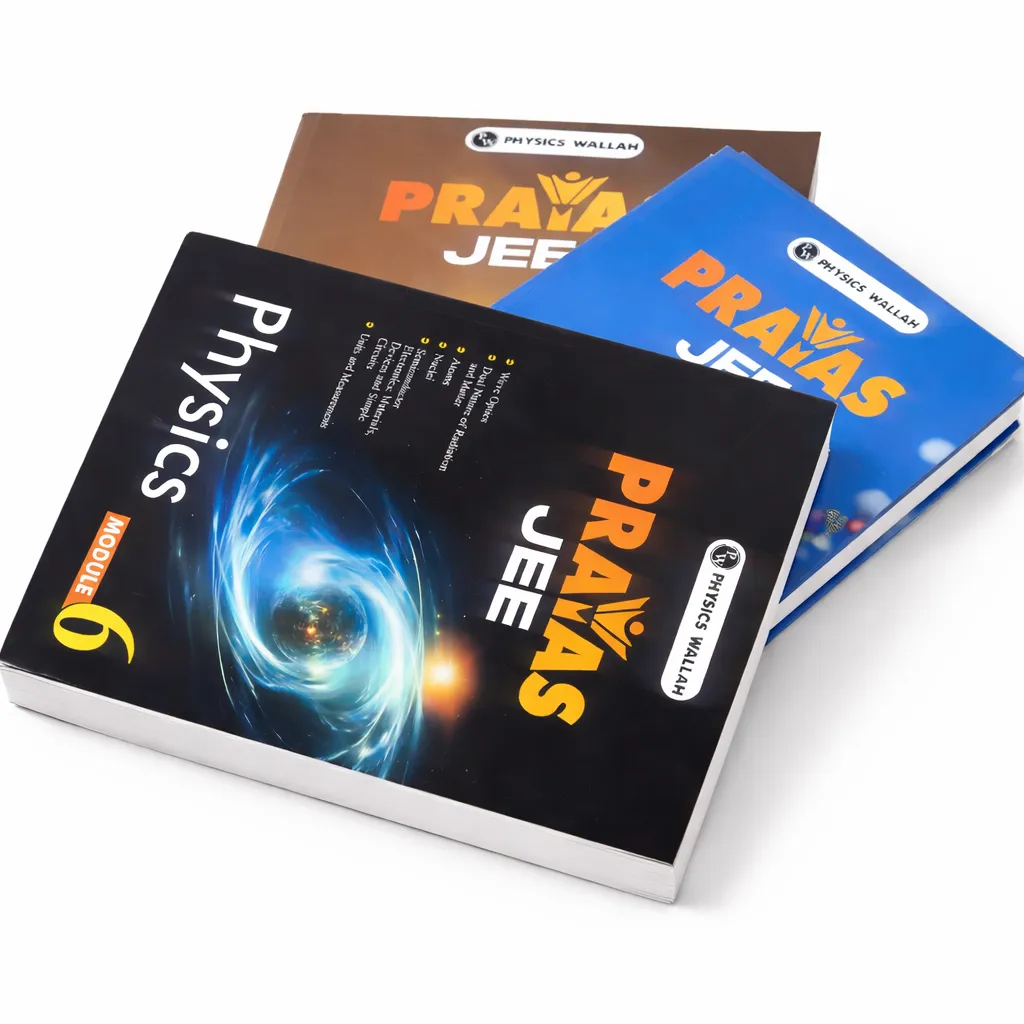 PW Prayas JEE Modules for 2026 | 18 Books Set for JEE 11+12 Preparation₹2,499
 Unacademy IIT JEE Version 4.0 for 2025- Complete Module Set Edition 24 Booklets₹3,499
 Bansal Classes Engineering Modules for JEE 2026 | 29 Modules for 11th+12th Class₹5,499
Continue reading
More in Buying Guides



Need help choosing?
Tell us your exam and stage on WhatsApp, we suggest the right set.