
JEE Advanced Syllabus 2026: Subject-Wise Topics
Complete JEE Advanced syllabus 2026 with subject-wise Physics, Chemistry, Maths topics, PYQ weightage tables, exam pattern.
 Competer

The jee advanced syllabus for 2026 covers three subjects — Physics, Chemistry and Mathematics — across two compulsory papers (Paper 1 and Paper 2) conducted in Computer-Based Test (CBT) mode. IIT Roorkee, the organising institute for 2026, has released the syllabus with no changes compared to 2025, and JEE Advanced 2026 is scheduled for 17 & 18 May 2026. The official syllabus and subject-wise PDFs are available on jeeadv.ac.in.
This guide gives you the complete, chapter-wise JEE Advanced 2026 syllabus for all three subjects, a PYQ-analysis-based weightage table for each, the exam pattern and marking scheme, the Class 11 vs Class 12 split, a clear JEE Main vs JEE Advanced difference table, the AAT syllabus, recommended books, and a printable topic-wise checklist — everything an aspirant, parent or teacher needs to plan preparation.
JEE Advanced Syllabus 2026: Quick Overview
JEE Advanced is the second and final stage of the IIT admission process, taken by the top ~2.5 lakh rank-holders of JEE Main. The jee advanced syllabus 2026 is deliberately deeper and more application-heavy than JEE Main, even though the chapter list overlaps heavily. Here is a snapshot before we dive into each subject.
| Particular | Detail (2026) |
|---|---|
| Conducting body | IIT Roorkee (under JAB) |
| Subjects | Physics, Chemistry, Mathematics |
| Papers | Paper 1 & Paper 2 (both compulsory) |
| Mode | Computer-Based Test (online) |
| Duration | 3 hours each paper (same day) |
| Exam date | 17 & 18 May 2026 |
| Marking | Full, partial & negative marking |
| Languages | English & Hindi |
| Syllabus change vs 2025 | No change |
Because the syllabus is settled, early 2026 aspirants can commit to a fixed plan without worrying about revisions. Well-structured, chapter-wise notes make a big difference at this depth — our printed eSaral IIT JEE Modules 2026 are built exactly around this official syllabus.

JEE Advanced 2026 Exam Pattern & Marking Scheme
JEE Advanced does not fix the number of questions or the exact mark distribution in advance — both papers follow a variable pattern decided each year. However, the structure is consistent: each paper is divided into three sections (Physics, Chemistry, Mathematics) with multiple question types. Understanding this is as important as the syllabus itself because negative marking here is unforgiving.
| Feature | Paper 1 & Paper 2 |
|---|---|
| Sections per paper | 3 (Physics, Chemistry, Maths) |
| Question types | Single-correct MCQ, multiple-correct MCQ, numerical/integer, match-the-column, comprehension |
| Total marks | Typically ~180 per paper (~360 combined) |
| Marking | +3/+4 full; partial marks for multi-correct; −1 to −2 negative |
| Numerical questions | Usually no negative marking |
| Duration | 3 hours per paper |
How many subjects and sections are there in JEE Advanced?
There are three subjects — Physics, Chemistry and Mathematics — and three corresponding sections in each of the two papers. You must attempt both Paper 1 and Paper 2 on the same day; skipping either disqualifies you.
JEE Advanced Physics Syllabus 2026
The jee advanced physics syllabus rewards conceptual depth and problem-solving stamina over rote formula recall. It is organised into General physics, Mechanics, Thermal physics, Electricity & Magnetism, Optics and Modern physics.
| Unit | Key topics |
|---|---|
| General physics | Units & dimensions, error & least count analysis, experimental skills (Vernier, screw gauge, meter bridge, etc.) |
| Mechanics | Kinematics, Newton’s laws, friction, work-energy-power, circular motion, centre of mass, momentum, rotational dynamics, gravitation, SHM, fluids & elasticity, waves |
| Thermal physics | Thermal expansion, calorimetry, kinetic theory of gases, laws of thermodynamics, heat transfer, Newton’s law of cooling |
| Electricity & Magnetism | Electrostatics, capacitors, current electricity, magnetic effects of current, magnetism, EMI, alternating current |
| Optics | Ray optics (reflection, refraction, lenses, prisms), wave optics (interference, diffraction, Young’s double slit) |
| Modern physics | Atomic structure, photoelectric effect, X-rays, nuclei & radioactivity, matter waves, semiconductors & logic gates |
JEE Advanced Physics weightage (PYQ-based)
Based on an analysis of the last five years of question papers, this is how marks typically distribute — use it to prioritise, not to skip.
| Area | Approx. weightage |
|---|---|
| Mechanics | 30–35% |
| Electricity & Magnetism | 25–30% |
| Modern physics | 12–15% |
| Optics | 10–12% |
| Thermal physics | 8–10% |
| General physics | 5–7% |
High-impact topics: Rotational mechanics, electrostatics, current electricity, EMI, and modern physics are near-guaranteed scorers and should be mastered first.
JEE Advanced Chemistry Syllabus 2026
The jee advanced chemistry syllabus is split into Physical, Inorganic and Organic chemistry. Chemistry is widely considered the most scoring of the three subjects because a large chunk is fact-and-reaction based and less calculation-heavy than Physics or Maths.
| Branch | Key topics |
|---|---|
| Physical chemistry | Mole concept & stoichiometry, atomic structure, gaseous & liquid states, thermodynamics, chemical & ionic equilibrium, electrochemistry, chemical kinetics, solid state, solutions, surface chemistry |
| Inorganic chemistry | Periodic properties, chemical bonding, s-block, p-block, d- & f-block, coordination compounds, metallurgy (isolation of elements), qualitative salt analysis |
| Organic chemistry | Basic concepts & isomerism, GOC & reaction mechanisms, hydrocarbons, haloalkanes/haloarenes, alcohols-phenols-ethers, aldehydes-ketones-carboxylic acids, amines, biomolecules, polymers, practical organic chemistry |
JEE Advanced Chemistry weightage (PYQ-based)
| Branch | Approx. weightage |
|---|---|
| Organic chemistry | 35–40% |
| Physical chemistry | 30–35% |
| Inorganic chemistry | 28–32% |
High-impact topics: Chemical bonding, coordination compounds, p-block, GOC and named organic reactions, thermodynamics, ionic equilibrium and electrochemistry together account for the bulk of chemistry marks.
JEE Advanced Maths Syllabus 2026
The jee advanced maths syllabus is the subject where the Advanced-vs-Main gap is widest — questions chain multiple concepts and demand speed with accuracy. It spans Algebra, Trigonometry, Analytical geometry, Calculus and Vectors.
| Unit | Key topics |
|---|---|
| Algebra | Quadratic equations, complex numbers, sequences & series, permutations & combinations, binomial theorem, matrices & determinants, probability, logarithms |
| Trigonometry | Trigonometric ratios & identities, equations, inverse functions, properties of triangles, heights & distances |
| Analytical geometry | Straight lines, circles, parabola, ellipse, hyperbola, 3D geometry |
| Differential calculus | Functions, limits, continuity & differentiability, derivatives, applications (maxima-minima, tangents-normals) |
| Integral calculus | Indefinite & definite integrals, area under curves, differential equations |
| Vectors | Vector algebra, dot & cross products, scalar & vector triple products |
JEE Advanced Maths weightage (PYQ-based)
| Area | Approx. weightage |
|---|---|
| Calculus (differential + integral) | 30–35% |
| Algebra | 25–30% |
| Coordinate & 3D geometry | 18–22% |
| Trigonometry | 8–10% |
| Vectors | 8–10% |
| Probability | 6–8% |
High-impact topics: Calculus (especially definite integrals and application of derivatives), complex numbers, matrices & determinants, conic sections and probability are the reliable mark-earners.
Class 11 vs Class 12 Syllabus Split for Phased Study
Roughly half the JEE Advanced syllabus comes from each class. Mapping topics to class helps droppers and Class 12 students decide what to revise first and lets Class 11 students build the right foundation early.
| Subject | Mostly Class 11 | Mostly Class 12 |
|---|---|---|
| Physics | Mechanics, thermal physics, waves, SHM | Electrostatics, current, EMI, optics, modern physics |
| Chemistry | Mole concept, atomic structure, bonding, thermodynamics, s/p-block, GOC, hydrocarbons | Electrochemistry, kinetics, solid state, d/f-block, coordination, oxygen-containing organic, biomolecules |
| Maths | Trigonometry, sequences, straight lines, circles, permutations & combinations | Calculus, 3D geometry, vectors, probability, matrices & determinants |
JEE Main vs JEE Advanced Syllabus: What’s Different
A common doubt is whether the two exams share the same syllabus. The chapter lists overlap by about 85–90%, but there are clear differences in both coverage and depth.
Is JEE Advanced syllabus same as JEE Main?
No — they are similar but not identical. JEE Advanced adds a few topics not in Main and drops some that appear only in Main, and crucially it probes every shared topic far more deeply with multi-concept problems.
| Only in JEE Advanced (extra) | Only in JEE Main (not in Advanced) |
|---|---|
| Thermal physics details (Newton’s law of cooling), elasticity emphasis | Semiconductors & communication (reduced/absent in Advanced) |
| Deeper qualitative salt analysis & practical chemistry | Electronic devices & logic gates (Main-heavy) |
| Greater depth in equilibrium, electrochemistry, organic mechanisms | Mathematical reasoning, statistics |
| Multi-concept, higher-order problem patterns | Set-theory-style direct questions |
Is JEE Advanced tougher than JEE Main?
Yes. JEE Main tests speed and accuracy on relatively direct questions; JEE Advanced tests conceptual depth, multi-step reasoning and the ability to combine topics. The same chapter can produce a one-step Main question and a four-step Advanced question.
Most Important / High-Weightage Topics in JEE Advanced
If you are short on time, these are the topics that return the highest marks per hour of study, consolidated across all three subjects from recent papers.
| Subject | Must-master topics |
|---|---|
| Physics | Rotational mechanics, electrostatics, current electricity, EMI, modern physics |
| Chemistry | Chemical bonding, coordination compounds, p-block, GOC & organic mechanisms, thermodynamics, electrochemistry |
| Maths | Definite integrals, application of derivatives, complex numbers, conic sections, matrices & determinants, probability |
Best Books & Study Material for JEE Advanced 2026
At the Advanced level, NCERT alone is not enough (more on that below). You need concept-building books plus high-quality problem sets. Here is a subject-wise shortlist.
| Subject | Recommended books |
|---|---|
| Physics | HC Verma (Vol 1 & 2), DC Pandey, Irodov (selected problems) |
| Chemistry | NCERT (Inorganic), JD Lee, MS Chouhan (Organic), P Bahadur (Physical) |
| Maths | Cengage series, SL Loney (trig & coordinate), ML Khanna / problem books |
Standalone books, however, are not sequenced to the exam. A single syllabus-aligned module set — theory, solved examples, mindmaps and graded practice in one place — saves months of assembling. Our eSaral IIT JEE Modules 2026 are mapped chapter-by-chapter to the official syllabus above, so each weightage block has ready notes and a question bank attached. Students preparing for both exams can pair them with the Careerwill NEET Study Module Set for the shared Physics and Chemistry foundation.
Subject-Wise Preparation Tips & Timeline
A realistic plan treats the two years (or one, for droppers) in phases. Use this timeline as a template and adjust to your starting level.
| Phase | Focus |
|---|---|
| Months 1–4 | Build concepts class-wise (Class 11 core), finish NCERT Chemistry, start HC Verma Physics |
| Months 5–9 | Complete Class 12 topics, begin Advanced-level problem solving, start full-chapter tests |
| Months 10–12 | Previous-year papers, mixed mock tests, error-log revision |
| Final 6–8 weeks | Full-length Paper 1 + Paper 2 mocks, high-weightage topic revision only |
Physics: solve derivation-style problems, not just plug-and-play numericals. Chemistry: make a reaction-and-exception sheet for Inorganic and revise it weekly. Maths: speed comes from doing, not reading — aim for 40+ problems a day in your weak units.
How to Cover the JEE Advanced Syllabus in a Limited Time
If you only have 6–8 months, do not attempt 100% coverage. Lock the 70% of topics that carry 90% of the marks (the high-weightage tables above), master previous-year patterns, and treat low-weightage areas as revision-only. Consistency with a daily target beats sporadic long sessions — a printable checklist (next section) keeps this honest.
Is NCERT enough for JEE Advanced?
For Chemistry, NCERT is near-essential — especially Inorganic, where direct lines are tested. For Physics and Maths, NCERT builds the base but is not sufficient; you must move to reference books and Advanced-level problem sets. Rule of thumb: NCERT for concepts and Inorganic facts, reference modules for problem-solving depth.
Where to Download the Official JEE Advanced Syllabus PDF
The authoritative source is always the official website. You can download the complete jee advanced syllabus pdf download and individual subject PDFs here:
- Official combined syllabus PDF — jeeadv.ac.in → Syllabus section
- Physics, Chemistry and Mathematics subject-wise PDFs — same page
- AAT syllabus — listed separately on the same portal
Always cross-check any third-party PDF against the jeeadv.ac.in version, since older copies labelled 2024/2025 (or even 2027) still circulate online. For 2026, the syllabus is unchanged from 2025, so a 2025 official PDF is still valid content-wise.
Where can I download the JEE Advanced syllabus PDF?
Download it from the official JEE Advanced website, jeeadv.ac.in, under the Syllabus tab — this is the only source guaranteed to match the current exam.
AAT (Architecture Aptitude Test) Syllabus 2026
Candidates who qualify JEE Advanced and want B.Arch admission at IIT Kharagpur or IIT Roorkee must clear the Architecture Aptitude Test (AAT). It is a separate, drawing-and-aptitude test with no additional academic syllabus.
| Section | What it tests |
|---|---|
| Freehand drawing | Simple drawing of objects, scenes, their proportions & details |
| Geometrical drawing | Lines, angles, triangles, polygons, 2D/3D plan-elevation exercises |
| Three-dimensional perception | Understanding & appreciation of 3D forms, structures, volumes |
| Imagination & aesthetic sensitivity | Creative composition, context & aesthetics, logical thinking |
| Architectural awareness | Knowledge of famous architects, buildings & places |
Printable Topic-Wise Checklist (Revision Tracker)
Tick each block as you finish theory, then again after you clear a full-chapter test. Keep it on your desk through the final phase.
| Subject | Checklist blocks (tick when done) |
|---|---|
| Physics | □ Mechanics □ Thermal □ Electrostatics □ Current □ Magnetism/EMI □ Optics □ Modern physics |
| Chemistry | □ Physical (all) □ Inorganic (all) □ GOC □ Hydrocarbons □ Oxygen compounds □ Amines □ Biomolecules/Polymers |
| Maths | □ Algebra □ Trigonometry □ Coordinate □ 3D □ Differential calculus □ Integral calculus □ Vectors □ Probability |
A module set with pre-built chapter tests makes ticking this checklist effortless — the eSaral IIT JEE Modules include graded exercises per chapter so you can self-verify before moving on.
Frequently Asked Questions
What is the syllabus for JEE Advanced 2026?
The JEE Advanced syllabus 2026 covers Physics, Chemistry and Mathematics in depth across Paper 1 and Paper 2. Physics spans mechanics, thermal physics, electricity & magnetism, optics and modern physics; Chemistry covers physical, inorganic and organic branches; Maths includes algebra, trigonometry, coordinate geometry, calculus and vectors. It is released on jeeadv.ac.in by IIT Roorkee and is unchanged from 2025.
Has the JEE Advanced syllabus changed for 2026?
No. IIT Roorkee has retained the same syllabus as 2025 with no additions or deletions for 2026, so aspirants can prepare with the existing official PDF from jeeadv.ac.in without waiting for revisions.
Which is the most important or high-weightage topic in JEE Advanced?
No single topic dominates, but the highest-return areas are Mechanics and Electromagnetism in Physics, Organic and Physical chemistry (especially bonding, coordination compounds and thermodynamics), and Calculus and Algebra in Maths. Together these cover the majority of marks in recent papers.
Is NCERT enough for JEE Advanced?
NCERT is sufficient for Inorganic Chemistry and for building core concepts, but it is not enough for Physics and Mathematics problem-solving at the Advanced level. Supplement NCERT with reference books and syllabus-aligned module sets that include higher-order practice questions.
How many subjects and papers are there in JEE Advanced 2026?
There are three subjects — Physics, Chemistry and Mathematics — and two compulsory papers, Paper 1 and Paper 2, each three hours long and conducted in computer-based mode on the same day.
Where can I download the JEE Advanced syllabus PDF for 2026?
Download the complete and subject-wise JEE Advanced syllabus PDF from the official website jeeadv.ac.in under the Syllabus section. This is the only fully reliable source; always verify third-party PDFs against it before using them to plan preparation.
Recommended Study Material


Competer
The Competer team: we pack the orders, so we know which editions aspirants keep coming back for.
Get it printed
JEE study material aspirants order most on Competer, delivered across India
 eSaral IIT JEE Modules 2026 | Complete Modules for JEE Preparation₹3,499
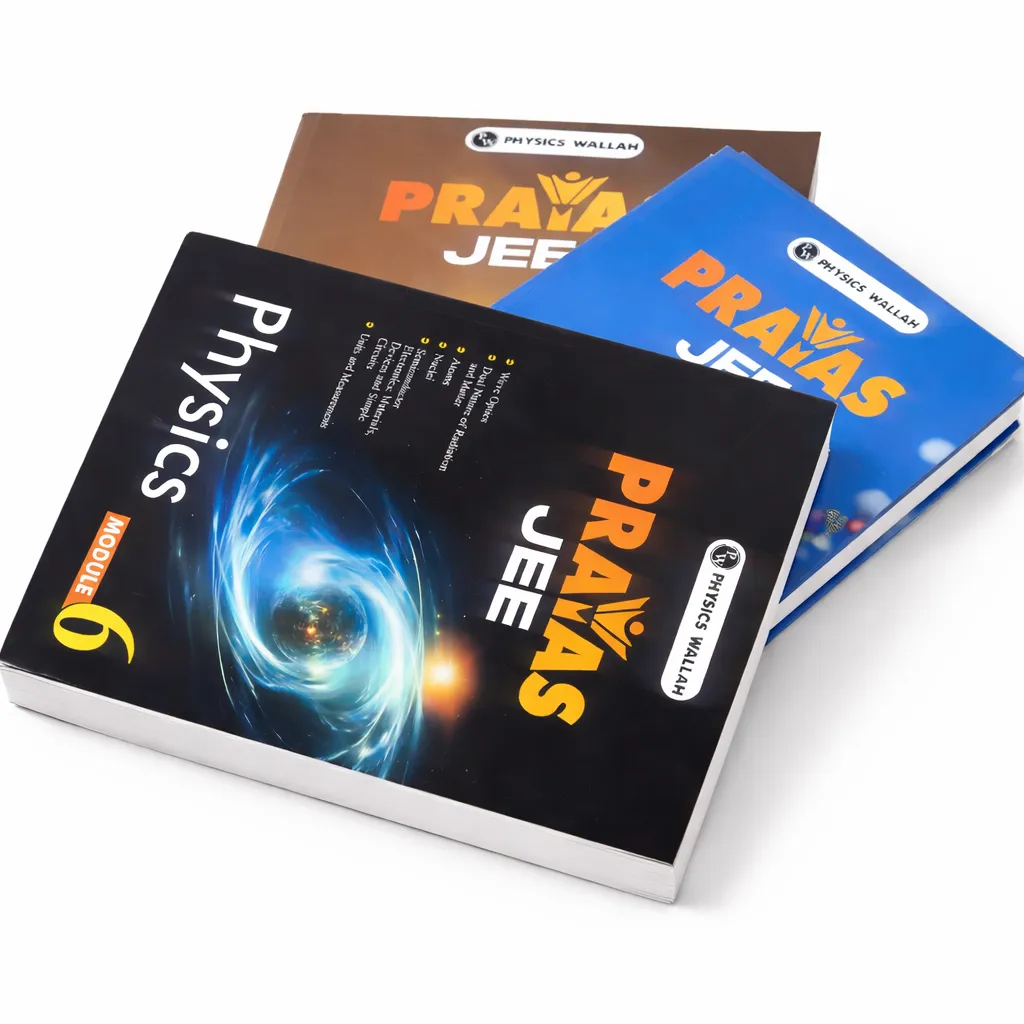 PW Prayas JEE Modules for 2026 | 18 Books Set for JEE 11+12 Preparation₹2,499
 Unacademy IIT JEE Version 4.0 for 2025- Complete Module Set Edition 24 Booklets₹3,499
 Bansal Classes Engineering Modules for JEE 2026 | 29 Modules for 11th+12th Class₹5,499
Continue reading
More in Buying Guides



Need help choosing?
Tell us your exam and stage on WhatsApp, we suggest the right set.