
Best Books for UPSC Prelims 2026: Subject-Wise List (GS + CSAT)
Best books for UPSC Prelims 2026 — subject-wise GS Paper 1 + CSAT booklist with editions, PYQ weightage, NCERTs, Hindi options and a topper-tested plan.
 Competer
The best books for UPSC Prelims 2026 are a tight, topper-tested set: NCERTs (Classes 6–12) as the base, then M. Laxmikanth (Polity), Spectrum (Modern History), Nitin Singhania (Art & Culture), GC Leong (Geography), Ramesh Singh or Sanjeev Verma (Economy), Shankar IAS (Environment), plus a CSAT manual and a monthly current affairs magazine. That is roughly 10–12 standard books — not a library. Read each 3–4 times, pair them with Previous Year Questions (PYQs), and you have 90% of what you need to clear the Civil Services Preliminary Examination.
This guide gives you the complete, subject-wise booklist for both GS Paper 1 and CSAT (Paper 2), with editions, which book to pick when two compete, PYQ-based weightage so you know why each book matters, a reading timeline, Hindi-medium options, and a ‘minimum viable’ list for beginners and working professionals. We also flag what you can safely skip so you do not over-buy.
At a glance: the UPSC Prelims booklist (subject wise)
If you read nothing else, read this. The table below is the entire core list — everything after it is detail on which edition, why it matters, and how to read it.
| Subject | Go-to book | Priority |
|---|---|---|
| Polity | M. Laxmikanth — Indian Polity | Must-have |
| Environment | Shankar IAS — Environment | Must-have |
| Modern History | Spectrum — A Brief History of Modern India | Must-have |
| Economy | Ramesh Singh or Sanjeev Verma (pick one) | Must-have |
| Geography | GC Leong + Atlas | High |
| Art & Culture | Nitin Singhania | High |
| Foundation | NCERTs (Classes 6–12) | Must-have |
| CSAT | CSAT Manual + reasoning practice | Must-have |
| Current Affairs | One monthly magazine (12 months) + newspaper | Must-have |
How we built this list (and how to trust any booklist)
A booklist is only as good as the logic behind it, so here is ours in the open. Every recommendation below is cross-checked against three things: the official UPSC Prelims syllabus, a decade of Previous Year Question papers mapped subject-by-subject, and the consistent pattern in what successful aspirants actually report revising — a small, fixed set rather than a sprawling one. Where two books compete for the same subject (Economy, Modern History), we tell you the trade-off instead of listing both, because owning both is the single most common way aspirants waste money and revision time. Nothing here asks you to buy more; most of it tells you what to leave out.
Why the right (and limited) books matter for UPSC Prelims
UPSC Prelims is a qualifying stage of 400 marks (GS Paper 1: 200, CSAT Paper 2: 200, the latter being qualifying at 33%). The syllabus is deliberately vague, which tempts aspirants into buying 40+ books. The toppers do the opposite — they fix a small list and revise it repeatedly. The principle is ‘limited books, unlimited revision’: your recall under exam pressure depends on how many times you have revised one standard source, not how many sources you touched once.
Data backs this. Across the last decade of Prelims papers, a consistent share of GS Paper 1 questions map directly to standard books — Polity to Laxmikanth, Environment to Shankar IAS, Economy basics to NCERT + Ramesh Singh. Buying a second book on the same subject gives diminishing returns; a third revision of the first book gives compounding returns.
| Prelims Paper | Marks | Questions | Negative Marking | Nature |
|---|---|---|---|---|
| GS Paper 1 | 200 | 100 | 1/3 (0.66) | Merit-ranking (cut-off decider) |
| CSAT Paper 2 | 200 | 80 | 1/3 (0.83) | Qualifying — 33% (66 marks) |
Start with NCERTs: the foundation before standard books
Before you touch any standard book, build the base with NCERTs (Classes 6–12). They are written in simple language, are factually reliable, and UPSC often frames questions directly from NCERT lines. For beginners especially, NCERTs convert an intimidating syllabus into a readable foundation.
Is NCERT enough to clear UPSC Prelims?
No — NCERTs are necessary but not sufficient. They build conceptual clarity and cover a meaningful chunk of easy questions, but they lack the depth, current-affairs linkage and factual density that Prelims demands in Polity, Environment and Economy. Treat NCERTs as Phase 1; standard books as Phase 2.
| Subject | Essential NCERT Classes | Why it matters |
|---|---|---|
| History | Class 6–8 (old), Class 11–12 (Themes in Indian History) | Chronology + base for Spectrum/Singhania |
| Geography | Class 6–12 (esp. 11th Fundamentals of Physical Geo) | Core physical + Indian geography concepts |
| Polity | Class 9–12 (Political Science) | Warm-up before Laxmikanth |
| Economy | Class 9–12 (esp. 11th Indian Economic Development) | Basic terms before Ramesh Singh |
| Science | Class 6–10 (General Science) | Covers most Prelims science directly |
Should I read the new or old NCERTs?
Use both strategically. The old NCERTs (RS Sharma for Ancient, Satish Chandra for Medieval, Bipan Chandra for Modern) are prized for History because they are denser and more chronological. The new NCERTs are better for Geography, Economy, Polity and Science, where clarity matters more than density. You do not need every class of every subject — follow the table above and stop there.
For a deeper, subject-wise breakdown of exactly which NCERTs to read and skip, our dedicated NCERT guide is a useful companion read before you finalise purchases.
Best books for UPSC Prelims — subject-wise GS Paper 1 booklist
This is the core subject-wise list of the best books for UPSC Prelims General Studies (GS Paper 1) that every aspirant should own. Each entry names the standard book, the ideal edition for 2026, and its approximate PYQ weightage so you can prioritise.
History — Ancient, Medieval, Modern & Art and Culture
History is split across four blocks. You do not need all four at equal depth — Modern History and Art & Culture carry the most Prelims weight.
- Ancient India — RS Sharma (old NCERT style). Light reading; low direct weightage.
- Medieval India — Satish Chandra. Read selectively; lowest priority.
- Modern India — Spectrum ‘A Brief History of Modern India’. High weightage — the freedom struggle is a Prelims favourite.
- Art & Culture — Nitin Singhania. Consistently 3–6 questions a year.
Spectrum vs Bipan Chandra — which Modern History book?
Pick Spectrum for Prelims — it is fact-dense, point-wise and built for objective recall. Keep Bipan Chandra (‘India’s Struggle for Independence’) for Mains-level understanding or if you have a History optional. For a Prelims-only candidate, Spectrum alone is enough.
Polity — M. Laxmikanth (non-negotiable)
Which book is best for UPSC Polity? M. Laxmikanth ‘Indian Polity’ — without debate. It is the single most important standard book for Prelims, routinely supplying 12–18 of the 100 GS questions. Buy the latest edition (updated for recent constitutional amendments and newly added schedules). Read it cover-to-cover a minimum of three times, and treat the summary tables at the end of each chapter as your final-week revision sheet.
Geography — GC Leong + Atlas
GC Leong ‘Certificate Physical and Human Geography’ covers physical geography cleanly. Pair it with the Oxford Student Atlas or Orient BlackSwan Atlas for map-based questions. NCERTs fill in Indian geography. Geography questions increasingly overlap with environment and current affairs (e.g., places in news), so keep an atlas open while reading the newspaper.
Economy — Ramesh Singh vs Sanjeev Verma
Both are popular. Choose one; do not read both.
| Criteria | Ramesh Singh (Indian Economy) | Sanjeev Verma (The Indian Economy) |
|---|---|---|
| Depth | Comprehensive, encyclopaedic | Concise, exam-focused |
| Best for | Serious aspirants, Economy-weak students | Beginners, limited-time candidates |
| Language | Denser | Simpler, more readable |
| Length | Longer (900+ pages) | Shorter, faster to revise |
| Verdict | Pick if you want one authoritative source and have time | Pick if you want to finish fast and revise more |
Environment & Ecology — Shankar IAS
The Shankar IAS Environment book is the Prelims gold standard — Environment & Ecology alone can account for 12–15 questions a year. Rajagopalan’s ‘Environmental Studies’ is an alternative but Shankar IAS is more Prelims-aligned. This is a must-buy in its latest edition, and it pairs naturally with environment-related current affairs (species in news, conventions, reports).
Science & Technology and Current Affairs
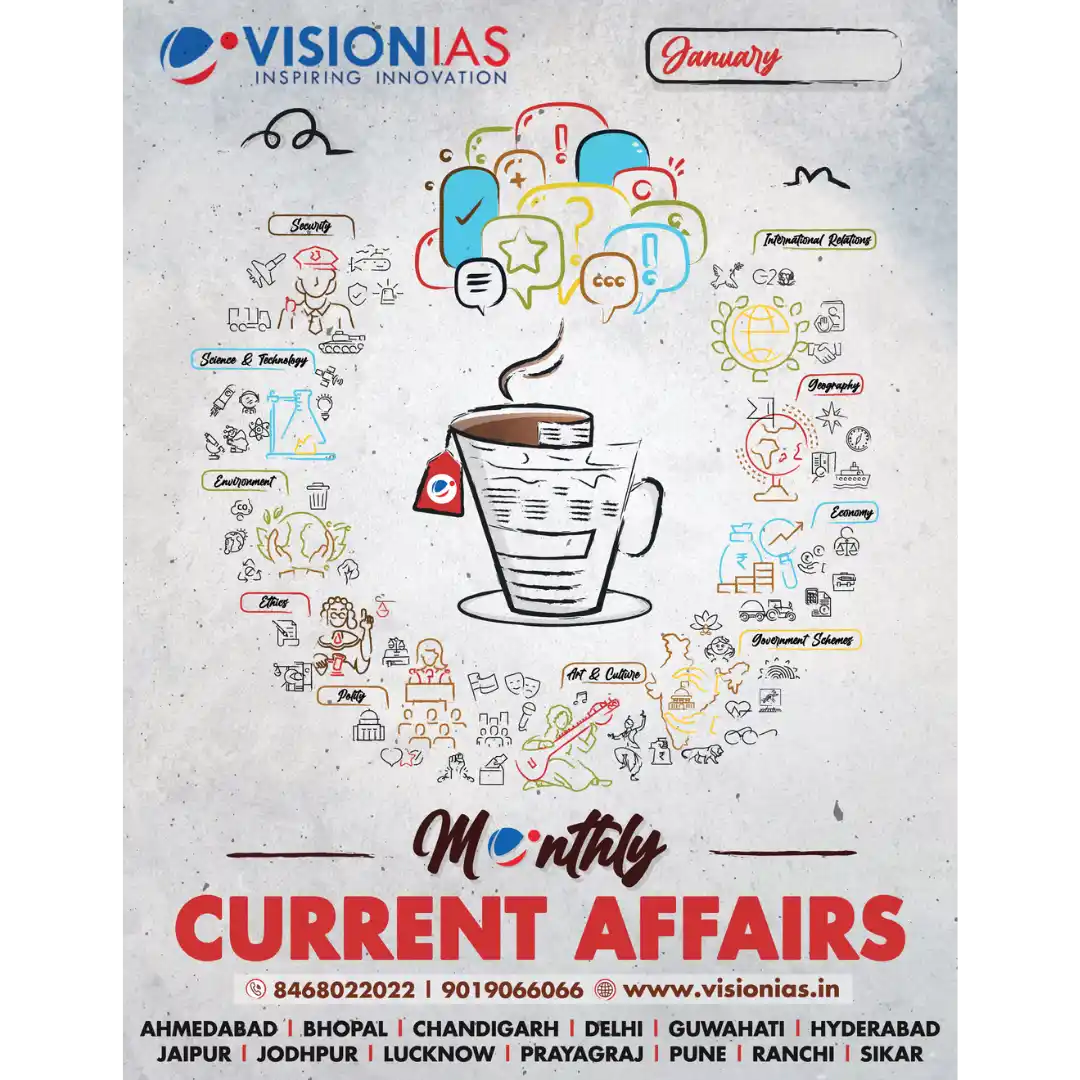
Do not buy a separate ‘science’ coaching book. NCERT General Science (Classes 6–10) plus current affairs (newspaper + monthly magazine) covers Prelims Science & Tech. Current affairs is where most aspirants leak marks — a reliable monthly magazine is essential. A quality source like the Vision IAS Current Affairs Magazine (January 2026) consolidates the month’s relevant events, and the December 2025 edition helps you build a continuous 12-month current-affairs base before the exam.
Complete GS Paper 1 booklist with editions & PYQ weightage
Here is the consolidated subject-wise table — your single reference for what to buy and why.
| Subject | Standard Book (Author) | Edition to buy | Approx. PYQ weightage |
|---|---|---|---|
| Polity | Indian Polity (M. Laxmikanth) | Latest edition | Very High (12–18 Qs) |
| Environment | Environment (Shankar IAS) | Latest ed. | Very High (12–15 Qs) |
| Economy | Indian Economy (Ramesh Singh / Sanjeev Verma) | Latest ed. | High (12–15 Qs) |
| Modern History | A Brief History of Modern India (Spectrum) | Latest revised | High (8–12 Qs) |
| Art & Culture | Indian Art & Culture (Nitin Singhania) | Latest ed. | Medium (3–6 Qs) |
| Geography | Physical & Human Geography (GC Leong) + Atlas | Latest ed. | Medium-High (8–12 Qs) |
| Ancient/Medieval | RS Sharma / Satish Chandra (or old NCERT) | Any recent | Low-Medium (3–5 Qs) |
| Current Affairs | Monthly magazine (12 months) + newspaper | 2025–26 issues | Very High (15–20 Qs) |
Always buy the most recent edition where it is available — Polity, Economy and Environment change year to year, and an outdated edition can cost you the two or three recall-based marks that decide a cut-off.
Best book for UPSC CSAT (Prelims Paper 2)
Which is the best book for CSAT? The Tata McGraw Hill ‘CSAT Paper 2’ Manual is the most complete single book, covering comprehension, reasoning, data interpretation and basic numeracy. For reasoning drill, add RS Aggarwal’s ‘A Modern Approach to Verbal & Non-Verbal Reasoning’.
Since 2023, CSAT difficulty has risen sharply — it is no longer a paper to ignore, even though it is only qualifying (33%). Comprehension and math fundamentals now decide who clears. A structured set like the Vajiram CSAT Complete Booklet Set with practice questions is a strong one-stop option for aspirants who want concept + practice in one place.
| CSAT Area | Best Resource | Priority |
|---|---|---|
| Comprehension | CSAT Manual + daily newspaper editorials | Highest |
| Quant / Numeracy | CSAT Manual / NCERT Maths (Class 6–10) | High |
| Logical Reasoning | RS Aggarwal Reasoning | High |
| Data Interpretation | CSAT Manual + practice sets | Medium |
Practical rule: attempt one full CSAT paper under timed conditions every week from month three onward. Most CSAT failures are not knowledge gaps — they are reading-speed and time-management gaps that only timed practice fixes.
Basic vs advanced books: a two-phase reading strategy
Split your prep into clear phases so you do not drown.
| Phase | Duration | What to read | Goal |
|---|---|---|---|
| Phase 1 — Foundation (Basic) | Months 1–3 | NCERTs (6–12) + Laxmikanth 1st read | Concept clarity, vocabulary |
| Phase 2 — Standard (Advanced) | Months 3–7 | Spectrum, Shankar IAS, Ramesh Singh, Leong, Singhania | Depth + fact density |
| Phase 3 — Revision + Tests | Months 7–11 | Re-read all + PYQs + mock tests | Retention + exam temperament |
How many revisions and hours per book?
Aim for at least three revisions of each core book. Rough reading effort: Laxmikanth ~40–50 hours first read (then 12–15 hours per revision), Spectrum ~25–30 hours, Shankar IAS ~20–25 hours, Economy ~30 hours. The second and third passes are far faster and are where marks are actually made.
Can you clear UPSC Prelims in 6 months with these books?
Yes — if you study full-time, limit sources ruthlessly and revise daily. A compressed six-month plan drops the optional add-ons and runs the minimum viable list on a tighter loop. Here is a realistic structure.
| Window | Focus | Books |
|---|---|---|
| Months 1–2 | Foundation + Polity | Core NCERTs + Laxmikanth (read 1) |
| Months 3–4 | High-weight standard books | Spectrum, Shankar IAS, one Economy book, Singhania, Leong |
| Month 5 | CSAT + current affairs consolidation | CSAT Manual + 12 months of one magazine |
| Month 6 | Revision + PYQs + full mocks | Re-read all + PYQ toolkit + weekly tests |
The non-negotiables in a six-month window: do not start any new book after month five, revise what you have read at least twice, and treat PYQs and mocks as part of the syllabus, not an extra.
Linking books to PYQs — why data-driven prep wins
A book is only ‘essential’ if PYQs justify it. The smartest aspirants read PYQs first, then read the book to answer them. This tells you exactly how deep to go in each subject and stops you over-reading low-yield areas. A dedicated topic-wise PYQ compilation is one of the highest-return purchases you can make.
The Forum IAS UPSC Prelims Toolkit — Topic-Wise PYQ (1992–2025) maps three decades of questions subject-by-subject, so you can see precisely which chapters of Laxmikanth or Shankar IAS repeat. Pairing your standard books with this toolkit converts passive reading into targeted scoring.
Minimum viable booklist for beginners & working professionals
What are the best books for UPSC Prelims for beginners? If you have limited time (working professionals, first-year aspirants), do not attempt the full advanced list. Master this minimum set first — it still covers the majority of Prelims marks.
| Must-Have (Minimum Viable) | Optional / Advanced Add-on |
|---|---|
| Selected NCERTs (6–12) | Satish Chandra (Medieval) |
| Laxmikanth (Polity) | Bipan Chandra (Modern, for Mains) |
| Spectrum (Modern History) | Second Economy book |
| Shankar IAS (Environment) | Separate Sci-Tech book |
| One Economy book + GC Leong | Extra test-series beyond one |
| Nitin Singhania (Art & Culture) | Multiple current-affairs magazines |
| CSAT Manual + 1 current-affairs magazine | — |
How many books are required for UPSC Prelims preparation?
Around 10–12 standard books plus NCERTs and current affairs — that is all. Anything beyond this is usually over-buying. The discipline is to limit sources and maximise revisions.
What can you safely skip?
Skip a second book on any subject you already own one for, skip exhaustive Ancient/Medieval reading (old NCERT is enough), skip multiple current-affairs magazines (one consistent source for 12 months beats five), and skip separate Science & Tech compilations.
Are digital PDFs or printed books better for Prelims?
For a syllabus you revise three to four times, most aspirants retain and annotate better on print — margin notes, underlining and the physical familiarity of ‘where on the page’ a fact sits all aid recall. Use digital for searchable current-affairs archives and quick look-ups; keep your core standard books in print so revision is friction-free.
Hindi-medium & bilingual book options
Are Hindi medium books available for UPSC Prelims? Yes — nearly every standard book has a Hindi edition, and coaching material is widely published in Hindi. Hindi-medium aspirants can follow the identical subject-wise list using Hindi editions of Laxmikanth (भारत की राजव्यवस्था), Spectrum, and NCERT Hindi versions, plus Hindi coaching booklets for consolidated notes.
For a ready printed Hindi package, the Drishti IAS Hindi Study Material (18 booklets) covers GS in Hindi, and the Vision IAS Current Affairs Magazine (Hindi edition) keeps Hindi-medium aspirants current without switching to English sources.
Total budget & combo value for the full Prelims set
Standard market books (Laxmikanth, Spectrum, Shankar IAS, Economy, Leong, Singhania, CSAT Manual) typically total roughly ₹3,500–₹5,000 when bought individually, before NCERTs and magazines. For aspirants who prefer consolidated, pre-organised coaching notes over assembling many separate books, a single GS booklet set can be more time-efficient — the Vision IAS GS 2026-27 Booklets (56 booklets with value-added material) bundles the full syllabus in one package, which suits candidates who want structure over sourcing.
Whichever route you pick, add one disciplined test series — practising under timed conditions is what converts reading into rank. A set like the Vision IAS Prelims Test Series 2026 builds accuracy and exam temperament, the single biggest differentiator in a qualifying paper with negative marking.
Common mistakes to avoid
- Buying too many books: five books half-read beat ten books touched once.
- Skipping PYQs: without them you cannot judge depth; you over-read low-yield topics.
- Ignoring CSAT until the end: post-2023 CSAT has failed well-prepared GS candidates.
- Changing books mid-prep: switching from Ramesh Singh to Sanjeev Verma in month 8 wastes your revisions.
- Buying an outdated edition: Polity, Economy and Environment update yearly; stale editions miss recall marks.
- No test practice: reading without mocks leaves accuracy and time-management untested.
Frequently Asked Questions
Which books are best for UPSC Prelims?
The best books are NCERTs (Classes 6–12) as a base, then Laxmikanth (Polity), Spectrum (Modern History), Nitin Singhania (Art & Culture), GC Leong (Geography), Ramesh Singh or Sanjeev Verma (Economy), Shankar IAS (Environment), a CSAT manual, and a monthly current-affairs magazine — about 10–12 standard books in total.
Is NCERT enough to clear UPSC Prelims?
No. NCERTs build essential foundations and cover easy questions, but they lack the depth and current-affairs linkage Prelims needs in Polity, Economy and Environment. Use NCERTs first, then move to standard books like Laxmikanth and Shankar IAS.
Which book is best for UPSC Polity?
M. Laxmikanth’s ‘Indian Polity’ (latest edition) is the undisputed best — it supplies 12–18 Prelims questions a year. Read it at least three times cover to cover.
Can I clear UPSC Prelims in 6 months with these books?
Yes, it is possible with full-time study, strict source-limiting and daily revision. Focus on the minimum viable booklist plus PYQs and one test series; skip optional advanced books and avoid starting new sources in the final months.
Which is the best book for CSAT (Prelims Paper 2)?
The Tata McGraw Hill CSAT Manual is the most complete single book, covering comprehension, reasoning, DI and numeracy. Add RS Aggarwal for reasoning practice, and treat CSAT seriously as it has become harder since 2023.
Are Hindi medium books available for UPSC Prelims?
Yes. Hindi editions exist for Laxmikanth, Spectrum and NCERTs, and full Hindi coaching material and current-affairs magazines are available, so Hindi-medium aspirants can follow the same subject-wise booklist without any disadvantage.
Recommended Study Material


Competer
The Competer team: we pack the orders, so we know which editions aspirants keep coming back for.
Get it printed
School study material aspirants order most on Competer, delivered across India
 FIITJEE Class 9th & 10th Complete Study Material₹6,499View on Competer →
 R. Paul Chemistry Notes (All Topics)₹2,200View on Competer →
 BANSAL CLASSES [2024 Edition] Study Material for Class 9₹2,499View on Competer →
 Aakash BYJU'S Biology Olympiad Study Package Set of 3 Books 2025 Edition₹1,799
Continue reading
More in Buying Guides



Need help choosing?
Tell us your exam and stage on WhatsApp, we suggest the right set.