
Best Books for JEE Main 2026: Subject-Wise List + Prices
Best books for JEE Main 2026: subject-wise Physics, Chemistry & Maths picks, topper choices, a minimal starter kit with prices, and is NCERT enough?
 Competer
The best books for JEE Main are NCERT (the non-negotiable foundation, especially for Chemistry) plus two trusted references per subject: Physics — HC Verma’s Concepts of Physics + DC Pandey Understanding Physics; Chemistry — NCERT + OP Tandon (Physical/Inorganic) and MS Chauhan/Morrison & Boyd (Organic); Maths — NCERT + Cengage (G. Tewani) or RD Sharma Objective. The single biggest mistake aspirants make is hoarding 8–10 books per subject. Toppers stick to 2–3 books per subject, finish them cover-to-cover, and drill previous year questions (PYQs).
Quick answer: there is no single “best” book — the best combination for JEE Main 2026 is NCERT as your compulsory base, one concept book and one practice book per subject, and 10+ years of PYQs solved under timed conditions. Master that small set and you cover the vast majority of the paper.
- Foundation (all subjects): NCERT Class 11 & 12 — compulsory, Chemistry especially.
- Physics: HC Verma for concepts, DC Pandey for JEE-pattern numericals.
- Chemistry: NCERT + OP Tandon (Physical/Inorganic) + MS Chauhan (Organic).
- Maths: NCERT + Cengage (G. Tewani) or RD Sharma Objective — pick one.
- Every subject: previous year questions (last 10+ years) are the highest-return resource.
- Rule of thumb: 2–3 books per subject, finished fully, beats ten books half-read.
This guide gives you a trustworthy, subject-wise shortlist for Physics, Chemistry and Maths, a definitive minimal starter kit with prices, book-vs-book comparisons (HC Verma vs DC Pandey, Cengage vs Arihant), Hindi-medium options, B.Arch/B.Plan (Paper 2) picks, and a realistic study plan for the 2026 exam — so you buy exactly what you need and nothing more.
Best Books for JEE Main 2026: Complete Subject-Wise List
Before the deep dives, here is the master list of the best books for JEE Main 2026 across all three subjects. NCERT sits at the top of every column because the NTA continues to frame a large share of questions — particularly in Chemistry — directly from NCERT lines, diagrams and exercises.
| Subject | Foundation (must-have) | Concept & Theory | Practice / Problem Book |
|---|---|---|---|
| Physics | NCERT Class 11 & 12 | HC Verma — Concepts of Physics (Vol 1 & 2) | DC Pandey — Understanding Physics (5-book series) |
| Chemistry | NCERT Class 11 & 12 | OP Tandon (Physical & Inorganic); MS Chauhan (Organic) | N. Awasthi (Physical); JD Lee (Inorganic, advanced) |
| Maths | NCERT Class 11 & 12 | Cengage Series — G. Tewani | RD Sharma Objective; SK Goyal (Arihant) |
Notice the pattern: one foundation book, one concept book, and one practice book per subject. That three-book template is what most rankers actually use. If you are still building Class 9–10 fundamentals before starting the JEE syllabus, structured school-level material such as the Aakash Class 10 study material can bridge the gap before you move to reference books.
Is NCERT Enough for JEE Main?
NCERT alone is not enough to score a top percentile in JEE Main, but it is the single most important resource you own — and skipping it is fatal. Here is the honest breakdown by subject:
- Chemistry: NCERT is nearly enough on its own, especially for Inorganic and Physical theory. Analyses of recent papers show roughly 80–90% of Chemistry questions are directly traceable to NCERT. Read every line, including in-text examples and exercise back-questions.
- Physics: NCERT gives you the syllabus and core theory, but its problems are too easy for JEE. You must pair it with HC Verma or DC Pandey for application-level questions.
- Maths: NCERT builds the base and covers the full syllabus, but JEE Maths demands speed and trick-handling that only objective practice books (Cengage, RD Sharma Objective) develop.
Verdict: NCERT + PYQs is enough to clear (qualify) JEE Main for an average target, but to crack a 95+ percentile or qualify for JEE Advanced you need one reference and one problem book per subject. Treat NCERT as compulsory and references as the multiplier.
Best Physics Books for JEE Main
The best physics books for JEE Main are NCERT for theory coverage, HC Verma to build conceptual clarity, and DC Pandey for exam-pattern numerical practice. Two of these three are sufficient for almost every aspirant.
| Book | Best for | Difficulty | Who should buy |
|---|---|---|---|
| NCERT Physics 11 & 12 | Theory, definitions, modern physics | Easy–Moderate | Everyone (compulsory) |
| HC Verma — Concepts of Physics | Concept building, mechanics, waves | Moderate | All aspirants — start here |
| DC Pandey — Understanding Physics | JEE-pattern numericals, topic-wise practice | Moderate | Those wanting more solved problems |
| Halliday, Resnick & Walker | Deep conceptual reading | Moderate | Self-study aspirants with time |
| Irodov — Problems in General Physics | Advanced problem solving | Very Hard | JEE Advanced / top-rank chasers only |
Are HC Verma and DC Pandey the Same Level for JEE Main?
No — they serve different purposes. HC Verma is a concept-first book: its theory and worked examples teach you why physics works, and its short-answer questions test understanding. DC Pandey is practice-first: it has a much larger volume of JEE-pattern MCQs and numericals organised topic-wise. For JEE Main specifically, the workflow is: build concepts with HC Verma, then drill questions with DC Pandey. Irodov and HRW are heavier and aimed at JEE Advanced — first-attempt JEE Main aspirants generally do not need them.
Is HC Verma Enough for JEE Main Physics?
HC Verma is enough to master the concepts, but not enough on question variety for the new NTA pattern. Combine NCERT + HC Verma + previous year questions, and you cover the vast majority of JEE Main Physics. Add DC Pandey if you want extra numerical drilling. Many integrated coaching modules, such as the eSaral IIT JEE Modules, repackage this concept-plus-practice flow into a single sequenced set, which suits self-study aspirants who do not want to juggle multiple authors.
Best Chemistry Books for JEE Main
Chemistry is the most scoring section, and the best chemistry books for JEE Main start and end with NCERT — then split by branch. Treat Chemistry as three separate subjects: Physical, Organic and Inorganic.
| Branch | Foundation | Recommended reference | Extra practice |
|---|---|---|---|
| Physical Chemistry | NCERT 11 & 12 | OP Tandon (theory) | N. Awasthi or RC Mukherjee (numericals); P. Bahadur |
| Organic Chemistry | NCERT 11 & 12 | MS Chauhan (JEE-focused) | Morrison & Boyd (deep theory) |
| Inorganic Chemistry | NCERT 11 & 12 (primary) | OP Tandon | JD Lee (selective, advanced) |
Key advice: For Inorganic Chemistry, NCERT is king — do not over-rely on JD Lee, which is dense and Advanced-oriented; use it only for specific topics like coordination compounds. For Physical, RC Mukherjee is the classic for mole-concept and numericals, while N. Awasthi offers a larger JEE-pattern problem bank. For Organic, MS Chauhan is the most JEE-aligned practice book, with Morrison & Boyd kept as a reference for mechanism depth.
Best Maths Books for JEE Main
The best maths books for JEE Main are NCERT for fundamentals plus one comprehensive objective series — either Cengage (G. Tewani) or the Arihant set. Maths rewards practice volume and speed more than reading, so your problem book matters most.
| Book | Strength | Best suited for |
|---|---|---|
| NCERT Maths 11 & 12 | Core concepts, full syllabus | Everyone (start here) |
| Cengage Series — G. Tewani | Topic-wise theory + graded problems | Self-study, conceptual learners |
| RD Sharma Objective | Large MCQ bank, JEE pattern | Practice-heavy aspirants |
| SK Goyal (Arihant) | Objective practice, all topics | Quick revision & drilling |
| SL Loney | Trigonometry & Coordinate Geometry | Topic specialists |
| ML Khanna / Amit Agarwal | Comprehensive problem sets | Top-rank chasers, extra practice |
Which Book Is Best for JEE Main Maths?
For most aspirants, the single best book for JEE Main Maths is the Cengage series by G. Tewani, used after NCERT — it pairs clear topic-wise theory with progressively harder, JEE-pattern problems, so one series carries you from concept to exam practice. If your coaching already covers theory and you only need a question bank, RD Sharma Objective or SK Goyal (Arihant) is the better pick. Whichever you choose, NCERT first, one objective series next, then PYQs — that is the complete Maths kit.
Cengage vs Arihant: Which Is Best for JEE Main Maths?
Cengage (G. Tewani) is theory-rich with well-structured, progressively harder problems — ideal if you are largely self-studying and want explanations alongside practice. Arihant (SK Goyal) is leaner and more objective-focused — better as a pure question bank for someone whose coaching already covers theory. Pick one, not both. For most JEE Main aspirants, NCERT + Cengage + PYQs is the complete Maths kit. SL Loney is worth adding only for Trigonometry and Coordinate Geometry if those are weak areas.
The Definitive JEE Main Starter Kit (Minimal Combo + Prices)
This is the gap most ranking pages leave open: they list 8–10 books per subject but never tell you the exact minimal combo to buy. Here is the no-over-buying starter kit — the smallest set that covers JEE Main 2026 completely. Prices are indicative market ranges for current editions.
| Subject | Buy exactly this | Approx. price (₹) |
|---|---|---|
| Physics | NCERT 11+12 + HC Verma Vol 1 & 2 + DC Pandey (optional) | ₹700 (NCERT) + ₹700 (HCV) + ₹1,800 (DCP set) |
| Chemistry | NCERT 11+12 + OP Tandon + MS Chauhan (Organic) | ₹700 (NCERT) + ₹650 + ₹450 |
| Maths | NCERT 11+12 + Cengage set (or RD Sharma Objective) | ₹500 (NCERT) + ₹2,500 (Cengage set) |
| All subjects | + One PYQ book (Arihant/Disha, last 10+ years) | ₹400–₹600 |
A complete print-text kit therefore costs roughly ₹8,500–₹10,500 if you buy each title separately. Aspirants who prefer one sequenced, exam-ready set instead of assembling individual authors often choose pre-built coaching modules like the eSaral IIT JEE Modules, which compile theory, solved examples and practice across all three subjects in a single package.
Best Books for JEE Main Recommended by Toppers
The clearest pattern in topper interviews is restraint: they use the best books for JEE Main recommended by toppers repeatedly rather than collecting new ones. The consensus list is remarkably consistent.
| Subject | Topper-favourite reference | Why toppers pick it |
|---|---|---|
| Physics | HC Verma + DC Pandey | Concept clarity + JEE-pattern numericals |
| Chemistry | NCERT + MS Chauhan + N. Awasthi | NCERT covers theory; references add problems |
| Maths | NCERT + Cengage | Strong theory-to-practice progression |
| All | Previous Year Questions (10+ yrs) | Reveals pattern, weightage & repeats |
How Many Books Should I Use Per Subject for JEE Main?
Use 2–3 books per subject — no more: one foundation (NCERT), one reference for concepts, and one for practice. Buying five or six books per subject is the classic trap. You finish none, your revision becomes scattered, and you never reach the depth a single good book offers. Finishing HC Verma cover-to-cover beats half-reading four physics books. Mastery comes from repetition, not collection.
Which Books to Choose by Aspirant Level & Prep Time
The right booklist depends on who you are. A first-attempt Class 12 student, a dropper repeating the year, and an average student short on time should not buy the same set.
| Aspirant type | Priority books | Strategy |
|---|---|---|
| First-attempt (Class 11–12) | NCERT + 1 reference per subject + PYQs | Build concepts steadily; don’t rush to Irodov |
| Average / qualify-focused | NCERT + PYQs + selective references | Maximise NCERT & PYQs; high ROI on Chemistry |
| Dropper / repeater | NCERT revision + DC Pandey + MS Chauhan + Cengage | Fix weak areas, full mock + PYQ drilling |
| Top-rank / Advanced aspirant | Add Irodov, JD Lee, ML Khanna selectively | Depth on top of the core kit, not instead of it |
| Limited time (<6 months) | NCERT + one PYQ book per subject | Theory from NCERT, practice from PYQs only |
Best Hindi-Medium Books for JEE Main
Hindi-medium aspirants are under-served by most guides, yet demand is large. The good news: NCERT is published in Hindi, and major publishers release Hindi editions of their JEE titles. The NTA conducts JEE Main in Hindi, English and several regional languages, so Hindi-medium preparation is fully viable.
| Subject | Hindi-medium recommendation |
|---|---|
| Physics | NCERT (Hindi) + HC Verma Hindi edition / Arihant Hindi physics |
| Chemistry | NCERT (Hindi) — primary; Arihant Hindi-medium objective sets |
| Maths | NCERT (Hindi) + RD Sharma / Arihant Hindi editions |
Tip for Hindi-medium students: master the English technical terms alongside Hindi, because the on-screen exam interface and many solutions use English terminology. NCERT in Hindi remains your strongest, most reliable foundation.
Importance of Previous Year Questions (PYQs)
If you skip nothing else, do not skip PYQs. Previous year questions are the highest-return resource in JEE Main preparation because the NTA repeats concepts, question types and even near-identical problems across sessions. Solving the last 10+ years (Arihant or Disha PYQ books, ideally with chapter-wise sorting) tells you:
- Weightage: which chapters carry the most marks each year.
- Pattern: the typical difficulty and framing of NTA questions.
- Repeats: recurring concepts you must never get wrong.
Are NCERT books and PYQs enough to clear JEE Main? For qualifying and an average percentile — yes, NCERT + PYQs is a credible minimum, especially in Chemistry. For a competitive rank, layer in one reference per subject. Make PYQ-solving a weekly habit from the second half of your preparation, under timed conditions.
Best Books for JEE Main Paper 2 (B.Arch / B.Plan)
JEE Main Paper 2 (B.Arch) and Paper 2B (B.Plan) need extra books beyond Paper 1, because of the Aptitude, Drawing and Planning sections. The Mathematics portion overlaps with Paper 1, so your Maths kit carries over.
| Section | Recommended book |
|---|---|
| Aptitude & Drawing (B.Arch) | Arihant — A Complete Self Study Guide for B.Arch (P.K. Mishra) |
| Drawing & visualisation | NATA & B.Arch practice/drawing workbooks |
| B.Plan (Planning) | Arihant Study Guide for B.Planning |
| Mathematics | Same as Paper 1 (NCERT + Cengage) |
High-weightage Paper 2 areas to prioritise: 3D visualisation and rotation, perspective and shadow drawing, mental ability, and (for B.Plan) general awareness of planning terms, graphs and data interpretation.
Latest NTA Syllabus & Editions for JEE Main 2026
For the 2026 exam, always buy the latest edition aligned to the current NTA-rationalised NCERT syllabus. Some topics were trimmed from NCERT in recent revisions, and current editions of HC Verma, DC Pandey, Cengage and the Arihant/Disha PYQ books reflect the updated pattern (including numerical-answer questions). A quick checklist before buying:
- Confirm the book matches the 2026 NCERT syllabus (latest print run).
- Buy PYQ books that include the most recent sessions (multiple sittings per year).
- Prefer editions that include numerical-value questions, not only MCQs.
Sample Study Plan: Mapping Each Book to a Timeline
Books only work if mapped to a schedule. Here is a realistic one-year plan tying each resource to a phase. Compress proportionally if you have less time.
| Phase | Focus | Books in use |
|---|---|---|
| Months 1–4 | Build concepts, finish Class 11 syllabus | NCERT + HC Verma + OP Tandon + Cengage (theory) |
| Months 5–8 | Class 12 syllabus + problem solving | DC Pandey + MS Chauhan + N. Awasthi + RD Sharma Objective |
| Months 9–10 | Revision + topic-wise PYQs | NCERT revision + chapter-wise PYQ books |
| Months 11–12 | Full mock tests + weak-area repair | Full-length PYQ/mock papers + targeted reference revisits |
Common Mistakes to Avoid When Buying JEE Main Books
- Hoarding books: owning ten physics books does not equal reading one well. Stick to 2–3 per subject.
- Skipping NCERT: the single costliest mistake, especially in Chemistry.
- Starting with Irodov: too advanced for JEE Main beginners; it kills confidence early.
- Ignoring PYQs until the end: start them by the midpoint of your prep.
- Buying outdated editions: always match the current 2026 syllabus.
- Reading without solving: Physics and Maths are mastered by working problems, not just reading theory.
Frequently Asked Questions
Which is the best book for JEE Main?
There is no single best book — the best combination is NCERT (foundation) plus one reference and one practice book per subject: HC Verma/DC Pandey for Physics, NCERT + OP Tandon/MS Chauhan for Chemistry, and NCERT + Cengage for Maths. NCERT is the most important single book overall, particularly for Chemistry.
Is NCERT enough for JEE Main?
NCERT is enough for most of Chemistry and to qualify the exam when paired with PYQs, but not enough for a competitive rank in Physics and Maths. Use NCERT as the compulsory base and add one reference plus one problem book per subject for higher percentiles.
Is HC Verma enough for JEE Main Physics?
HC Verma is enough to master concepts but lacks the question variety of the latest NTA pattern. Combine it with NCERT and previous year questions, and optionally DC Pandey for extra numerical practice, to fully cover JEE Main Physics.
Are HC Verma and DC Pandey the same level for JEE Main?
No. HC Verma is concept-first — its theory and worked examples build understanding — while DC Pandey is practice-first, with a far larger bank of JEE-pattern numericals organised topic-wise. They are complements, not substitutes: learn concepts from HC Verma, then drill questions with DC Pandey.
Which books do JEE toppers recommend?
Toppers consistently recommend NCERT for all subjects, HC Verma and DC Pandey for Physics, MS Chauhan and N. Awasthi with NCERT for Chemistry, and Cengage (G. Tewani) for Maths — plus 10+ years of PYQs. Their common advice is to use only 2–3 books per subject and finish them thoroughly.
Which book is best for JEE Main Maths?
After NCERT, the best all-round Maths book for JEE Main is the Cengage series by G. Tewani, which combines topic-wise theory with graded, JEE-pattern problems. If you only need a question bank on top of coaching theory, RD Sharma Objective or SK Goyal (Arihant) works well. Pick one objective series, then move to PYQs.
How many books should I use per subject for JEE Main?
Use 2–3 books per subject: NCERT as the foundation, one reference for concepts, and one for practice or PYQs. More than that scatters your revision and reduces depth. Mastery comes from finishing a few good books repeatedly.
Are NCERT books and PYQs enough to clear JEE Main?
Yes, NCERT plus previous year questions are enough to clear (qualify) JEE Main for an average target, especially in Chemistry. For a top percentile or JEE Advanced, add one reference book per subject for deeper conceptual and numerical practice.
Recommended Study Material


Competer
The Competer team: we pack the orders, so we know which editions aspirants keep coming back for.
Get it printed
JEE study material aspirants order most on Competer, delivered across India
 eSaral IIT JEE Modules 2026 | Complete Modules for JEE Preparation₹3,499
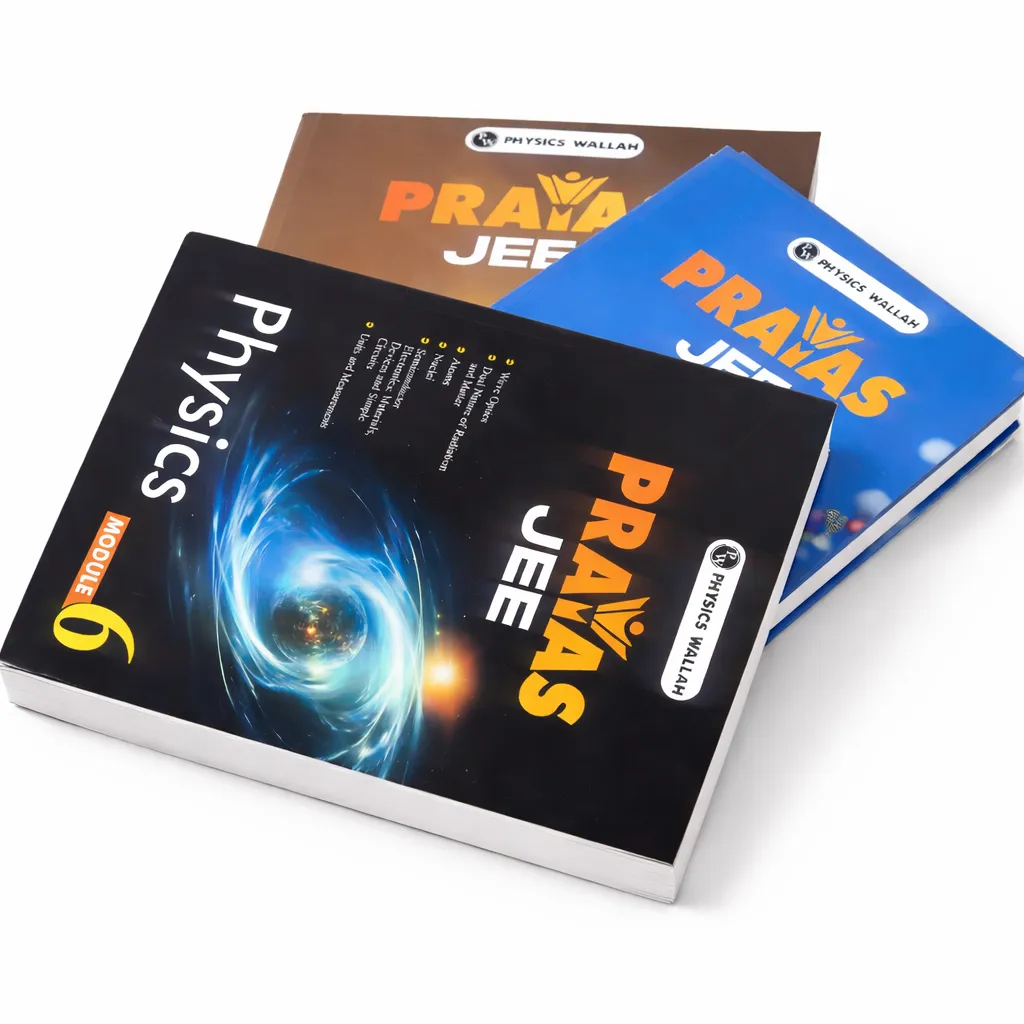 PW Prayas JEE Modules for 2026 | 18 Books Set for JEE 11+12 Preparation₹2,499
 Unacademy IIT JEE Version 4.0 for 2025- Complete Module Set Edition 24 Booklets₹3,499
 Bansal Classes Engineering Modules for JEE 2026 | 29 Modules for 11th+12th Class₹5,499
Continue reading
More in Buying Guides



Need help choosing?
Tell us your exam and stage on WhatsApp, we suggest the right set.