
Best Books for JEE Advanced 2026: Subject-Wise List & Tiers
The best books for JEE Advanced 2026 — subject-wise Physics, Chemistry & Maths list with essential vs optional tiers, prices, reading order & topper tips.
 Competer

The best books for JEE Advanced are NCERT (as your base), H.C. Verma and D.C. Pandey for Physics; O.P. Tandon, M.S. Chauhan, V.K. Jaiswal and J.D. Lee for Chemistry; and Cengage/Vikas Gupta with S.L. Loney and R.D. Sharma for Maths — adding I.E. Irodov and the hardest classics only once your fundamentals are solid. You do not need 15 books per subject. A serious aspirant can crack JEE Advanced with a focused set of 2-4 books per subject plus NCERT, if used correctly.
This guide gives you the exact subject wise books for JEE Advanced, a budget-friendly “minimum essential” tier, the right reading order, approximate prices, and how toppers actually used each book. Below you will find a consolidated at-a-glance table, deep breakdowns for Physics, Chemistry and Maths, a student-type matcher (dropper vs Class 11 vs rank-chaser), a realistic timeline, and answers to the questions IIT aspirants and parents ask most before buying.
Why Book Selection Matters More for JEE Advanced Than JEE Main
JEE Main rewards speed, accuracy and syllabus coverage — it is largely NCERT-plus-practice. JEE Advanced, by contrast, tests conceptual depth, multi-concept linking, and the ability to solve unfamiliar, multi-step problems under pressure. That difference is exactly why your choice of books matters so much: a book that is perfect for Mains (lots of single-concept MCQs) can leave you under-prepared for Advanced, where a single question may combine mechanics, calculus and reasoning.
The goal is not to collect every recommended title. It is to pick a lean set that (a) builds rock-solid concepts, (b) offers a large bank of Advanced-level problems, and (c) you can realistically finish. The most common reason capable students underperform is owning 15 books and mastering none. This guide is built around the principle toppers repeat: master a few, not many.
| JEE Main | JEE Advanced |
|---|---|
| NCERT-centric, direct questions | Application-heavy, indirect & multi-concept |
| Single-concept problems | Two or three concepts fused in one question |
| Fixed MCQ pattern | Multiple correct, matrix-match, integer, paragraph types |
| Speed & accuracy decide rank | Depth & problem-solving stamina decide rank |
| NCERT + one reference per subject suffices | NCERT + concept book + Advanced problem book per subject |

Best Books for JEE Advanced 2026: At a Glance (All Subjects)
Here is the complete subject-wise shortlist of the best books for JEE Advanced 2026. Treat NCERT as non-negotiable across all three subjects, then layer concept and problem books on top. Prices are approximate Indian market ranges and vary by seller and edition — always pick the latest edition so the content maps to the current JEE Advanced syllabus.
| Subject | Concept / Theory | Problem Practice | Advanced / Optional | Approx. Price Range |
|---|---|---|---|---|
| Physics | NCERT, H.C. Verma Vol I & II | D.C. Pandey Understanding Physics (5 books) | I.E. Irodov, Halliday/Resnick/Walker | ₹350-₹700 each |
| Physical Chemistry | NCERT, O.P. Tandon | R.C. Mukherjee, Narendra Awasthi | P. Bahadur (Numericals) | ₹300-₹550 each |
| Organic Chemistry | NCERT, O.P. Tandon | M.S. Chauhan | Morrison & Boyd, Solomons | ₹300-₹700 each |
| Inorganic Chemistry | NCERT (core) | V.K. Jaiswal | J.D. Lee (Adapted) | ₹300-₹600 each |
| Maths | NCERT, R.D. Sharma | Cengage / Vikas Gupta Advanced Problems | I.A. Maron, S.L. Loney, Hall & Knight, A. Das Gupta | ₹350-₹800 each |
Minimum Essential Set vs Optional (The Budget Tiering Nobody Tells You)
Most listicles dump 15+ books on you without saying what to buy first. Here is the honest tiering. If money and time are limited, buy only Tier 1 — it is genuinely enough to score well. Add Tier 2 once Tier 1 is done. Touch Tier 3 only if you are chasing a top-500 rank and have months of runway.
| Tier | Physics | Chemistry | Maths | Who it’s for |
|---|---|---|---|---|
| Tier 1 — Essential (buy first) | NCERT + H.C. Verma Vol I & II | NCERT + O.P. Tandon (Phy) + M.S. Chauhan (Org) | NCERT + Cengage (one series) | Everyone; budget aspirants |
| Tier 2 — Recommended | D.C. Pandey series | N. Awasthi + V.K. Jaiswal | R.D. Sharma + S.L. Loney | Serious aspirants aiming top 5,000 |
| Tier 3 — Advanced / Optional | I.E. Irodov, HRW | J.D. Lee, Morrison & Boyd | I.A. Maron, Hall & Knight, A. Das Gupta | Rank-chasers (top 500-1,000) |
Notice that Tier 1 is only about 5-6 books plus NCERT. That is deliberate. A focused student who finishes Tier 1 thoroughly will out-score a scattered student who owns everything in all three tiers. If you prefer a single coaching-style package instead of assembling loose books, a ready-made module set like the eSaral IIT JEE Modules 2026 consolidates theory and practice across all three subjects, which many self-study aspirants find easier to follow than juggling six separate titles.
Best Books for JEE Advanced Physics
Physics for JEE Advanced is about concept clarity first, raw problem volume second. Start with NCERT only to anchor definitions and the official syllabus, then move straight to H.C. Verma.
Which is the best physics book for JEE Advanced?
H.C. Verma’s Concepts of Physics (Vol I & II) is the single best starting book for building intuition, and D.C. Pandey’s Understanding Physics series is the best for dense Advanced-level practice. H.C. Verma is unmatched for conceptual understanding, but it is lighter on the hardest Advanced problems — that gap is exactly what D.C. Pandey and, later, Irodov fill.
| Book | Best For | Strength | Weakness |
|---|---|---|---|
| NCERT Physics | Base & syllabus | Clear fundamentals, exam-aligned | Too few/too easy problems for Advanced |
| H.C. Verma Vol I & II | Concepts + intuition | Legendary short-answer conceptual questions | Fewer very-hard Advanced problems |
| D.C. Pandey (5 books) | Topic-wise practice | Huge graded problem bank, Advanced-level sets | Can feel repetitive if done end-to-end |
| I.E. Irodov | Top rankers only | Toughest, most demanding problems | No theory; overkill for average aspirant |
| Halliday/Resnick/Walker | Deep theory lovers | Excellent explanations & graphics | Bulky; not tailored to Indian pattern |
Is HC Verma enough for JEE Advanced?
H.C. Verma alone is not quite enough for a top rank, but it is the most important Physics book you will own. It builds the conceptual backbone; however, its problem set does not fully replicate the difficulty and variety of recent Advanced papers. Pair it with D.C. Pandey for practice. Only strong students chasing the top 1,000 should add Irodov — and even then, only after H.C. Verma and D.C. Pandey are complete.
Best Books for JEE Advanced Chemistry
Chemistry is the most “scoring” subject if you choose books smartly, because it splits cleanly into three branches with different needs. This is also the section most listicles under-cover on the Physical and Inorganic problem side — so pay attention here.
Physical Chemistry
NCERT plus O.P. Tandon for theory, then numerical practice from R.C. Mukherjee (for the time-saving mole-concept approach) and Narendra Awasthi (for Advanced-level problem variety). Awasthi is particularly valued because its problems mirror the twist and depth of actual Advanced questions.
Organic Chemistry
NCERT and O.P. Tandon for fundamentals, M.S. Chauhan for problem practice, and Morrison & Boyd or Solomons as a deep reference for mechanisms. Himanshu Pandey is a popular alternative for “get the product” reaction practice.
Which book is best for organic chemistry in JEE Advanced?
M.S. Chauhan is the best problem book for organic chemistry in JEE Advanced, used alongside NCERT for theory. For students who want to truly understand reaction mechanisms rather than memorise them, Morrison & Boyd is the gold-standard reference — but it is a reference, not a day-to-day practice book. Do not read Morrison & Boyd cover to cover; use it to resolve doubts.
Inorganic Chemistry
Here NCERT does most of the heavy lifting — inorganic is the one area where NCERT is genuinely close to sufficient for facts and trends. Add V.K. Jaiswal for Advanced-level problems and J.D. Lee (Indian adapted edition) for the depth in bonding, coordination and periodic properties that NCERT skims.
| Branch | Theory | Problems | Reference / Advanced |
|---|---|---|---|
| Physical | NCERT, O.P. Tandon | R.C. Mukherjee, Narendra Awasthi | P. Bahadur |
| Organic | NCERT, O.P. Tandon | M.S. Chauhan | Morrison & Boyd, Solomons |
| Inorganic | NCERT (primary) | V.K. Jaiswal | J.D. Lee (adapted) |
Best Books for JEE Advanced Maths
Maths for JEE Advanced is pure practice. Concepts are fewer than in Physics, but the problems are long, multi-step and unforgiving. Your workhorse should be one strong Advanced problem series (Cengage by G. Tewani or Vikas Gupta’s Advanced Problems in Mathematics), supported by classic topic specialists.
Which maths book is best for JEE Advanced?
Cengage (G. Tewani) is the best all-round Maths series for JEE Advanced, combining theory, solved examples and Advanced-level exercises topic by topic. For exhaustive problem drilling, Vikas Gupta & Pankaj Joshi’s Advanced Problems in Mathematics is excellent. Use R.D. Sharma (Objective) for building fluency before you attempt the harder sets.
| Book | Topic Strength | Role in Your Prep |
|---|---|---|
| NCERT Maths | All topics (base) | Definitions, core formulae, starting point |
| R.D. Sharma (Objective) | All topics | Fluency & volume before Advanced sets |
| Cengage (G. Tewani) | All topics | Primary Advanced-level series |
| Vikas Gupta Advanced Problems | All topics | Hardest practice, near exam level |
| S.L. Loney | Trigonometry & Coordinate Geometry | Classic depth in two high-weight areas |
| Hall & Knight | Algebra | Foundations of higher algebra |
| I.A. Maron | Calculus | Advanced calculus problem mastery |
| A. Das Gupta (MCQ) | All topics | Objective practice bank |
Focus on one primary series (Cengage or Vikas Gupta) rather than attempting both plus every classic. S.L. Loney, Hall & Knight, Maron and Das Gupta are topic-specific supplements — dip into them for your weak chapters, not as full reads.
Which Books Suit Which Type of Student
The “best” book depends on where you are starting. A Class 11 beginner should not open Irodov; a dropper who already did H.C. Verma twice should not re-buy it. Use this matcher.
| Student Type | Priority Books | Avoid / Delay |
|---|---|---|
| Class 11 beginner | NCERT + H.C. Verma + Cengage/O.P. Tandon basics | Irodov, J.D. Lee, Maron (too early) |
| Class 12 (syllabus half done) | D.C. Pandey, M.S. Chauhan, V.K. Jaiswal, Cengage | Starting brand-new concept books from scratch |
| Dropper (1-year repeat) | Full Tier 1 + Tier 2, heavy PYQ & mock focus | Re-reading theory you already know; buy problem books |
| Weak in one subject | Extra concept book for that subject only (e.g., HRW for Physics) | Buying advanced books in your strong subjects |
| Rank-chaser (top 500) | Add Irodov, J.D. Lee, Maron, Awasthi | Nothing — but finish Tier 1 & 2 first |
JEE Advanced Book List for Self Study: Reading Order & Timeline
Self study works for JEE Advanced if you sequence your books correctly and pair them with tests. The mistake is opening an advanced problem book before concepts are built, or saving NCERT for the end. Follow this order.
| Phase | Timeline | What to Read | Goal |
|---|---|---|---|
| Phase 1 — Foundation | Class 11 / Months 1-4 | NCERT + H.C. Verma + O.P. Tandon + NCERT Maths | Build concepts; finish one topic fully before moving on |
| Phase 2 — Practice | Class 12 / Months 5-10 | D.C. Pandey, M.S. Chauhan, V.K. Jaiswal, Cengage, R.D. Sharma | Volume of graded problems; branch-wise mastery |
| Phase 3 — Advanced | Final 4-6 months | Irodov (Physics), Awasthi (Physical), Maron (Calculus) | Top-rank-level depth, only after Phase 2 |
| Phase 4 — Revision & Mocks | Last 2-3 months | PYQs (last 10-15 years) + full mock tests | Speed, accuracy, exam temperament |
For self-study aspirants who want structure without building this schedule from scratch, a prepared module set such as the eSaral IIT JEE Modules already sequences theory and practice phase-wise, which reduces the planning burden. Students also preparing for NEET alongside (common for medical-plus-engineering droppers) often add the Careerwill NEET Study Module Set to cover the biology and NCERT-depth angle.
Standard Books or Coaching Modules: Which Should You Pick?
This is the question most buyer-intent searchers never see answered clearly. Standard author books (H.C. Verma, Cengage, O.P. Tandon) give you the deepest, most time-tested treatment of each subject and are ideal if you enjoy assembling and sequencing your own prep. Coaching-style module sets, by contrast, pre-package theory, solved examples and graded practice in syllabus order across all three subjects, so you spend less energy planning and more time solving. Neither is universally “better”: pick standard books if you are a confident self-planner chasing a top rank, and a module set if you want a ready-made path and a single consolidated purchase. Many aspirants sensibly combine the two — a module set as the spine, with one or two classic titles (H.C. Verma, Cengage) added for depth in their weaker subject.
How to Choose JEE Advanced Books (A Quick Checklist)
- Latest edition: Buy the most recent edition so content matches the current JEE Advanced syllabus and question pattern.
- Full syllabus coverage: The book should map to the official syllabus, not add out-of-scope topics that waste time.
- Plenty of graded problems: For Advanced, a book’s worth is in its problem quality — look for multiple-correct, integer, and paragraph-type questions.
- Topper- and teacher-recommended: The titles in this guide are the ones repeatedly named by rankers and faculty.
- Solutions available: For self study, pick books with reliable solutions so you can self-correct.
- Finishable: Honestly ask whether you can complete it. A book you won’t finish is a wasted purchase.
How to Use the Books Effectively (Topper Strategy)
Owning the right books is step one; using them well is what converts into rank. Here is how toppers actually used these titles.
- One concept book, one problem book per subject — read theory once, then spend 70% of your time solving. Re-reading theory feels productive but rarely moves your rank.
- Maintain an error notebook — log every wrong problem and the concept behind the mistake. Revise this, not the whole book, before tests.
- Do NCERT first, always — especially for Inorganic Chemistry, where NCERT lines are quoted almost verbatim in exams.
- Attempt, don’t peek — give each hard problem 10-15 minutes before checking the solution. The struggle is where learning happens.
- Two revision rounds minimum — a book read once is a book half-learnt. Plan a second pass of marked problems.
- Finish before you add — never buy the next book until the current one is genuinely complete.
Common Mistakes Aspirants Make With Books
| Mistake | Why It Hurts | Fix |
|---|---|---|
| Buying 15+ books per subject | No book gets finished; shallow prep | Stick to Tier 1, add only when done |
| Ignoring NCERT | Direct marks lost, especially Inorganic Chemistry | Treat NCERT as compulsory base |
| Over-relying on Irodov early | Demoralising; no theory support | Open Irodov only in Phase 3, if at all |
| Reading theory, skipping problems | JEE Advanced is problem-driven | 70% time on solving, not reading |
| Switching books mid-topic | Breaks continuity, wastes money | One primary series per subject |
| Skipping revision & mocks | Weak exam temperament | Reserve the final 2-3 months for PYQs + mocks |
Value for Money: How Much Should a JEE Advanced Book Kit Cost?
A complete Tier 1 kit (NCERT + H.C. Verma Vol I & II + O.P. Tandon + M.S. Chauhan + one Cengage Maths title) typically costs roughly ₹2,500-₹4,000 depending on editions and sellers. A full Tier 1 + Tier 2 set across all subjects usually lands between ₹6,000 and ₹10,000. Tier 3 additions (Irodov, J.D. Lee, Maron) add another ₹1,500-₹3,000. Compared with coaching fees running into lakhs, a well-chosen book kit is the highest-return investment in your preparation — provided you actually finish it. Consolidated module sets like the eSaral IIT JEE Modules 2026 are often more cost-effective than buying each classic separately, since they bundle theory and practice for all three subjects in one set.
Can You Crack JEE Advanced With Self Study and These Books?
Yes — many top rankers are self-studiers. The books in this guide form a complete JEE Advanced book list for self study. What self study demands in return is discipline: a fixed timetable, strict problem-solving hours, an error notebook, and regular mock tests to simulate exam pressure. The books give you the content; your consistency supplies the rest. If you find pure self study isolating, structured module sets provide a middle path — the rigour of a syllabus-mapped course with the freedom to study at your own pace.
Suggested Weekly Timetable for Self-Study Aspirants
| Day | Focus | Approx. Hours |
|---|---|---|
| Mon / Thu | Physics (theory + D.C. Pandey problems) | 3-4 hrs |
| Tue / Fri | Chemistry (branch rotation + problems) | 3-4 hrs |
| Wed / Sat | Maths (Cengage topic + practice) | 3-4 hrs |
| Sunday | Full/half mock + error-notebook revision | 3-5 hrs |
Rotate your weakest subject into an extra slot, and never let a mock-test day slip — exam temperament is a skill you can only build by testing.
Frequently Asked Questions
Which books are best for JEE Advanced preparation?
The best books are NCERT as your base, plus H.C. Verma and D.C. Pandey for Physics; O.P. Tandon, M.S. Chauhan, V.K. Jaiswal and J.D. Lee for Chemistry; and Cengage/Vikas Gupta with S.L. Loney and R.D. Sharma for Maths. Start with the essential tier and add advanced titles like Irodov only once your basics are strong.
Is NCERT enough for JEE Advanced?
NCERT alone is not enough for JEE Advanced, but it is essential — especially for Inorganic Chemistry, where questions are often lifted almost directly from NCERT. Use NCERT to build your base, then layer concept and Advanced-level problem books on top for the depth JEE Advanced demands.
Which maths book is best for JEE Advanced?
Cengage (G. Tewani) is the best all-round Maths series for JEE Advanced because it pairs topic-wise theory with Advanced-level exercises. For the hardest drilling, add Vikas Gupta’s Advanced Problems in Mathematics, and use R.D. Sharma (Objective) to build fluency first. Treat S.L. Loney, Hall & Knight and Maron as targeted supplements for weak chapters.
Is HC Verma enough for JEE Advanced?
H.C. Verma is the best book for Physics concepts but not sufficient on its own for a top rank, because its problem set is lighter than recent Advanced papers. Pair it with D.C. Pandey for practice, and add Irodov only if you are chasing the top 1,000 ranks.
Which book is best for organic chemistry in JEE Advanced?
M.S. Chauhan is the best problem book for organic chemistry in JEE Advanced, used alongside NCERT and O.P. Tandon for theory. For deep mechanism understanding, keep Morrison & Boyd as a reference rather than a cover-to-cover read.
How many books should I use per subject for JEE Advanced?
Two to four books per subject is ideal: NCERT, one concept book, and one or two Advanced-level problem books. Using more than that usually means none get finished. The proven rule is to master a few books fully rather than skim many.
Can I crack JEE Advanced with self study and these books?
Yes. This book list is a complete self-study set, and many top rankers prepare without full-time coaching. Success depends on a disciplined timetable, heavy problem-solving, an error notebook, and regular mock tests. Structured module sets can add syllabus-mapped guidance if you want more direction.
What are the best books for JEE Advanced 2026?
The best books for JEE Advanced 2026 are the same proven titles — NCERT, H.C. Verma, D.C. Pandey, O.P. Tandon, M.S. Chauhan, V.K. Jaiswal, J.D. Lee, Cengage, Vikas Gupta and R.D. Sharma — but buy the latest editions so topics and question patterns match the current syllabus. If you prefer a single syllabus-mapped package, a 2026 module set is a convenient alternative to assembling loose books.
Recommended Study Material


Competer
The Competer team: we pack the orders, so we know which editions aspirants keep coming back for.
Get it printed
JEE study material aspirants order most on Competer, delivered across India
 eSaral IIT JEE Modules 2026 | Complete Modules for JEE Preparation₹3,499
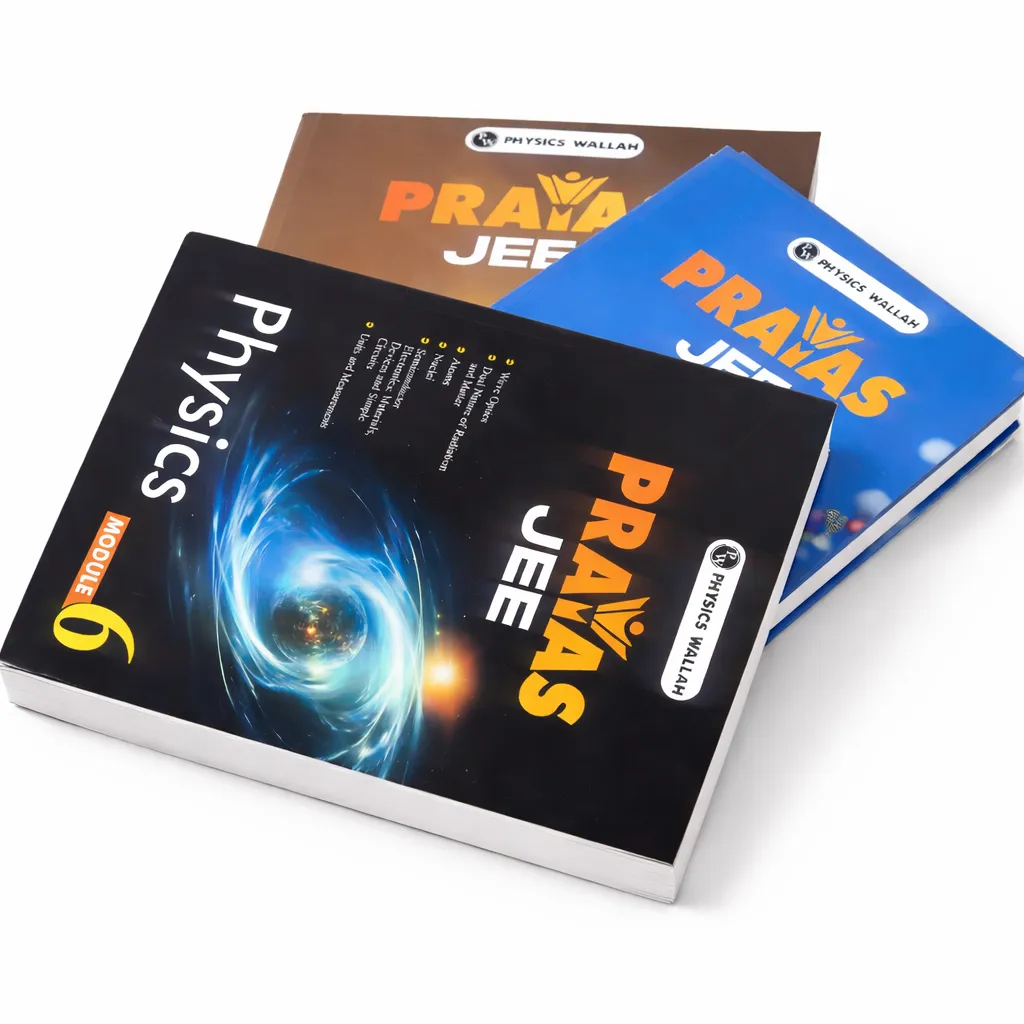 PW Prayas JEE Modules for 2026 | 18 Books Set for JEE 11+12 Preparation₹2,499
 Unacademy IIT JEE Version 4.0 for 2025- Complete Module Set Edition 24 Booklets₹3,499
 Bansal Classes Engineering Modules for JEE 2026 | 29 Modules for 11th+12th Class₹5,499
Continue reading
More in Buying Guides



Need help choosing?
Tell us your exam and stage on WhatsApp, we suggest the right set.